2.08 Decomposers at Work: The Mold Bag and the Compost Bottle
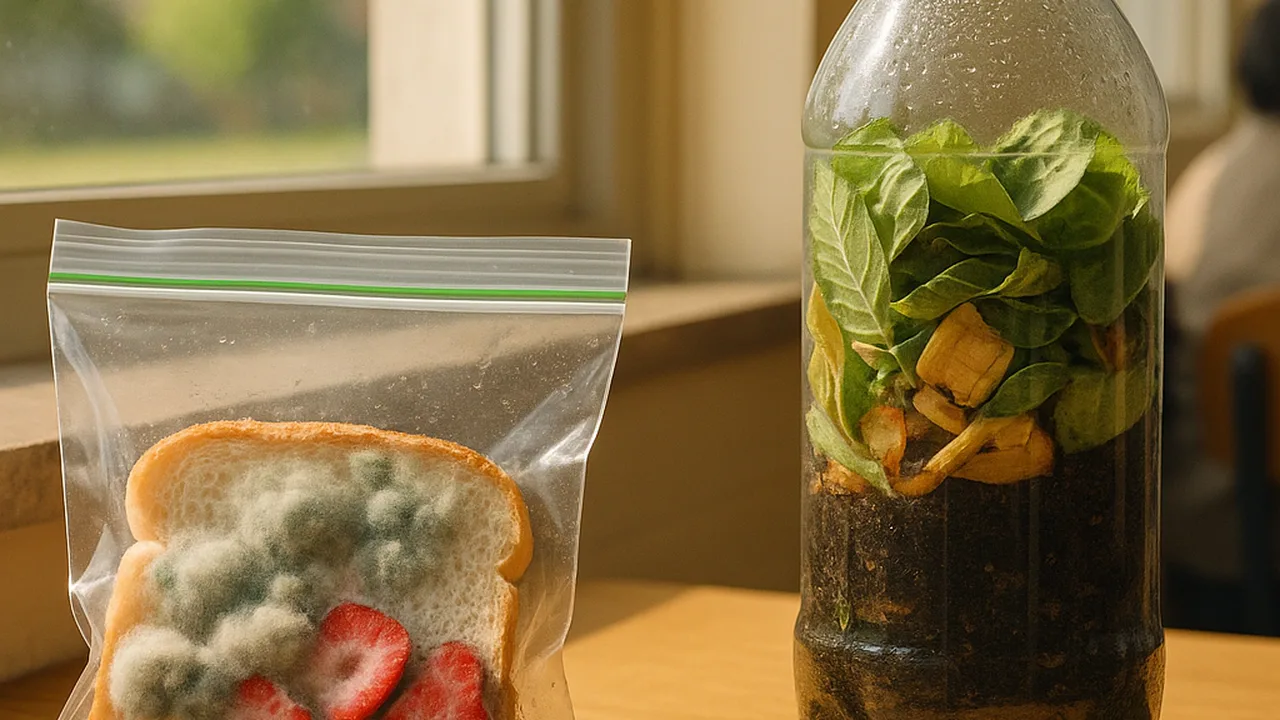
set up and observe two decomposer investigations, and describe how decomposers break down dead matter and return it to the environment.
- I can explain how animals eat plants or other animals, and how matter moves between them when they eat.
- I can describe how decomposers, like fungi and bacteria, break down dead plants and animals and return matter to the environment.
- I can show how organisms take in matter from the environment for life and release waste back into the environment.
Phase 2: Investigate
Warm-Up ~5 min
The forgotten sandwich. You find a sandwich at the bottom of a backpack after two weeks. It has fuzzy blue-green spots. What are they, and where did they come from?
A slice of damp bread sits in a sealed bag in a warm room for a week. What will you see?
Instruction ~10 min
Explore first. Today your team sets up two investigations. You will check them every few days for the next two weeks.
Investigation 1: The Mold Bag. Wipe a slice of bread on a table top, then sprinkle it with a few drops of water. Put it in a zip bag and seal it. Tape the seal shut. Make a second bag with dry bread kept in the fridge.
Investigation 2: The Compost Bottle. Use a clear plastic bottle with its top cut off. Layer garden soil, dry leaves and small fruit and vegetable scraps, like apple cores and lettuce. Add a few earthworms if your teacher has them. Mist it with water. Cover the top with mesh. Mark the height of the pile with tape.
| Day | Mold bag (warm, damp): what we see | Mold bag (cold, dry): what we see | Compost bottle: height of pile (cm) | Compost bottle: what we see and smell |
|---|---|---|---|---|
| 1 | ||||
| 4 | ||||
| 7 | ||||
| 14 |
Worked example 1: a careful observation. On day 4, Ava’s team writes, “Warm bag: two white fuzzy spots, each about the size of a pea. Cold bag: no change.” That is clear and measurable. It does not guess why yet.
Worked example 2: a compost check. On day 7, Diego’s team writes, “Pile is 2 cm lower than the tape. Lettuce is brown and soft. Smells earthy, like a forest floor.” A shrinking pile is a clue that something is breaking the scraps down.
Decomposers. Mold, mushrooms and many bacteria are decomposers. They feed on dead plants and animals. Earthworms help too by eating dead leaves and leaving behind rich soil. As they feed, they release matter back into the soil and the air.
Criteria check. Add to your garden list: what should go in the club’s compost, and what should stay out?
Guided Exercises ~15 min
Answer with your team as you set up and observe.
Independent Practice ~10 min
Make your first observation record.
Sketch your compost bottle on day 1. Label each layer. Then write what you think it will look like on day 14.
How confident are you that you can I can describe how decomposers break down dead matter.
Closure ~5 min
Your decomposer experiments are running. The Recorder checks them every few days. Next lesson, we trace the energy in a school lunch back to where it started.
Exit ticket: where do you think the matter in a rotting apple core goes? Name two places.
Teacher notes
Materials: bread (bakery bread without preservatives molds faster), zip bags, packing tape, a spray bottle, 2-liter clear bottles with tops cut off (cut ahead by an adult), mesh or cheesecloth, rubber bands, garden soil, dry leaves, fruit and vegetable scraps, optional earthworms, gloves. Rotate team roles today: Materials Manager, Recorder, Tester, Reporter. Each person gets a new job.
Setup: check for mold allergies and asthma before the lesson. Store mold bags in one tray in a warm spot away from food. Dispose of them sealed. Keep compost bottles out of direct heat, and mist them every few days.
Listen for: “the mold came from inside the bread” (spores land from the air and surfaces); “rotting means the food is disappearing” (matter goes to soil and air; it is not destroyed).
Support / stretch: give a picture checklist for setup steps. Stretch: design a third mold bag that tests one more variable, such as light or dark.