1.02 Wonder Board Workshop: Sharpening the Problem
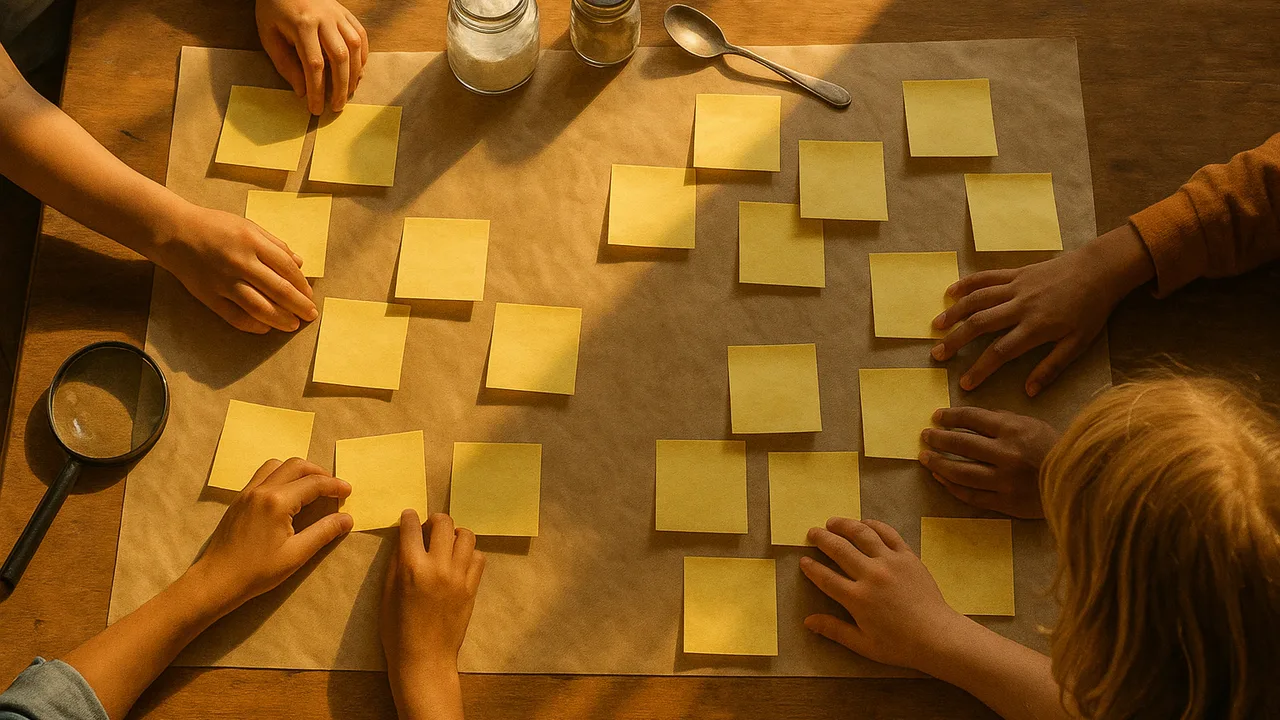
The Mystery Powder Test Kit
How can we tell which white powder is which, safely and for sure, without ever tasting it?
The mystery: Sugar disappears when you stir it into water, but the water still tastes sweet. Where did the sugar go, and is it still there?
describe the pantry’s problem as one a new tool or process could solve, explain how needs change over time, and name what we will investigate.
- I can describe a problem that could be solved by making a new or better object, tool, process, or system.
- I can explain how people’s needs and wants can change over time.
- I can identify what we are investigating, including the properties of materials we can observe and measure.
Phase 1: Spark
Warm-Up ~5 min
Do Now. Look at the five sealed bags, A to E. Do not open them. Through the plastic, what differences can you already notice? Then read our Wonder Board from last time.
Which Wonder Board question could our class answer with a test in this room?
Instruction ~10 min
A good design starts with a clear problem. The pantry did not ask us for “something cool.” They need a tool or a step-by-step process that identifies five powders safely. Engineers call a step-by-step method a process. A test kit is a set of tools plus a process for using them.
Worked example 1: a strong problem statement. Diego’s team wrote: “Pantry volunteers need a safe, quick process to identify flour, sugar, salt, baking soda and cornstarch, because families must know what food they are taking home.” It names the who, the what and the why. A new tool and process could solve it.
Needs change over time. Long ago, many families bought flour and sugar from big barrels at a store. Today, most food comes in packages with printed labels. In the United States, food labels must now name common allergens, such as wheat. The basic need, safe food, stayed the same. What people expect to know about their food has grown.
Worked example 2: our pantry’s needs changed, too. Malik’s aunt volunteers at a pantry. She says it once handed out mostly canned food. Now it also gives out baking supplies and fresh food, so families can cook from scratch. New kinds of donations bring new problems, like a box with no labels.
What will we investigate? Our investigations will look at the properties of materials: color, hardness, shine, what happens in water, and more. We collect data because each material has its own set of properties. If we know those sets, we can match an unknown powder to its name.
Team contract. Your team also writes a short contract today: how you will share jobs, stay safe and solve disagreements. Every member signs.
Guided Exercises ~15 min
Sort and sharpen our questions with your team. Use the arrows to move through the cards.
Independent Practice ~10 min
Write your own problem statement and think about change over time.
Write a problem statement for our test kit. Name who needs it, what they need, and why.
Describe something about food or cooking that has changed over time. What need stayed the same? What changed?
Closure ~5 min
Our Wonder Board is sorted, and our problem is sharp. Next time, the investigations begin with the mystery of the disappearing sugar.
Exit ticket: name one property of a powder we could investigate, and explain how it could help the pantry.
Teacher notes
Materials: the Wonder Board, sticky notes in two colors (“we can test it” / “we need to look it up”), sealed powder bags A–E, a team contract template.
Setup: draw a T-chart for the two kinds of questions. Reporters move each sticky note and explain why.
Listen for: students mixing up needs and wants; “a testable question is any yes/no question.” Keep the history general; no dates are needed. The allergen-labeling fact is United States law; do not add specific numbers or years.
Support / stretch: frame: “What happens to ___ when we ___?” Stretch: rank the testable questions by how much each would help the pantry.