1.03 The Disappearing Sugar Trail
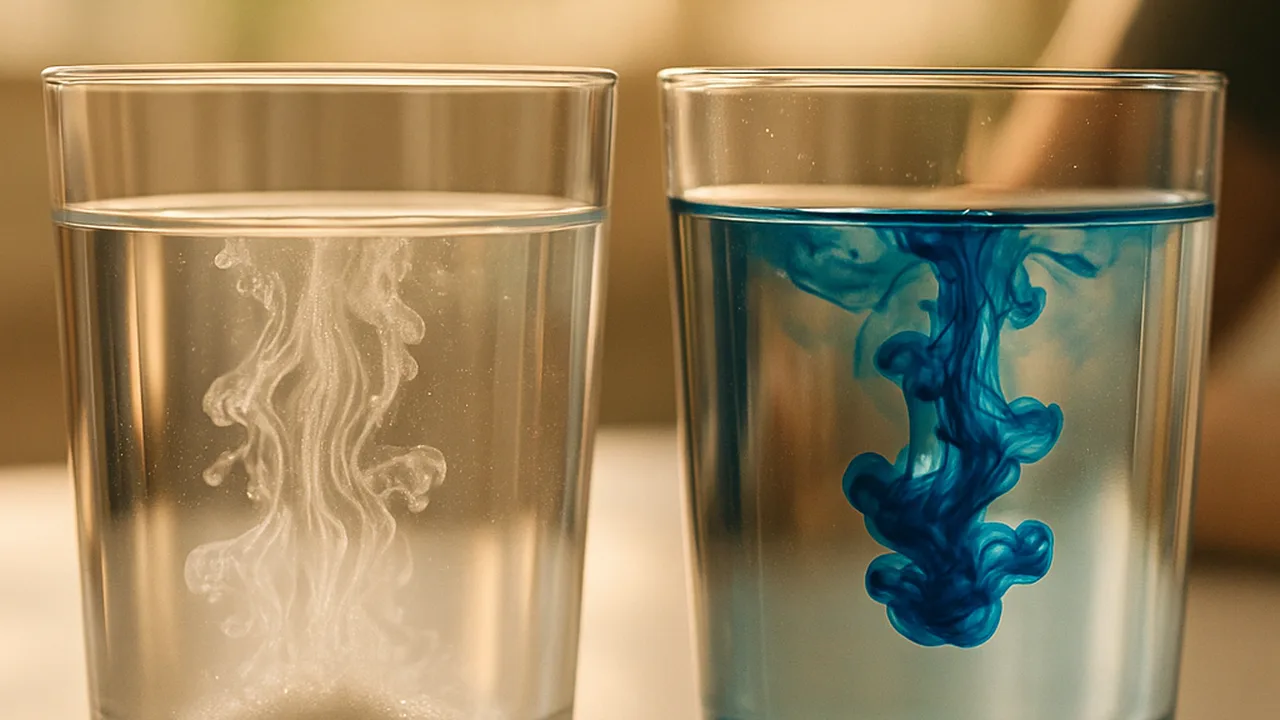
observe sugar and color spreading through water and use a drawing to show that matter can break into pieces too small to see.
- I can develop a model to show that matter is made of tiny particles that are too small to see.
- I can identify and label both the visible matter (like sugar, air, or water) and the tiny particles in my model.
- I can use my model to describe how tiny, invisible particles make up the matter we can see and touch.
- I can explain how the way many tiny particles behave together helps us understand things we observe, like a balloon expanding or sugar dissolving.
Phase 2: Investigate
Warm-Up ~5 min
Do Now. Today you explore first, and we name the ideas later. A sugar cube sits in the middle of a plate. Your teacher will pour a thin layer of water around it. A few drops of food coloring wait on top of the cube.
What will happen to the sugar cube and the color in the water?
Instruction ~10 min
Pantry detectives, today you are observers. You will run two short tests. Look closely and use a hand lens. Write what you see, not what you think it means. Explaining comes later.
- Test 1, the sugar trail: put a sugar cube in the center of a plate. Add one drop of food coloring to its top. Pour water gently around it, just enough to cover the plate. Watch for three minutes.
- Test 2, the vanishing spoonful: stir one spoonful of sugar into a clear cup of warm water. Check every 30 seconds until you cannot see any sugar. Then set out one shallow dish of salt water from your teacher. We will check it in a few days.
| Time | What the sugar cube looks like | How far the color spread (cm) | Sugar in the cup: can I see it? (yes / a little / no) | Drawing of what I think is happening |
|---|---|---|---|---|
| Start | ||||
| 1 minute | ||||
| 2 minutes | ||||
| 3 minutes |
Worked example 1: careful observing. Ava wrote, “The corners of the cube got round first. Then the cube slumped into a little pile. The color made a ring about 4 cm wide.” She did not write “the sugar melted.” She only wrote what she saw. These are sample notes. Your data will be your own.
Worked example 2: zooming in with a drawing. Diego drew the cube as a block of tiny dots stuck together. In his next picture, dots broke off and spread out among the water. He labeled the big cube “sugar I can see” and each dot “a tiny piece too small to see.” A drawing like this is a model. It lets us show things our eyes cannot see.
A question to keep. If the sugar is still in the water, how could we prove it without tasting? Our salt water dish is one clue to check later. Next time, you will look for more invisible matter.
Guided Exercises ~15 min
Use your team’s table to answer these. The Recorder reads your notes out loud.
Independent Practice ~10 min
Draw your own two-part model in your notebook.
Draw the sugar cube before and after. Label the sugar you can see and the tiny pieces you cannot see. Write one sentence under each drawing.
How confident are you that you can I can draw a model showing matter as tiny pieces too small to see.
Closure ~5 min
Sugar seemed to vanish, but our models suggest it broke into tiny pieces. Next time, we hunt for more invisible matter: air and smells.
Exit ticket: describe one thing you saw today that suggests matter can be made of pieces too small to see.
Teacher notes
Materials (per team): a white plate, 2 sugar cubes, food coloring, a cup of water, a clear cup, granulated sugar, a spoon, a hand lens, a ruler. Teacher: one shallow dish of salt water per class, set somewhere it will not be bumped.
Setup: pour water gently so the cube is not knocked over. The salt dish needs a few days in a warm, dry place for crystals to reappear; use salt, since sugar water often dries to a sticky syrup instead.
Listen for: “the sugar melted” (it dissolved; melting is one material warming from solid to liquid, while dissolving is one material mixing into another). Hold back “particle model” as a formal idea until 1.10. Stay at the scale of particles; do not introduce atoms or molecules (5-PS1-1 boundary).
Support / stretch: let some students record with drawings and “a little / a lot.” Stretch: repeat Test 2 with cold water and compare how long the sugar takes to disappear.