1.18 Prototype Day: The Flowchart ID Key
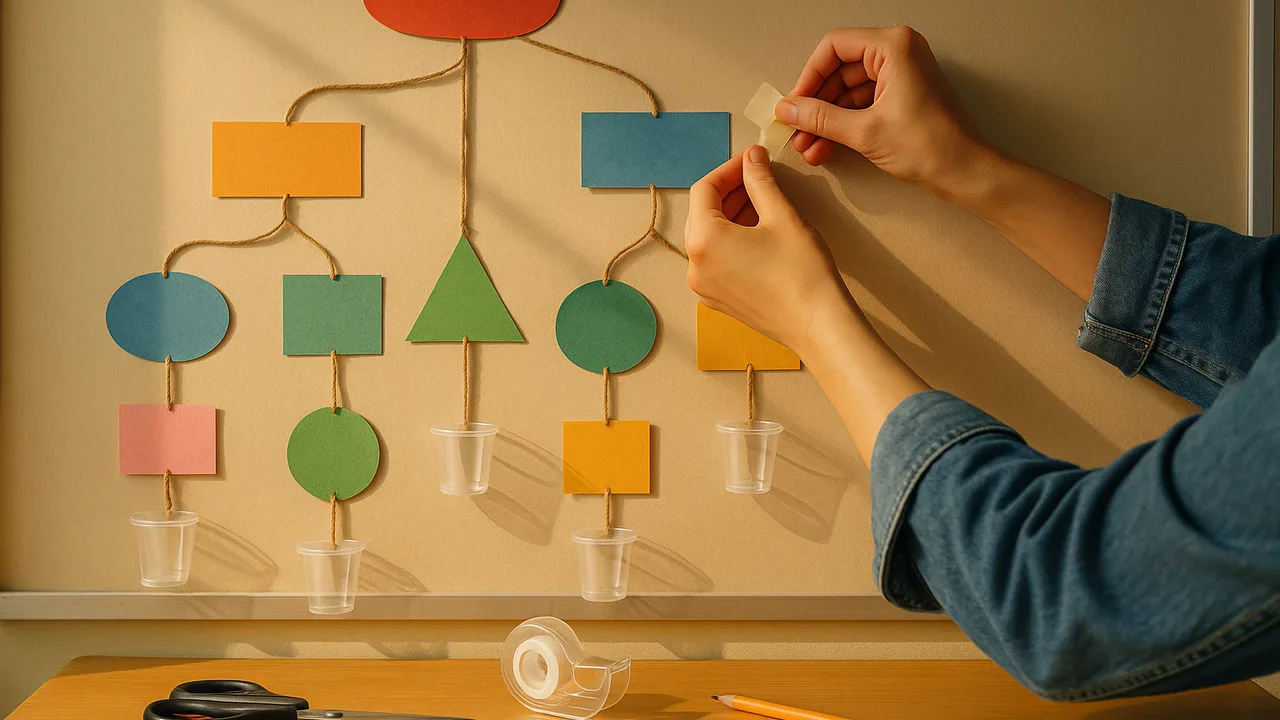
build a first version of our flowchart ID key and plan a test for each of our criteria.
- I can explain the purpose of my investigation, including how I will find problems or failure points in my model or prototype to help make it better.
- I can create a plan that includes different tests for each criterion or constraint of my model or prototype.
- I can describe what I will change in each test, what I will measure, what tools and methods I will use to collect data, and what I will keep the same to make the test fair.
Phase 4: Build
Warm-Up ~5 min
Do Now. A flowchart asks yes-or-no questions. Each answer sends you down one path. Play “Guess the Animal” with a partner using only yes-or-no questions.
Why is a good first question in a flowchart one that splits the choices into groups?
Instruction ~10 min
Junior chemists, today you build a prototype. A prototype is a first version you test and improve. Ours has two parts: the kit box and a flowchart ID key on one card.
Each box in the key is a property test. Our tests use properties: how a powder reacts with vinegar, whether it dissolves in water, grain shape, and how it feels. Each test is chosen because it splits the powders into groups.
Worked example 1: Diego’s key. Box 1: add 5 drops of vinegar. Fizz? Yes → baking soda. No → Box 2: stir a pea-sized scoop into water. Clear? Yes → sugar or salt, go to Box 3. Cloudy? → flour or cornstarch, go to Box 4. Box 3: look with a magnifier or use the bulb tester. Box 4: add a few drops of water to a fresh scoop. Does it act like a liquid when still but get firm when you poke it? That is cornstarch. A sticky paste is flour.
Every key needs a safe exit. At every box, add: “Not sure? Set it aside and tell the pantry manager.” That exit is one of our criteria.
Worked example 2: Ava’s test plan. Before testing, Ava planned one test for each criterion. To check “identifies all 5,” her team runs each known powder through the key. To check “under 10 minutes,” a teammate times a full run. To check “any volunteer can follow it,” someone outside the team tries it with no help. The purpose is to find failure points, the places where the key breaks down.
| Criterion or constraint | How we will test it | What we measure | What we keep the same |
|---|---|---|---|
| Identifies all 5 powders | |||
| Any volunteer can follow it | |||
| Full test in 10 minutes or less | |||
| Kitchen-safe, fits in a shoebox |
Guided Exercises ~15 min
Build your key card, then check it with these questions.
Independent Practice ~10 min
Plan how you will test your prototype.
Fill in the test plan table. For each criterion, describe what you will measure, which tool you will use and what you will keep the same.
Which property in your key is measured in a unit, like grams or minutes? Which ones are observed with your senses?
Closure ~5 min
Your prototype exists! Next time, another team will critique it, and you will critique theirs.
Exit ticket: where do you think your key is most likely to fail? Why?
Teacher notes
Materials: index cards or cardstock for key cards, shoeboxes, labeled jars of the five known powders, small cups, pea-sized scoops, droppers, water, vinegar, magnifiers, a timer.
Setup: 15 minutes to draft the key and pack the box, 10 minutes for the test plan. Teams may ask another team how they handled a tricky split; that conversation is part of good design.
Listen for: keys that start with color (all five are white); keys with no safe exit; test plans that only check “does it work?” instead of one test per criterion.
Support / stretch: give a blank flowchart with four boxes already drawn. Stretch: design the key so it needs only one fresh scoop of powder.