1.14 Ideate: Brainstorming the Test Kit
brainstorm at least three test kit ideas grounded in our property data, and check each one against the pantry’s criteria and constraints.
- I can define the limits for solving a problem, making sure it is about something people need or want right now.
- I can list the features that a solution must have to solve the problem.
- I can describe the limits on my design, such as how much it costs, what materials I can use, or how much time I have.
Phase 3: Make Sense
Warm-Up ~5 min
Do Now. Imagine a pantry volunteer opening our kit for the first time. They have never been in our class. What is the very first thing they need to see?
Which kit idea would a brand-new volunteer find easiest to use?
Instruction ~10 min
Pantry detectives, now we ideate. To ideate means to come up with many ideas before choosing one. Today, each team brainstorms at least three different kit designs. Every idea must use what we learned about properties.
Our problem, one more time. The pantry needs a safe way to identify five white powders, now, with the volunteers and supplies it has. Look at our criteria and constraints chart from 1.08. A good idea meets every criterion and stays inside every limit.
Worked example 1: three ideas from one team.
- Idea 1, the Flip Book: one test per page, in sorting-key order, with a photo of each possible result.
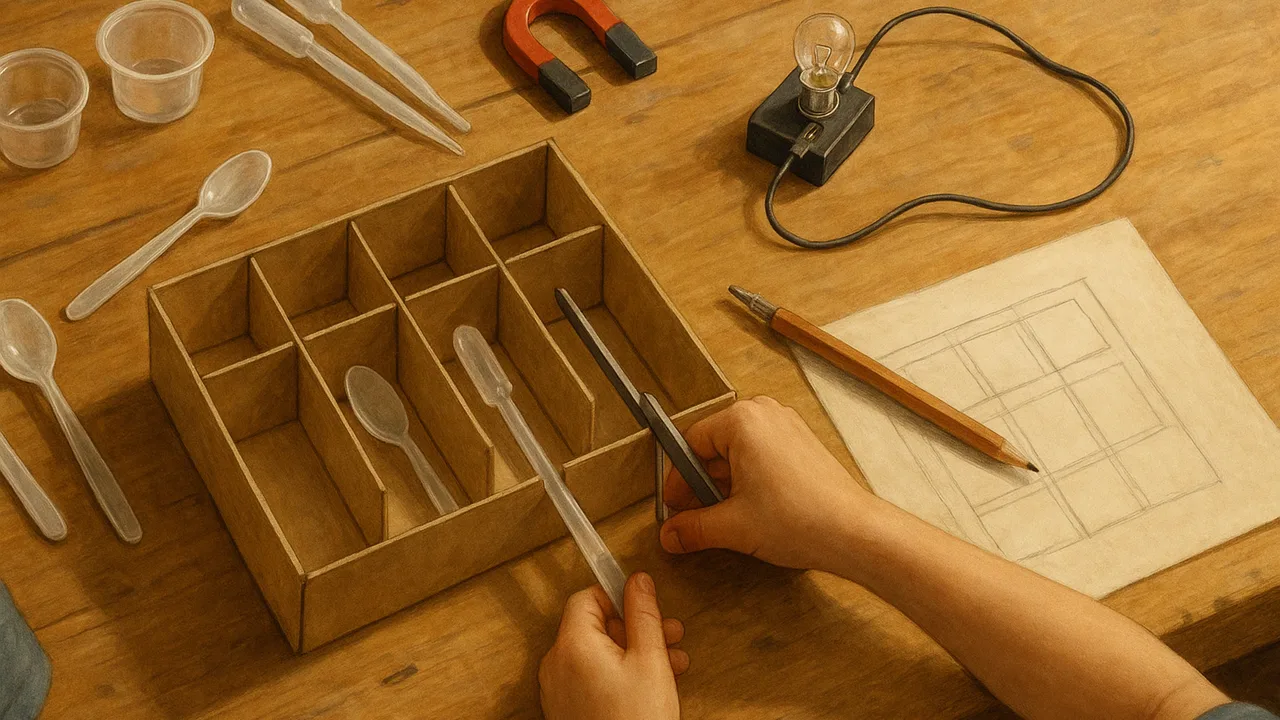
- Idea 2, the Color-Coded Tray: a muffin tin with labeled cups, so each test happens in its own spot and powders never mix.
- Idea 3, the Two-Test Shortcut: use only iodine and vinegar first, then a third test only if needed, to save powder.
Worked example 2: checking an idea against the limits. Priya liked a fancy digital tester. Then she checked the constraints. It cost more than our budget, and volunteers would need training. She kept the idea but wrote “over budget” beside it. Checking every idea against the limits is how engineers stay honest.
Brainstorm rules. Sketch quietly for 5 minutes. Then share using “Yes, and…” to build on each other’s ideas. No idea is judged until the checking step.
Guided Exercises ~15 min
Check ideas against our chart with your team.
Independent Practice ~10 min
Fill in a team idea chart. For each idea, write a check or an X for every criterion and constraint.
Sketch and describe at least three kit ideas. For each one, name the property tests it uses and one criterion or constraint it meets well.
How confident are you that you can I can define a problem's criteria and constraints and use them to check my ideas.
Closure ~5 min
Your team has at least three ideas, each grounded in property science. Next, in the Build phase, you will compare your ideas fairly and build the best one. First, take the 3DX field trip to shrink down and see matter up close.
Exit ticket: describe your team's favorite kit idea. Which feature makes it work, and which limit will be hardest to meet?
Teacher notes
Materials: sketch paper, the criteria and constraints chart, the sorting keys from 1.12, a team idea chart template.
Setup: run a 5-minute silent sketch, then a 6-minute “Yes, and” round. Each team keeps all three ideas; part 2 compares them fairly against the criteria (3-5-ETS1-2).
Listen for: ideas with no property science named; ideas that use too much powder or skip safety. Redirect to the chart.
Support / stretch: give a menu of kit parts with the property each tests. Stretch: add a feature that helps a volunteer who reads little English.