4.24 Night Sky Night: The Family Showcase
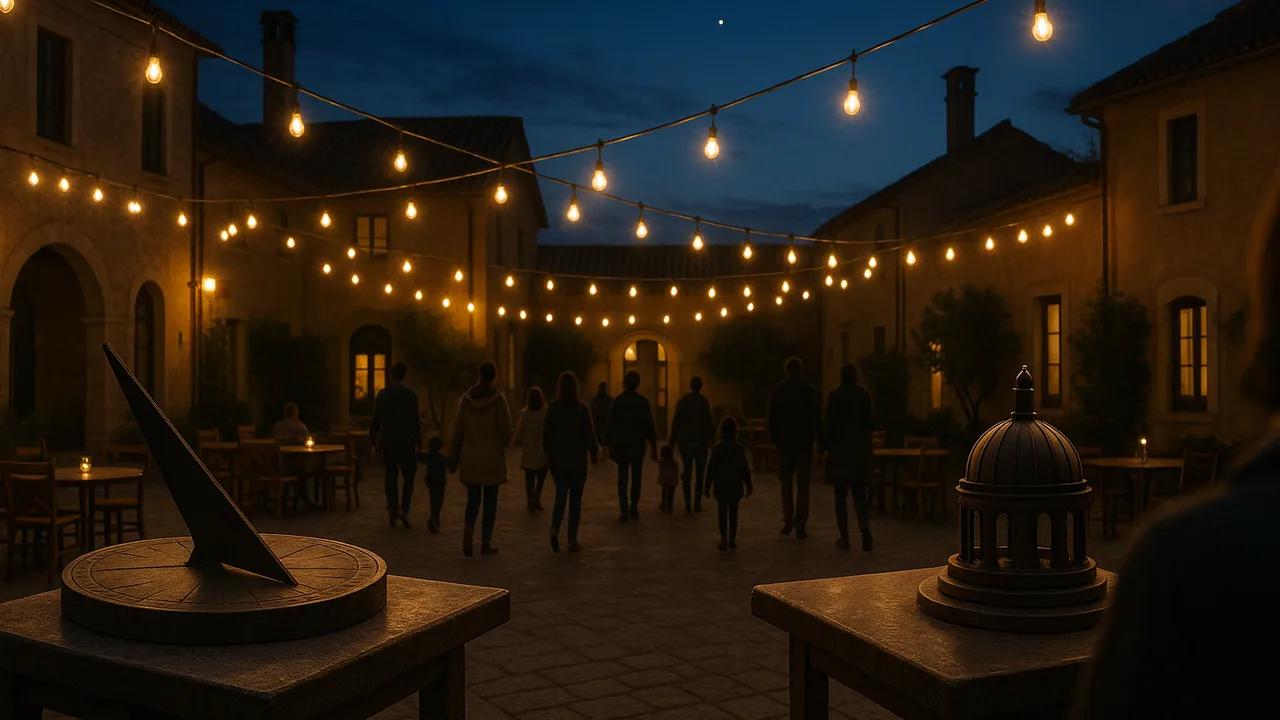
present our shadow clock and sky tool to families and explain the science of sky patterns, star brightness and gravity behind them.
- I can use evidence and reasoning to argue that the sun looks brighter and bigger than other stars because it is much closer to Earth, even though all stars give off their own light and are very large.
- I can explain that objects, like stars, look smaller and dimmer the farther away they are, so stars that are farther from Earth seem less bright than the sun.
- I can use examples of stars that look different in brightness to show that stars are at different distances from Earth.
- I can compare my data about shadows, daylight, and stars to find similarities and differences in how often these changes happen, like how shadows change daily and stars appear seasonally.
- I can share my ideas and findings about design solutions with others to help create more possible solutions.
Phase 5: Prove It
Warm-Up ~5 min
Do Now. Practice your 30-second welcome with a partner. Start with: “Welcome to Night Sky Night! Our team built…”
A family asks why your shadow clock works. Which answer is the strongest?
Instruction ~10 min
Junior engineers, tonight you are the experts. Families visit your station at the library. Each team has three minutes to show its shadow clock and sky tool, explain the science and answer a question.
Worked example 1: a strong station talk. Priya: “Our shadow clock tells time within 10 minutes. The pointer tilts toward the North Star, so the hour lines stay accurate longer. Our plumb line set it straight, because gravity pulls toward Earth’s center.” She gave data and science.
Worked example 2: answering a hard question. A parent asks, “Why is that star so dim?” Malik answers, “All stars give off their own light. That one looks dim mainly because it is so far away, just like a streetlight at the end of a long street.”
Gallery notes. While other teams present, collect one idea that could improve your own tools.
Guided Exercises ~15 min
Final rehearsal checklist. Every team member must be ready for every card.
Independent Practice ~10 min
Write your part of the station talk.
Write the three or four sentences you will say. Include one pattern, one number from your test data, and how your design solves the family's problem.
Public product: the Night Sky Night shadow clock and sky tool
Present your team’s shadow clock and your sky calendar or star-finder at the library’s family Night Sky Night (or at a class showcase where guests play the families). Your station shows how your tools work, how you tested them, and the science behind them. Include an explanation card that answers, “Why is the Sun so much brighter than other stars?”
Submission workflow
- Set up the station: shadow clock, sky tool, test data table and explanation card.
- Explain the shadow pattern: why the shadow changes length and direction during the day.
- Show the accuracy test data and the revision you made, and explain one trade-off.
- Demonstrate the sky tool: which star groups families can see this month and which they can see all year.
- Explain why the Sun looks brighter than other stars, using distance and a model.
- Answer a family’s question, and record one idea from another team.
How it is scored
| Criterion | What proficient looks like |
|---|---|
| Sky patterns | Uses data to explain the daily shadow pattern and the yearly star pattern, and compares how often each repeats. |
| Star brightness | Argues with evidence and a model that the Sun looks brightest because it is much closer than other stars, and that all stars give off their own light. |
| Design and data | Explains how the tools solve the client’s problem and uses accuracy test data to support design choices and one revision. |
| Communication | Presents clearly, every member speaks, answers a question with evidence, and uses ideas shared by others. |
Closure ~5 min
You built real sky tools for real families. Next class is the unit checkpoint.
Exit ticket: what question from a family surprised you? How did you answer it, and what evidence did you use?
Teacher notes
Materials: each team’s shadow clock, sky tool, data tables, explanation cards, printed rubric, a timer, table tents with team names.
Setup: Coordinate with the school librarian. If families cannot attend, invite another class or staff to play families. Give 10 minutes to set up and rehearse. If the event is after dark, display the shadow clocks with photos of their daytime tests.
Listen for: “dim stars are small”; “the Sun moves around Earth.” Also check that teams cite data, not just opinions.
Support / stretch: Give a station script with blanks. Stretch: ask teams to answer “Would your shadow clock work in Australia?”