3.03 Rock, Water, Air or Life? A Schoolyard Sort
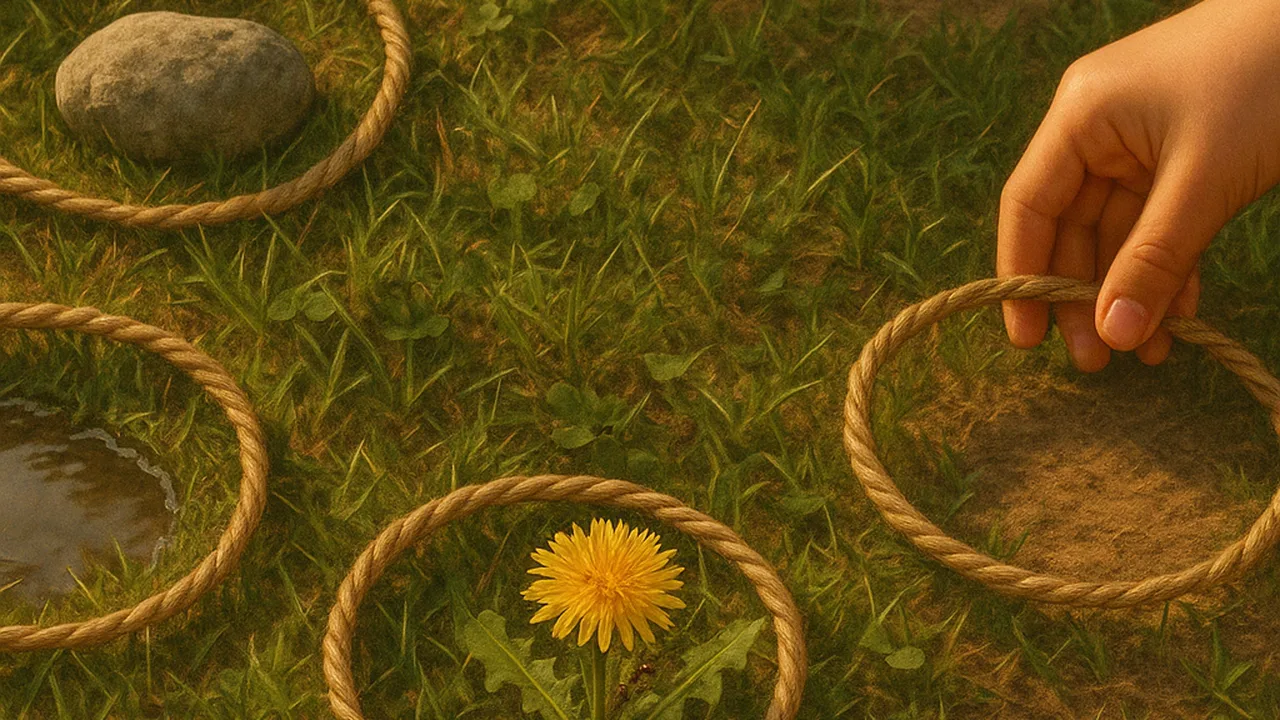
sort the things I find outside into groups of land, water, air and living things, and notice places where two groups touch.
- I can develop a model using a specific example to show how two of Earth’s systems interact.
- I can identify and label the important parts of my example, including features from two Earth systems like the geosphere, hydrosphere, atmosphere, or biosphere.
Phase 2: Investigate
Warm-Up ~5 min
Do Now. Look out the window for one minute. List five things you can see. Then try to sort them into groups that make sense to you.
A puddle sits on a dirt path, and a worm crawls across it. How many different “kinds” of Earth stuff are in that one small spot?
Instruction ~10 min
Creek guardians, today you explore first. You will go on a sorting hunt. Your team decides how to group what you find. We will give the groups their science names next phase.
Why we are hunting. Our creek is not just water. It has a rocky bed, air above it and fish and plants in it. To protect it, we need to see all of its parts and how they connect.
Worked example 1: sorting one spot. Ava looks at the base of a tree. She writes “soil and pebbles” in the Land column. She writes “dew on the grass” in the Water column. She writes “the breeze moving leaves” in the Air column. She writes “the tree and an ant” in the Living column.
Worked example 2: where two groups touch. Jamal sees tree roots holding soil on a small slope. He circles it as a “touch spot.” A living thing (roots) is changing the land (soil). He writes one sentence about what each part is doing to the other.
Thinking about our client. Start a list called Criteria and Constraints. Criteria are what the creek plan must do. Constraints are its limits, like money, time or space. Add one idea today.
Guided Exercises ~15 min
Hunt in your team’s zone for 10 minutes, or use the photo cards. The Recorder fills in this table.
| Land (rock, soil, sand) | Water (liquid or ice) | Air (wind, clouds) | Living things | Touch spot: two groups acting on each other |
|---|---|---|---|---|
Then answer the questions with your team.
Independent Practice ~10 min
Picture our client’s creek.
Draw a creek bank. Label one thing from each group: land, water, air and living things. Circle one touch spot.
Add to the Criteria and Constraints list: write one thing the creek plan must do.
Closure ~5 min
You found land, water, air and life everywhere, often touching. Next, we watch water move between the air and the ground inside a bag.
Exit ticket: describe one touch spot you found. Which two groups were acting on each other?
Teacher notes
Materials: clipboards, the four-column table, hand lenses (optional), cones or rope to mark zones. Backup photo cards: a stream with rocks, a muddy puddle, a windy beach, a tree root on a slope, fog over a field.
Setup: Mark safe zones for each team. Check for wet or icy patches first.
Listen for: students who place a puddle under “land” because it is on the ground. Ask, “What is it made of?” Hold off on the words geosphere, hydrosphere, atmosphere and biosphere until 3.10; use “land, water, air, life” for now.
Support / stretch: Give picture icons for each column. Stretch: ask students to find a spot where THREE groups touch.