4.22 Think Like a Planetarium Educator
use evidence to explain why the Sun looks brighter than other stars, and improve our sky tool with peer feedback.
- I can identify a claim that the sun looks brighter than other stars because it is much closer to Earth.
- I can decide if the evidence I have really helps explain why the sun looks brighter and bigger than other stars because of how far away they are.
- I can use evidence and reasoning to argue that the sun looks brighter and bigger than other stars because it is much closer to Earth, even though all stars give off their own light and are very large.
- I can explain that objects, like stars, look smaller and dimmer the farther away they are, so stars that are farther from Earth seem less bright than the sun.
- I can use examples of stars that look different in brightness to show that stars are at different distances from Earth.
Phase 4: Build
Warm-Up ~5 min
Do Now. A younger sibling at Night Sky Night asks, “If the Sun is a star, why is it SO much brighter than all the others?” Write the answer you would give in one sentence.
Two identical flashlights shine at you. One is 1 meter away, the other 10 meters away. How do they look?
Instruction ~10 min
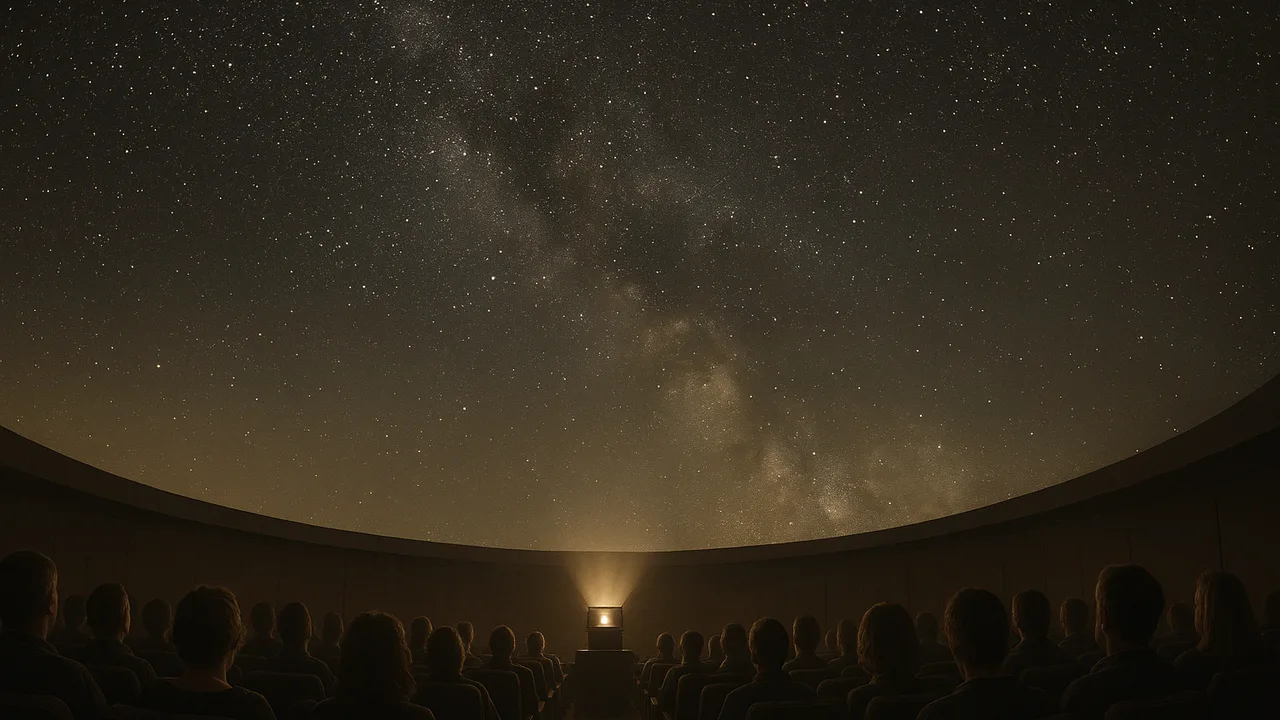
Junior engineers, meet a sky explainer. A planetarium educator teaches visitors about the night sky. They take big, hard ideas and make them clear with models, questions and stories. Your sky tool needs the same skill.
The claim. The Sun looks brighter and bigger than other stars because it is much, much closer to Earth. All stars give off their own light, and all stars are very large.
Worked example 1: the streetlight model. Jamal stands at the end of a long street lined with matching streetlights. The nearest light looks big and bright. Lights far down the street look like tiny, dim dots. The lights are the same, but their distances are different. Stars work the same way.
Worked example 2: evidence about distance. Light from the Sun takes about 8 minutes to reach Earth. Light from the next nearest star takes more than four years. That huge gap in distance helps explain the huge gap in brightness. Ava asks, “Is that enough evidence?” She adds a second piece: our flashlight test. Together, a model and real distances make a stronger argument.
Peer critique of sky tools. Swap sky tools with another team. Try to find tonight’s star groups using only their tool. Then give an “I like, I wonder, What if.”
Guided Exercises ~15 min
Run the flashlight test. Use two matching flashlights. Rate how bright each looks from 1 (dim) to 5 (very bright).
| Distance from viewer | Brightness rating (1–5) | Size of the glow |
|---|---|---|
| 1 meter | ||
| 5 meters | ||
| 10 meters |
Independent Practice ~10 min
Write the explanation card for your sky tool.
CER card: Why does the Sun look brighter and bigger than other stars? Give a claim, two pieces of evidence (the flashlight or streetlight model, and the light travel times), and your reasoning.
Closure ~5 min
You have the science and the feedback you need. Next class is the Prove It phase, starting with the big accuracy test for your shadow clock.
Exit ticket: explain to a 6-year-old, in two sentences, why the Sun is brighter than other stars.
Teacher notes
Materials: two matching flashlights (same model, fresh batteries), a meter stick or measuring tape, tape to mark 1, 5 and 10 meters, a darkened hallway or classroom, teams’ sky tool drafts.
Setup: Run the flashlight test in a hallway with the lights dimmed. Then swap sky tools between teams for the critique.
Boundary note: keep the explanation to relative distance. Do not compare star sizes, ages or life stages.
Listen for: “the Sun is not a star”; “stars are tiny.” Return to the streetlight model.
Support / stretch: Give a CER card with sentence starters: “The Sun looks brighter because… My evidence is… This shows that…” Stretch: ask what MORE evidence an astronomer might collect.