3.15 Choose Our Fixes
use information from reliable sources to choose one way to protect our creek and explain what my team will test and why.
- I can find information from books and reliable websites about how a human activity, like farming or using energy, affects Earth’s resources and the environment.
- I can find information about how a community uses science ideas to protect a natural resource and the environment where it is found.
- I can explain the purpose of my investigation, including how I will find problems or failure points in my model or prototype to help make it better.
- I can list the features that a solution must have to solve the problem.
Phase 4: Build
Warm-Up ~5 min
Do Now. Picture a heavy rainstorm at school. Where does the water on the roof go? Where does the water on the parking lot go? Sketch the path you think the water takes to the creek.
Rain falls on a parking lot and on a grassy field. Which one sends MORE water rushing toward the creek?
Instruction ~10 min
Guardians of the Creek, welcome to the Build phase. In Make Sense, you brainstormed ways to protect the creek. Now your team will choose one fix, model it, and test it. The watershed group will put the best fixes into our Watershed Protection Plan.
The fix menu. Each fix works on a different part of the watershed.
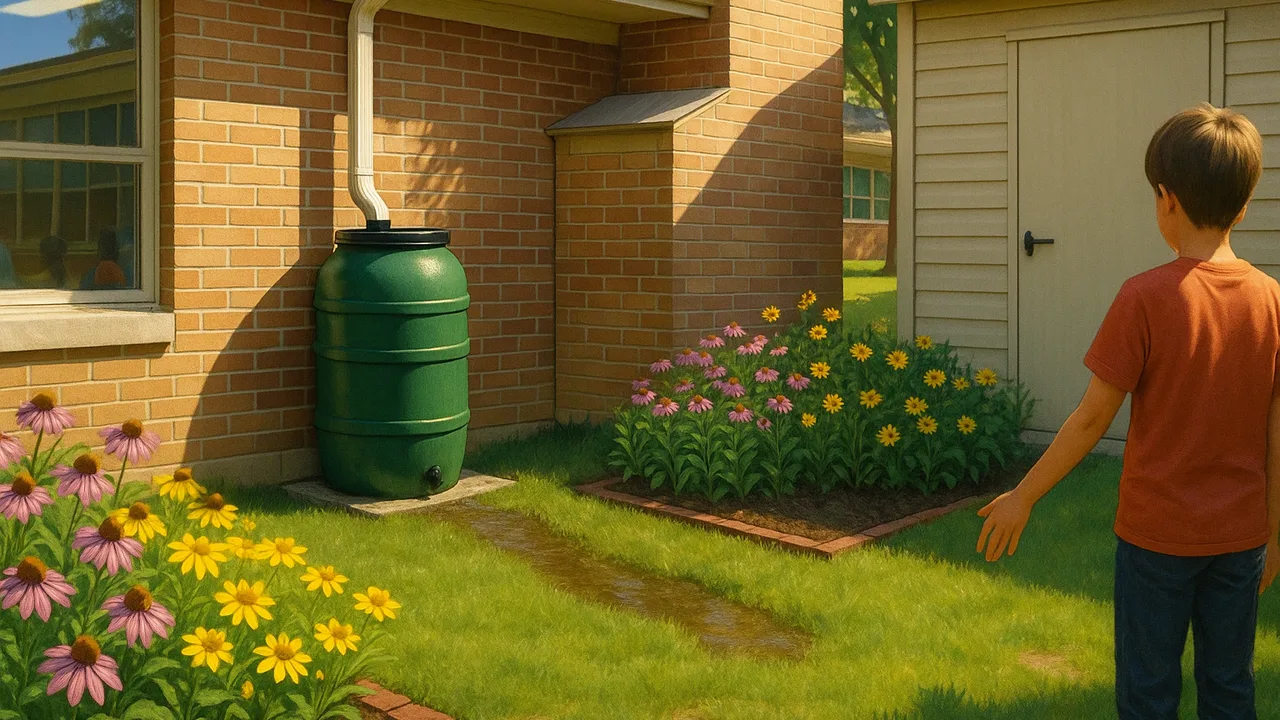
- Rain barrel: a barrel catches water from a roof gutter. People save it to water gardens later.
- Rain garden: a shallow garden in a low spot. Its plants and loose soil let runoff soak into the ground.
- Stream-bank plants: trees, shrubs and grasses along the creek. Their roots hold soil in place.
- Litter and runoff campaign: posters, storm-drain signs and cleanups that change what people do.
- Water saving at school: small changes that use less clean water every day.
Use reliable sources. Scientists do not guess. They read sources they can trust, like science books, government water agencies, and watershed groups. Today each team reads two fix cards and takes notes.
Worked example 1: Diego’s team picks a rain garden. Their source says rain gardens hold runoff and let it soak in. Their reasoning: the school parking lot sends muddy water to the creek. A rain garden at the edge could catch it. Their question to test: “Will a sponge-and-soil garden in our model send less muddy water to the creek cup?”
Worked example 2: Priya’s team picks stream-bank plants. Their source says plant roots hold soil on stream banks. Their test question: “Will a bank covered with grass lose less soil than a bare bank?”
Why we test. Engineers test to find failure points, the spots where a design does not work yet. Finding them early tells you what to fix.
Our criteria and constraints.
- Criterion: less rainwater rushes over the ground into the creek.
- Criterion: the water that reaches the creek is cleaner, with less mud and litter.
- Criterion: it uses what we learned about how land, water, air and living things interact.
- Constraint: families, the school or the town could really do it, at low cost.
- Constraint: it is safe for people and wildlife, with no harsh chemicals.
- Constraint: our model fix fits in the watershed model tray, and we have two build days.
Guided Exercises ~15 min
Read your two fix cards with your team. Use the arrows to move through each step. The Recorder takes notes, and everyone helps.
Independent Practice ~10 min
On your own, connect your fix to Earth’s systems.
Your fix changes how two of Earth's systems interact. Name the two systems (for example, the hydrosphere and the geosphere). Explain what your fix changes between them.
Closure ~5 min
Your team chose a fix using real information, not a guess. Next time, you will plan a fair test for every criterion.
Exit ticket: “Our fix is a ____. It protects the creek by ____. We will test whether it ____.”
Teacher notes
Materials: fix cards for the five fixes (print short passages from a state or county conservation agency, a watershed group, or a science text); team project folders; the criteria and constraints poster.
Setup: Give each team two fix cards so every fix is covered by at least one team. Aim for some teams on model fixes (rain barrel, rain garden, stream-bank plants) and some on people fixes (campaign, water saving). People-fix teams still build a small model piece in 3.17 or 3.18. If you want living grass for 3.18, plant grass seed in a cup today or buy a small piece of sod.
Listen for: “a rain barrel cleans the water.” It mostly holds water back; it does not filter it. Also listen for confusion between criteria (what it must do) and constraints (limits).
Support / stretch: Pre-highlight key sentences on fix cards. Stretch: ask teams to find a second source and say whether the two sources agree.