4.14 Ideate: Dream Up the Shadow Clock and Sky Calendar
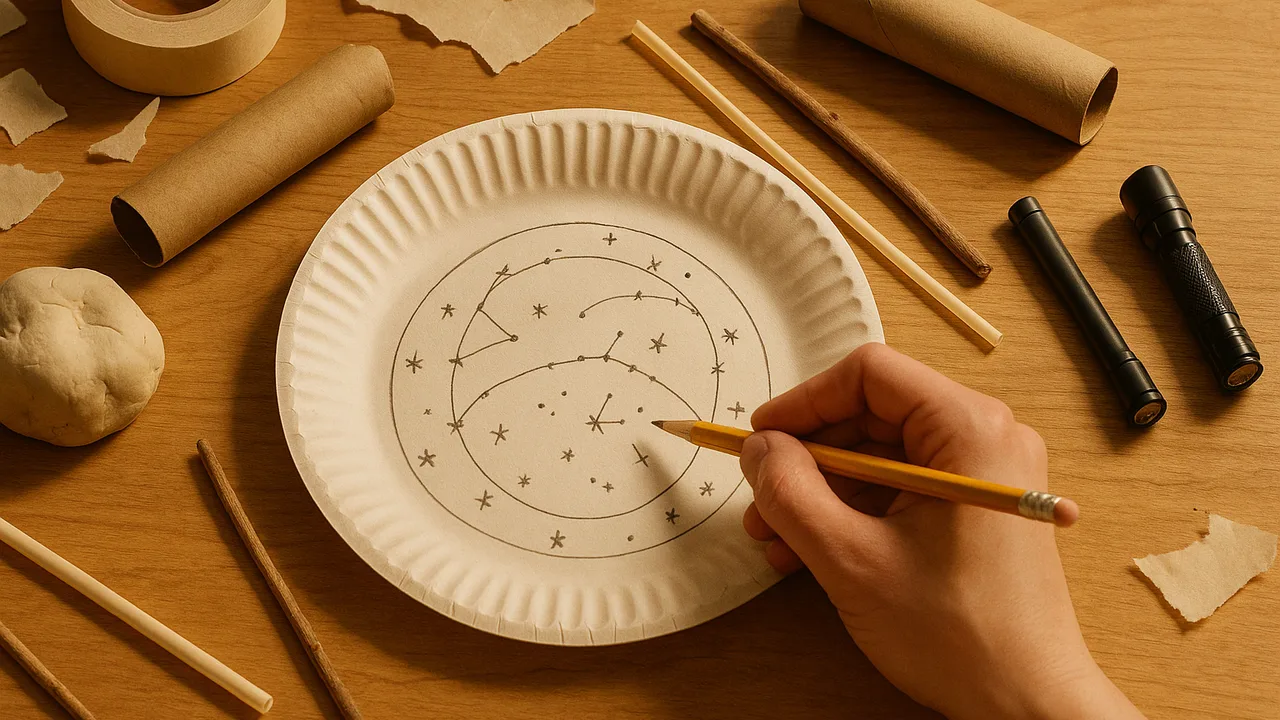
brainstorm at least three ideas for each of our tools and explain the sky science each idea uses.
- I can compare my data about shadows, daylight, and stars to find similarities and differences in how often these changes happen, like how shadows change daily and stars appear seasonally.
- I can use reasoning to connect evidence about Earth’s shape and objects falling down to support the claim that gravity pulls objects toward Earth’s center.
- I can explain that if Earth is spherical and everyone sees objects fall straight down, then objects must be falling toward Earth’s center.
- I can argue that when an object moves downward after being released, a force (gravity) must be pulling it toward the center of Earth.
- I can use evidence and reasoning to argue that the sun looks brighter and bigger than other stars because it is much closer to Earth, even though all stars give off their own light and are very large.
- I can explain that objects, like stars, look smaller and dimmer the farther away they are, so stars that are farther from Earth seem less bright than the sun.
- I can use examples of stars that look different in brightness to show that stars are at different distances from Earth.
Phase 3: Make Sense
Warm-Up ~5 min
Do Now. Re-read our criteria and constraints chart. Then look at our Wonder Board. Put a check on every question we can now answer. Which questions are still open?
How should we make sure the shadow clock's stick stands perfectly straight up?
Instruction ~10 min
Junior engineers, it is time to ideate. To ideate means to come up with lots of ideas before choosing one. Every idea must use science we discovered. Wild ideas are welcome, as long as they fit our criteria and constraints. We will choose and build in the next phase.
Brainstorm rules. Go for quantity first. Build on each other’s ideas with “Yes, and…” Do not judge ideas yet. Sketch with labels so others can see your thinking. The Recorder writes every idea down.
Worked example 1: three shadow clock ideas. Priya’s team sketched a flat board with a straight stick and painted hour lines. They sketched a “human sundial,” where a family member stands on a spot and becomes the stick. They sketched a stick with a plumb line hanging beside it, so families can see it stands straight toward Earth’s center. Each idea used the daily shadow pattern: long west in the morning, short north near solar noon, long east in the afternoon.
Worked example 2: three sky calendar ideas. Jamal’s team sketched a four-panel poster, one panel per season, with that season’s constellations and daylight hours. They sketched a spinning paper wheel that shows one season at a time. They sketched a booklet with a page called “Why is the Sun so bright?” It explains that all stars give off light, but the Sun looks brightest because it is much closer.
| Idea sketch | Science it uses (gravity, distance and brightness, daily or yearly pattern) | Criteria it meets | A concern or question |
|---|---|---|---|
| Shadow clock idea 1 | |||
| Shadow clock idea 2 | |||
| Shadow clock idea 3 | |||
| Sky calendar idea 1 | |||
| Sky calendar idea 2 | |||
| Sky calendar idea 3 |
Guided Exercises ~15 min
Use our science to check the ideas. Talk with your team before each answer.
Independent Practice ~10 min
Fill in your own row of the idea table, then explain your best idea.
Sketch one new idea for either tool. Label the science it uses, and explain why it would work at Night Sky Night.
How confident are you that you can I can explain the science behind my design ideas.
Closure ~5 min
Our idea table is full of science-based designs. Next, in Build, we choose, prototype and test them for the library. First, your 3DX field trip!
Exit ticket: which idea do you think the library families would love most, and which sky pattern does it depend on?
Teacher notes
Materials: the criteria and constraints chart, the Wonder Board, sketch paper, colored pencils, the idea table.
Setup: post brainstorm rules. Give each team a timer for two quick rounds: shadow clock ideas, then sky calendar ideas.
Listen for: ideas that break the science, such as hour lines swinging from east to west, or a calendar claiming the Sun is the biggest star. Teams choose and compare designs in Build, where 3-5-ETS1-2 is developed. Keep today on generating ideas grounded in the science.
Support / stretch: give a starter sketch to adapt. Stretch: design a version of the shadow clock that a family could take home and set up themselves.