3.09 A Watershed on Crumpled Paper
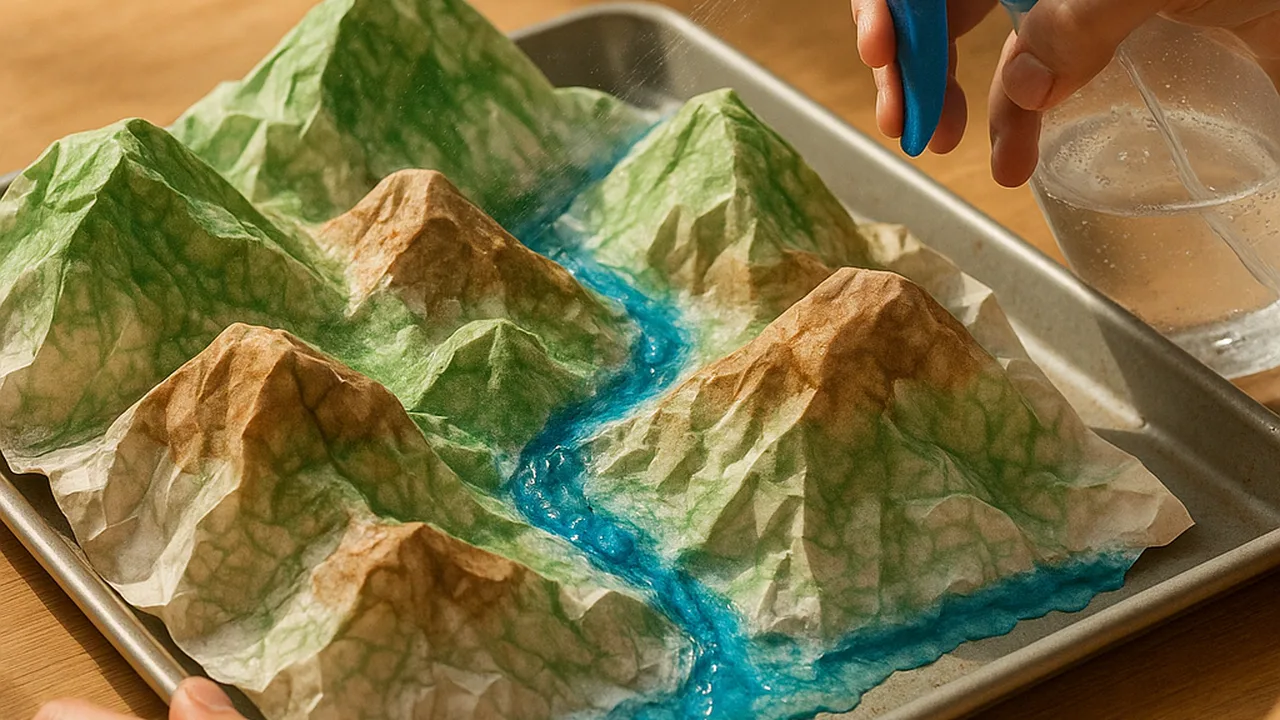
build a watershed model, observe where rain and pollution flow, and list the criteria and constraints for our creek plan.
- I can use my model to explain different ways the two Earth systems in my example work together to change Earth’s surface.
- I can use my model to show how parts of one Earth system help that system work and also help the other system work.
- I can list the features that a solution must have to solve the problem.
- I can describe the limits on my design, such as how much it costs, what materials I can use, or how much time I have.
Phase 2: Investigate
Warm-Up ~5 min
Do Now. A drop of rain lands on a roof three streets away from the creek. Could that drop end up in the creek? Draw the path you think it takes.
We draw “pollution” dots with marker on the high parts of a crumpled-paper model. Then we make it rain. Where will the color end up?
Instruction ~10 min
Creek guardians, today you build a watershed. A watershed is all the land that drains into the same creek or river. The high lines between watersheds are called ridges. Water on one side of a ridge flows to one creek. Water on the other side flows somewhere else.
How to build it. Crumple a sheet of paper, then open it partway. Set it in a tray so it has peaks and valleys. Trace the ridges with a blue washable marker. Add brown dots for loose soil and black dots for oil and trash on the high parts. Spray it gently with water, like rain.
Worked example 1: following the color. Jamal sprays his model five times. Brown and black streaks run down the folds. They collect in one low valley. He labels that valley “our creek.” Pollution from far uphill ended up in it.
Worked example 2: from creek to the sea. Our creek flows into a big river. That river may join an even bigger river, and that one flows on downstream until it reaches the ocean. So a drop from our creek can travel all the way to the ocean.
Criteria and constraints. Now we can list what our plan must do. Criteria: less rainwater rushes over the ground into the creek, and the water that reaches it is cleaner, with less mud and litter. Constraints: families, the school or the town could really do it at low cost, and it is safe for people and wildlife, with no harsh chemicals.
Guided Exercises ~15 min
Build and spray your model. The Recorder fills in this table. Then the team starts the client’s criteria and constraints chart.
| Sprays | Where the blue water went | Where the brown and black dots went | Low spot where it collected |
|---|---|---|---|
| After 2 sprays | |||
| After 5 sprays | |||
| After 10 sprays |
| Criteria: our plan must… | Constraints: our plan is limited by… |
|---|---|
Independent Practice ~10 min
Connect the model to our community.
Write three criteria and two constraints for the creek plan. For one criterion, explain which data from 3.05 or today supports it.
Closure ~5 min
Seven investigations are done. Next: your 3DX field trip to the Water Cycle Station. Then we make sense of everything we found.
How confident are you that you can I can use a model to show how water moves through a watershed.
Exit ticket: explain how something done on a hill far away could change the water in our creek, and even in rivers downstream.
Teacher notes
Materials (per team): a sheet of white copy paper or butcher paper, a shallow tray, washable markers (blue, brown, black), a spray bottle of water, paper towels, the two-part chart.
Setup: Test the markers first; some washable brands run better than others. Have a map ready that shows our creek, the big river it feeds and the rivers downstream.
Listen for: “Only trash dumped IN the creek matters.” Point to the streaks that started far uphill. Keep the criteria/constraints language short; part 2 builds on this chart.
Support / stretch: Give pre-cut cards of criteria and constraints to sort. Stretch: build two watersheds side by side with a ridge between them and show the color splitting.