3.24 The Watershed Summit
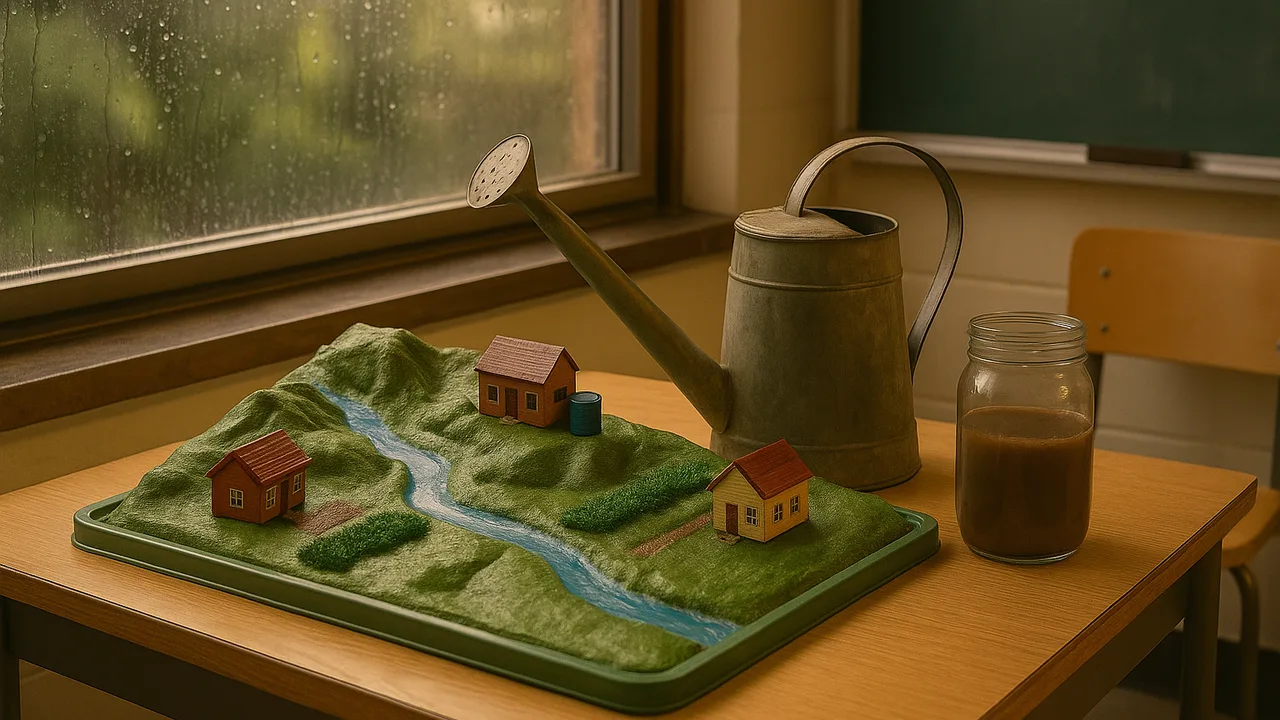
present my team’s part of the Watershed Protection Plan and explain, with evidence from my sources and tests, how it helps our community protect the creek.
- I can combine information from two or more sources to describe both the positive and negative effects that human activities have on the environment.
- I can combine information from different sources to explain how a community uses science ideas to protect a natural resource and its environment.
- I can use information I am given to explain a problem that comes from something people need or want.
- I can use my graphs to explain that most of Earth’s water is in the oceans.
- I can use my graphs to describe that most of Earth’s fresh water is stored in glaciers or underground.
- I can use my graphs to show that only a small amount of fresh water is found in lakes, rivers, and wetlands.
Phase 5: Prove It
Warm-Up ~5 min
Do Now. Practice your opening line with a partner: “Almost all of Earth’s water is salty, so the fresh water in our creek matters.” Can you explain why in one breath?
Why does protecting fresh water in creeks and rivers matter so much?
Instruction ~10 min
Summit day. Today the watershed group, or classmates and guests playing them, comes to hear our plan. Each team gives a three-minute talk about its part. Together, the parts make one Watershed Protection Plan.
A strong summit talk has five parts.
- Why water matters: most of Earth’s water is salty; fresh water in creeks is a small share.
- The problem: what people need, and what harms the creek. Name the criteria and constraints.
- The science: how two Earth systems interact in your fix.
- The evidence: facts from two sources and your test data.
- The ask: one action for the community to take.
Worked example 1: Priya’s opening. “Only a tiny part of Earth’s water is in rivers and lakes. Our creek is part of that. When rain hits bare banks, runoff carries soil into the water. People need clean water for wildlife and for fun, and our fix must be low cost and safe.”
Worked example 2: Priya’s evidence. “A conservation agency says stream-side plants hold soil. A watershed group says buffers also shade the water. In our model, the grassy bank’s runoff dropped from muddiness 5 to 2. We ask the town to plant native shrubs along the creek trail.”
Be a good audience. Listen, then ask one question. Fill in a summit card with one star and one wish for each team.
Guided Exercises ~15 min
Get ready, then present. Use the arrows to move through each step.
Independent Practice ~10 min
On your own, be a thoughtful summit guest.
Summit card: pick another team. Name the two Earth systems in their fix. Give one star and one wish.
Public product: the Watershed Protection Plan
Present your team’s part of the class Watershed Protection Plan to the watershed group. Show your model, your plan page and your test data. Explain why fresh water is precious, how your fix changes the way Earth’s systems interact, and how our community can use it to protect the creek. Use information from at least two sources.
Submission workflow
- Finish your plan page: the problem, criteria and constraints, the science, good and bad human effects from two sources, and your test results.
- Set up your model, version 2 and data table for the gallery.
- Rehearse a three-minute talk where every team member speaks.
- Present at the Watershed Summit and answer one guest question.
- Add your page to the class plan that goes to the watershed group.
How it is scored
| Criterion | What proficient looks like |
|---|---|
| Earth’s systems and water | Accurately explains that most water is salty and little is in creeks, and uses a model to show how two Earth systems interact in the fix. |
| Protecting resources | Combines information from two or more sources to describe positive and negative human effects and how a community can protect the creek. |
| Engineering design | Defines the problem with clear criteria and constraints, shares real test data, and explains a failure point and the change it led to. |
| Communication | Plan page and talk are clear, accurate and organized; every member speaks and the team asks for one specific action. |
Closure ~5 min
You shared a real plan with real evidence. Next time, the unit checkpoint shows everything you have learned.
Exit ticket: what part of the class plan do you think will help the creek most? Explain with evidence.
Teacher notes
Materials: models, plan pages, data tables, summit cards, a timer, the 4-row rubric.
Setup: Invite a guest to play the client: a principal, a parent, or a member of a local watershed or conservation group if one is available. With many teams, run a gallery: half present, half visit, then switch. Bind the plan pages into one class plan for the client.
Listen for: talks that skip the water-amount idea, models that mix more than two systems without explaining them, and evidence from only one source.
Support / stretch: Offer a talk script with sentence frames; allow presenting by pointing and labeling. Stretch: ask teams how the town’s water needs might change in 20 years and how the plan could change too.