4.15 The Shadow Clock Design Brief
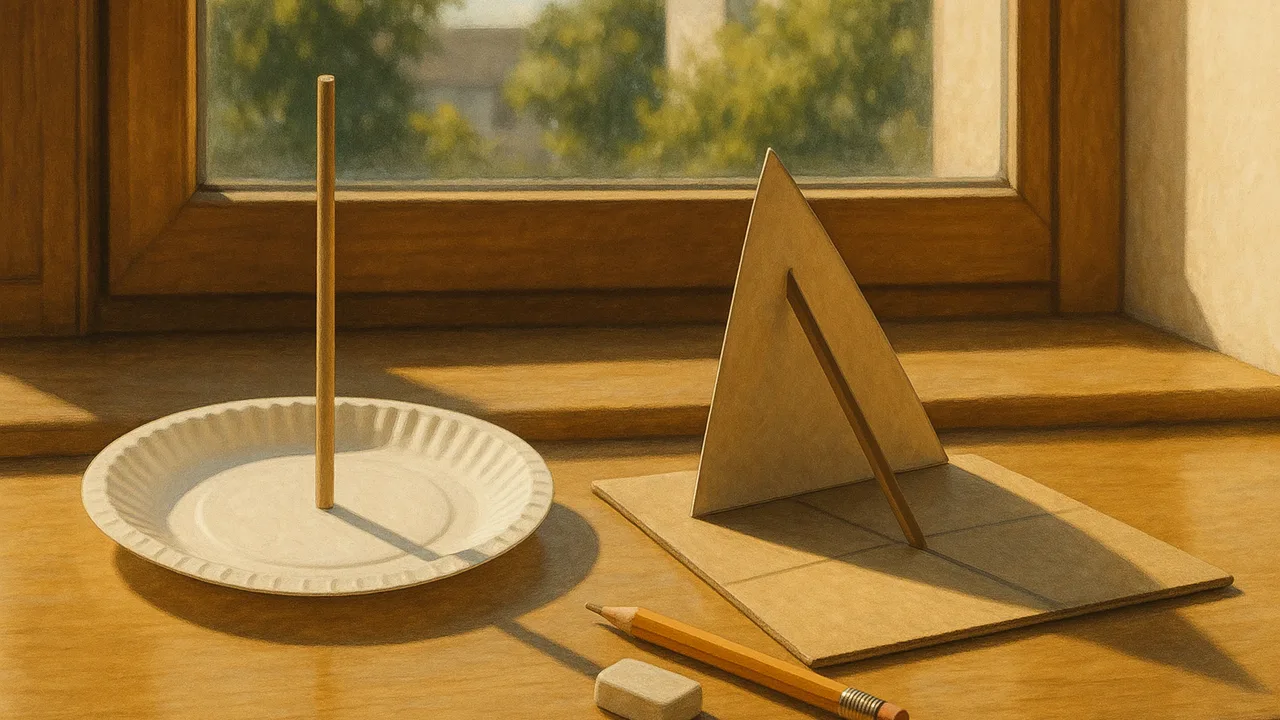
use what I know about shadows to write the criteria and constraints for a shadow clock and sketch two different designs.
- I can describe the required features (criteria) and limits (constraints) for a solution, including ways to increase benefits, decrease risks or costs, and meet what people need.
- I can explain how I will use the criteria and constraints to help create and test my design solutions.
- I can use information from research to explain what causes a problem and what effects it has.
- I can use scientific facts I have learned to help me understand the problem.
- I can come up with at least two possible solutions to a problem using what I know about science.
Phase 4: Build
Warm-Up ~5 min
Do Now. Read the note from our client, the school library. “At Night Sky Night, families will arrive before sunset. We want a shadow clock on the library lawn that tells the time, plus a sky tool that shows which stars to look for. Can our 5th grade engineers build them?”
A stick stands straight up in the sun. Where will its shadow point at 9:00 in the morning?
Instruction ~10 min
Junior engineers, welcome to the Build phase! In Investigate you tracked shadows all day. You found a pattern: the Sun appears to cross the sky from east to west, because Earth spins. So a shadow swings from west to east and is shortest near the middle of the day. A shadow clock turns that pattern into a way to tell time.
Step 1: define the problem. Engineers first ask what causes the problem and what the effects are. Here the cause is simple: the Sun’s place in the sky changes in a pattern all day. The effect is that a shadow moves in a pattern too. If we mark where the shadow falls each hour, we can read the time.
Step 2: criteria and constraints. Criteria are what the design must do. Constraints are the limits it must stay inside.
| Criteria (must do) | Constraints (limits) |
|---|---|
| Tells the time within 15 minutes of a real clock | Built from cardboard, sticks, clay and other free or cheap materials |
| Easy for families to read in a few seconds | Fits on a base no bigger than a pizza box |
| Stays steady in a light wind | Built and tested in about four class periods |
Worked example 1: two designs. Diego’s team sketches a straight-stick clock. A pencil stands straight up in the middle of a board. Priya’s team sketches a tilted-pointer clock. Its pointer leans toward the north, aimed at the North Star. Two different ideas give the team something real to compare.
Worked example 2: using research. Mei reads that a pointer tilted toward the North Star keeps its hour marks closer to correct all year. A straight stick is easier to build, but its marks drift as the weeks pass. That trade-off belongs in the design brief.
Guided Exercises ~15 min
Work with your team. The Recorder fills in the design brief while the others discuss each part.
| Design brief | Our team’s answer |
|---|---|
| The problem (cause and effect) | |
| Criterion 1 | |
| Criterion 2 | |
| Constraint 1 | |
| Constraint 2 | |
| Design A sketch name | |
| Design B sketch name |
Independent Practice ~10 min
Write like an engineer for the library.
Explain the problem in two sentences: what CAUSES a shadow to move, and what is the EFFECT we can use to tell time?
Pick one criterion and one constraint from your brief. Explain how each one will shape the design you build.
Closure ~5 min
Your design brief is the map for the whole build. Next class we build both designs and start marking the hours.
Exit ticket: name your two designs. What is one way they are different, and why might that difference matter?
Teacher notes
Materials: the client letter (read aloud or project it), design brief handout, compass or a phone compass app (teacher only), sample pencil-and-clay gnomon, sketch paper.
Setup: Re-post the class shadow data from Investigate so teams can cite it. Assign roles: Materials Manager, Recorder, Tester, Reporter.
Listen for: “the Sun moves around Earth.” Redirect: the Sun only appears to move, because Earth spins. Also listen for criteria and constraints being mixed up.
Support / stretch: Give a sorting card set (criteria vs. constraints) to students who need it. Stretch: ask teams to add a criterion about readability for younger siblings at the event.