4.23 The Accuracy Test: Shadow Clock vs. Real Clock
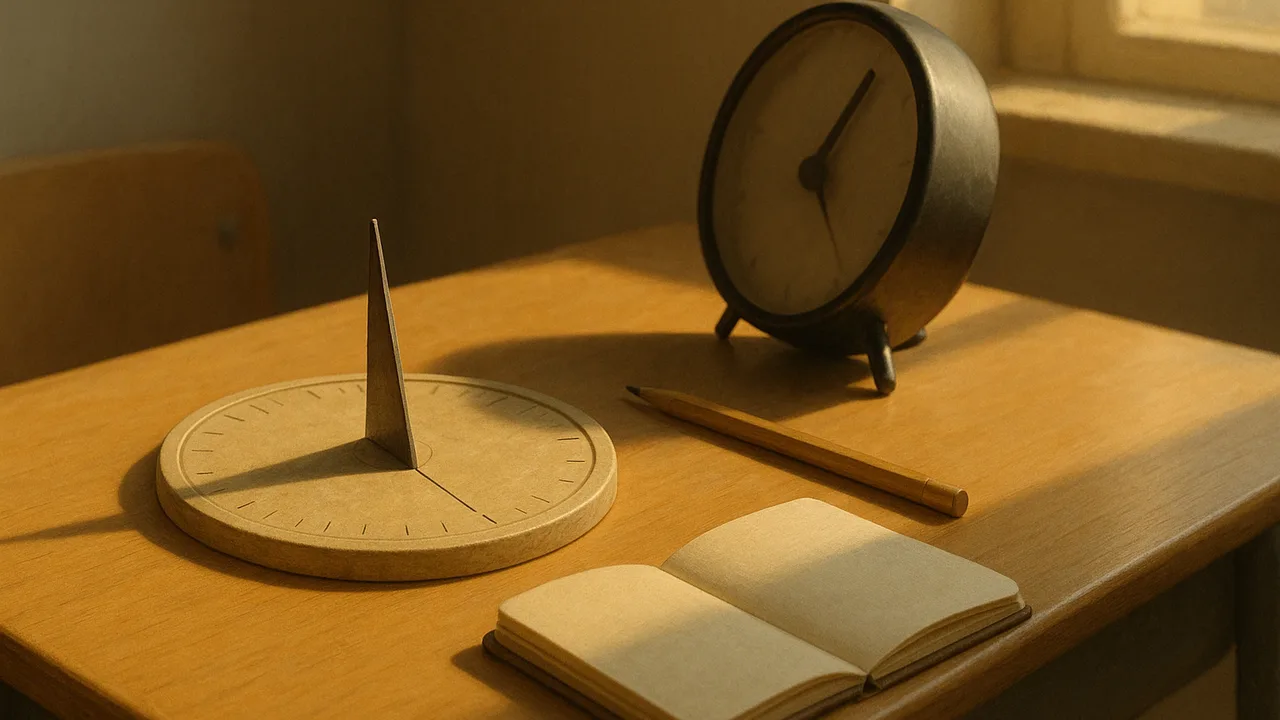
test our shadow clocks against a real clock at different times, use the data to compare designs, and decide on a final revision.
- I can test each solution in different situations and collect data to see how well it meets the criteria and constraints.
- I can use the data I collected to compare how well each solution meets the criteria and constraints of the problem.
- I can compare my data about shadows, daylight, and stars to find similarities and differences in how often these changes happen, like how shadows change daily and stars appear seasonally.
Phase 5: Prove It
Warm-Up ~5 min
Do Now. Our criterion says the clock must be within 15 minutes of a real clock. Predict: will your clock pass at every test time?
How confident are you that you can I can test a design fairly and use data to decide how well it meets the criteria.
Instruction ~10 min
Junior engineers, this is the big test. Today the Tester reads each shadow clock at the exact moment the Timekeeper reads the real clock. We test at three times of day. Then we revise once and test again.
Worked example 1: pass or fail. Sample data for Diego’s straight stick: 9:30, error 10 minutes; 11:30, error 5 minutes; 1:30, error 20 minutes. Two readings pass, one fails. His clock does not yet meet the criterion at every time.
Worked example 2: deciding with data. Diego looks closer. His 1:30 mark was made on a cloudy day by guessing. He re-marks it on a sunny day, retests, and gets an error of 5 minutes. One focused revision, based on data, fixed the failure.
Why do marks drift? The Sun’s daily path shifts a little from week to week. A shadow clock is a pattern tool. When the pattern shifts, the marks need a check-up.
Guided Exercises ~15 min
Test both designs. Mark P (pass) if the error is 15 minutes or less.
| Test time | Straight stick reads | Error | P / F | Tilted pointer reads | Error | P / F |
|---|---|---|---|---|---|---|
| Morning | ||||||
| Midday | ||||||
| Afternoon | ||||||
| Retest after revision |
Independent Practice ~10 min
Make the final decision.
Name the design your team will bring to Night Sky Night. Explain one trade-off you made between a criterion (like accuracy) and a constraint (like time or materials).
Closure ~5 min
Your clock has been tested, revised and retested. Next class is the Night Sky Night showcase!
Exit ticket: what was your clock's biggest error today, and what do you think caused it?
Teacher notes
Materials: calibrated prototypes, a phone or watch set to the correct time for each Timekeeper, data tables, clipboards.
Setup: Pick three test times spread across the school day, and arrange for Sky Timekeepers to record readings outside class time. If it is cloudy, use the backup data set and the flashlight model, and run the real test on the next sunny day.
Listen for: errors computed backward (“minus” confusion). Encourage drawing a number line between the two times.
Support / stretch: Provide a clock-face strip for counting minutes. Stretch: ask students to graph the error of each design at each test time.