4.03 Drop Zone: Which Way Is Down?
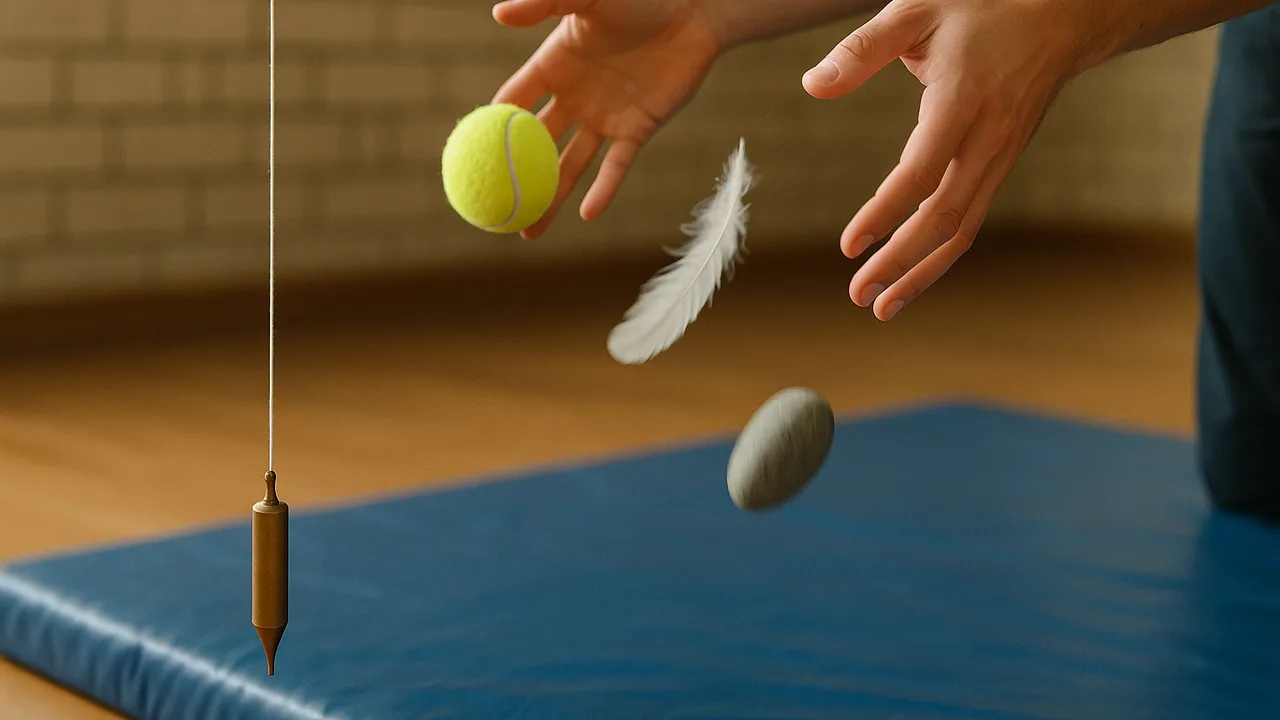
test how different objects fall when dropped, compare their paths to a hanging plumb line, and list our project’s criteria and constraints.
- I can describe evidence that shows Earth is shaped like a sphere, such as ships disappearing over the horizon, the shape of Earth’s shadow on the moon, and the changing height of the North Star.
- I can explain that objects dropped anywhere on Earth appear to fall straight down.
- I can describe that people all around the world see objects fall straight down, no matter where they live.
- I can identify the claim that Earth’s gravity pulls objects down toward the center of Earth.
Phase 2: Investigate
Warm-Up ~5 min
Do Now. Today you explore first. We will name the big idea at the end. Hold an eraser at shoulder height over a tape X on the floor. Before you let go, make a prediction.
Where will the eraser land?
Instruction ~10 min
Junior scientists, today you are drop testers. Each team drops four objects: an eraser, a crumpled paper ball, a metal washer and a tennis ball. Hold each one at the same height, right above a tape X. Let go gently. Do not throw or push. Measure how far from the X it lands, in centimeters. Run 3 trials for each object.
The plumb line. Next, tie a washer to a string about 1 meter long. Hold the top of the string still and let the washer hang. Builders call this a plumb line. Compare the path of your dropped objects to the line of the string. Then try the plumb line in three other places in the room.
| Object | Trial 1: distance from X (cm) | Trial 2 (cm) | Trial 3 (cm) | Path (straight down / slanted / curvy) | Same line as the plumb line? (yes / no) |
|---|---|---|---|---|---|
| Eraser | |||||
| Paper ball | |||||
| Washer | |||||
| Tennis ball |
Worked example 1: reading sample data. Jamal’s team dropped a marker cap three times. It landed 1, 0 and 2 cm from the X. Every trial landed very close to the spot right below it. These are sample numbers, and your data will be your own. A small miss usually means the hand moved a little when letting go.
Worked example 2: a slow faller. Mei’s team noticed the paper ball fell more slowly than the washer. It still fell down, though, not sideways or up. Air slows light, fluffy objects, but it does not change which way they go. Down is down for every object they tried.
Now we can name it. Every object fell toward the floor, along the same line as the plumb line. Something pulled each one down. Scientists call that pull gravity. It is a force from Earth that pulls objects down. Where exactly does “down” point? We will find out next time with a globe.
Define the problem. Engineers list criteria, the things a design must do, and constraints, the limits it must stay within. Our shadow clock must show the hour on a sunny day and be easy for families to read. Our sky calendar must show all four seasons. Constraints: cheap classroom materials, safe for young children, and ready before Night Sky Night.
Guided Exercises ~15 min
Use your team’s data table to answer these. The Recorder reads the numbers out loud.
Independent Practice ~10 min
Look at your own team’s data table.
Describe the path of the objects you dropped. Use at least two numbers from your table as evidence.
Add one more criterion or constraint for our shadow clock. Is it something the clock must DO, or a LIMIT?
Closure ~5 min
Every object fell straight down, along the same line as the plumb line. We named the pull gravity. Next time, we test what “down” means on the other side of the world.
Exit ticket: what evidence from today shows that objects fall straight down? Name one criterion of our project, too.
Teacher notes
Materials (per team): an eraser, a sheet of scrap paper to crumple, a metal washer, a tennis ball, masking tape for the X, a meter stick, and about 1 m of string with a second washer for the plumb line.
Setup: tape one X per team on a hard floor with space around it. Post the criteria and constraints chart; teams add to it all unit.
Listen for: “heavy things fall and light things float” (all fall down; air slows light, spread-out objects). Keep 5-PS2-1 about direction only; no formulas for gravity and no talk of mass and weight math. Hold the word gravity until the end of the mini lecture.
Support / stretch: let some Recorders mark “on X / near X / far” instead of centimeters. Stretch: drop a flat sheet and a crumpled sheet together and explain what changed and what did not.