3.23 Test Day in the Watershed Model
carry out my team’s test plan on version 2, record the data, and use it to decide which criteria and constraints our fix meets.
- I can carry out my investigation and collect and record data by following my plan.
- I can describe how I will collect evidence about how well my model or prototype meets the criteria and constraints.
- I can identify and describe specific parts of my model or prototype that do not meet the criteria or constraints.
- I can explain which parts of my model or prototype could be improved to better meet the criteria and constraints.
- I can describe how the parts of the two Earth systems in my model interact with each other in my example.
Phase 5: Prove It
Warm-Up ~5 min
Do Now. Read your test plan out loud with your team. Check: what do we change, what do we measure, and what stays the same?
On Test Day, we should use the same number of sprays as we did for version 1.
Instruction ~10 min
Test Day, Guardians. Today you prove what your fix can do. Testers run the model. Recorders write every number right away. Materials Managers reset the model between runs. Reporters watch that the plan is followed exactly.
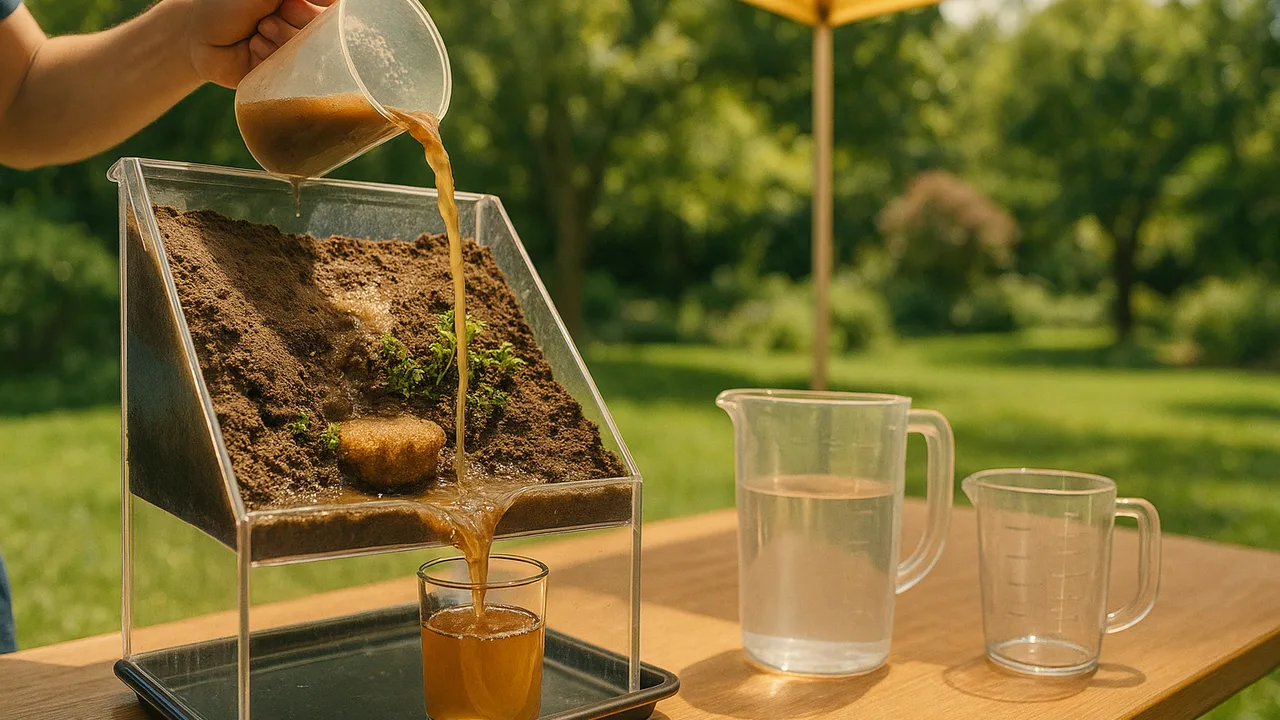
Our watershed model. A plastic bin is tilted so one end is higher. The high end is the “hills and town.” Soil, a cardboard roof and a strip of plastic “pavement” sit there. The low end is the “creek,” where a cup catches the runoff. A spray bottle makes the rain. A pinch of cocoa powder sprinkled on the land stands in for pollution like dirt, oil and fertilizer.
Run three trials. One run can be a fluke. If three runs give similar results, the evidence is stronger.
Worked example 1: Diego’s data. Without the garden, the creek cup held 150, 140 and 145 mL, muddiness 5 each time. With version 2, it held 80, 85 and 75 mL, muddiness 2 each time. These are sample numbers. The pattern is clear: less water and cleaner water reached the creek.
Worked example 2: an honest result. Mei’s version 2 bank was better, but trial 3 was muddier. She looked and saw the soil had dried and cracked. She recorded it and wrote it as a new failure point. Honest data helps the watershed group more than perfect-looking data.
| Run | Trial 1 | Trial 2 | Trial 3 | Meets the criterion? (yes / not yet) |
|---|---|---|---|---|
| Without fix: creek cup mL and muddiness | ||||
| Version 2: creek cup mL and muddiness | ||||
| Low cost and doable (research check) | ||||
| Safe for people and wildlife (research check) | ||||
Guided Exercises ~15 min
Run your tests. Use the arrows to move through each step.
Independent Practice ~10 min
On your own, write a test-day claim.
Write a claim, evidence and reasoning. Claim: does version 2 meet the runoff criterion? Evidence: your numbers. Reasoning: how water and land interact in your model.
Closure ~5 min
You have real evidence now. Next time, you will share it with the watershed group at the Watershed Summit.
Exit ticket: write your best version 2 result and one idea for version 3.
Teacher notes
Materials: watershed models, version 2 fixes, spray bottles, measuring cups, muddiness cards, cocoa powder, towels, data tables.
Setup: Stagger teams if models are shared. Reset soil and cocoa the same way between runs. Campaign teams run their litter model test or a quick survey of classmates about the message (before and after reading the poster).
Listen for: students who average the wrong rows or ignore a messy trial. Celebrate honest “not yet” results.
Support / stretch: Give a partly filled table. Stretch: find the average of three trials and explain why averages help.