4.06 Shadow Tracker, Part 1: Setting Up the Shadow Stick
set up a shadow stick, measure the length and direction of its shadow at several morning times, and organize the data in a table.
- I can organize data about how the length and direction of shadows change at different times during one day using graphs or charts.
- I can use graphs to show how the amount of daylight changes throughout the year by recording sunrise and sunset times.
- I can organize data to show which stars or groups of stars are visible in the night sky at different times of the year.
Phase 2: Investigate
Warm-Up ~5 min
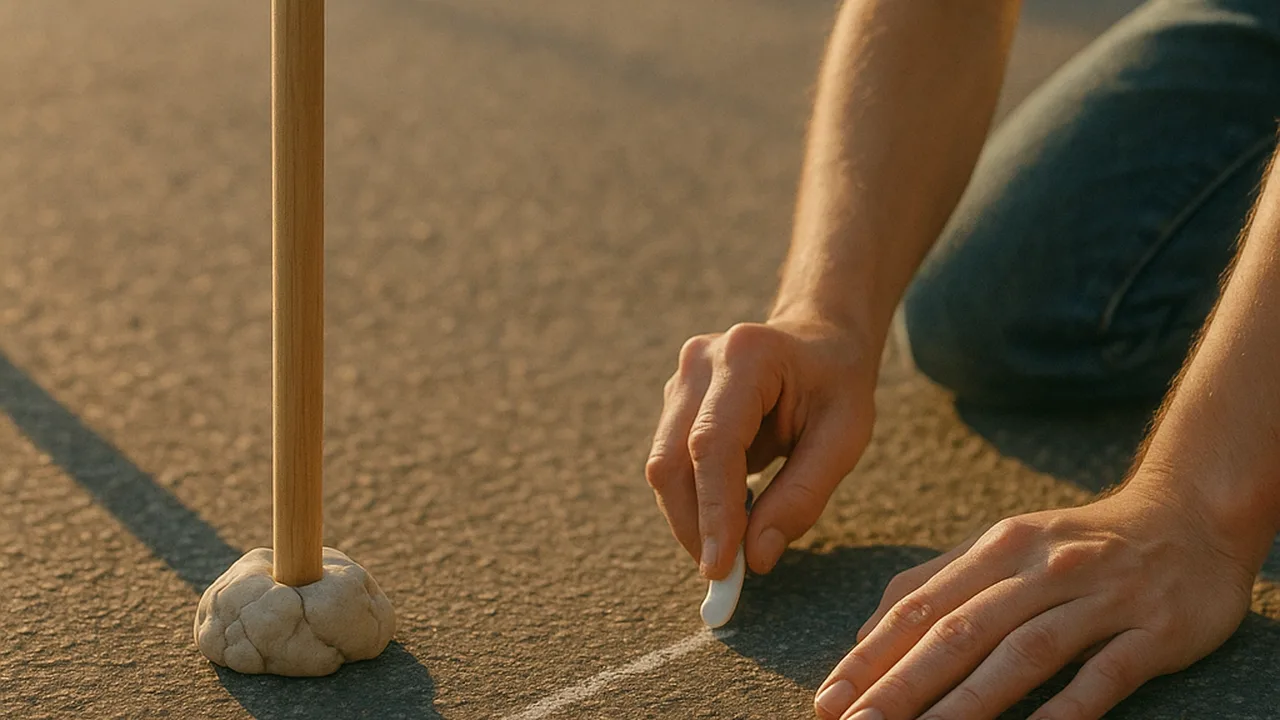
Do Now. Today you explore first. We will name the pattern later. Look at a pencil standing in a lump of clay on a sunny windowsill or outside. Notice its shadow. Make a prediction.
Between 9:00 and 11:00 this morning, what will the stick's shadow do?
Instruction ~10 min
Junior astronomers, today you are shadow trackers. Each team gets a shadow stick: a straight dowel or pencil about 20 cm tall. Push it into clay in the middle of a big sheet of paper. Set the paper on flat, sunny ground. Use a plumb line to make sure the stick stands straight up. Then tape the paper corners down so nothing moves all day.
Mark the directions. Use a compass to find north. Write N, S, E and W on the edges of the paper. Every reading uses the same spot, the same stick and the same paper. That keeps our test fair.
How to take a reading. Put a dot at the very tip of the shadow. Write the time beside the dot. Measure from the bottom of the stick to the dot, in centimeters. Then write the direction the shadow points, like west or northwest. Note where the Sun is, too, but NEVER look straight at it.
| Clock time | Shadow length (cm) | Shadow points toward (N, NE, E, SE, S, SW, W, NW) | Where the Sun is (low or high; east, south or west) |
|---|---|---|---|
| 9:00 | |||
| 10:00 | |||
| 11:00 | |||
| 12:00 |
Worked example 1: one reading. Malik’s team took a reading at 9:00. The tip dot was 54 cm from the stick, and the shadow pointed west. The Sun was low in the east. These are sample numbers. Your shadow depends on your stick, your place and your day.
Worked example 2: spotting a change. At 10:00, Malik’s team measured 33 cm. The shadow had swung a little toward the north. The Sun looked higher. In just one hour, the shadow got shorter AND changed direction. Organizing the data in a table makes changes like this easy to see.
Project link. A shadow clock is just a shadow stick with hour marks. Our tracing paper is the first draft of the library’s clock face!
Guided Exercises ~15 min
Use your morning readings to answer these. The Recorder holds the table.
Independent Practice ~10 min
Look at your own morning data.
Describe how your shadow's length AND direction changed this morning. Use numbers and directions from your table.
Predict the shadow's length and direction at 2:00 this afternoon. Explain why you think so.
Closure ~5 min
Our shadow sticks are set and our morning data is in. The shadows got shorter and swung around. Next time, we finish the afternoon readings and graph a whole day of shadows.
Exit ticket: why do we write both the length and the direction for every shadow reading?
Teacher notes
Materials (per team): a 20 cm dowel or unsharpened pencil, clay or play dough, a large sheet of paper or poster board, tape, a ruler, a plumb line from 4.03, a compass (a phone compass app is fine, run by an adult).
Setup: choose a spot that stays sunny all day, away from building shadows. A 40-minute class cannot stay outside all day, so schedule quick two-minute readings: Recorders step out at set times, or an adult photographs each board with a ruler in view. The 12:00 reading may happen during lunch.
Listen for: “the Sun gets closer at noon” (it gets higher in the sky, not closer). Hold the word “solar noon” until 4.12. Keep 5-ESS1-2 to describing and organizing the pattern.
Support / stretch: give some Recorders a direction wheel to match instead of writing letters. Stretch: ask teams to predict exactly where the next tip dot will land and mark it with a small x first.