3.04 A Water Cycle in a Bag
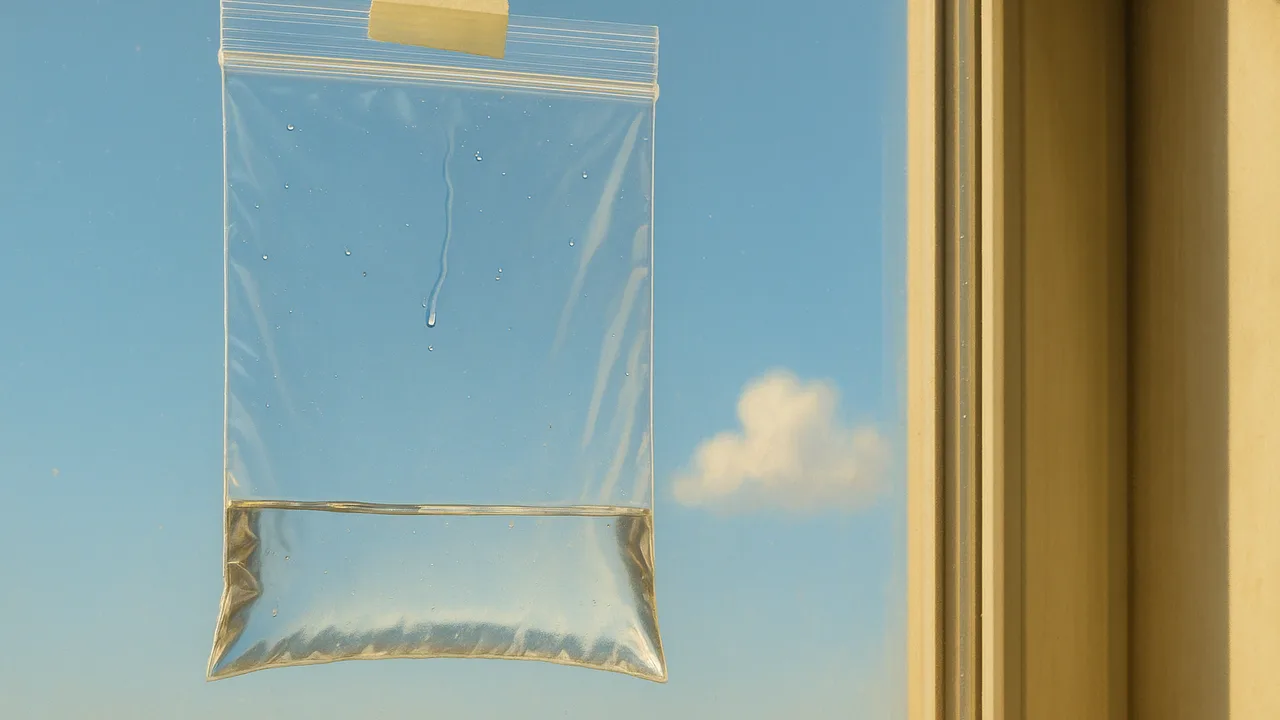
build a sealed water cycle model and observe how water moves between the air and the water inside it.
- I can develop a model using a specific example to show how two of Earth’s systems interact.
- I can identify and label the important parts of my example, including features from two Earth systems like the geosphere, hydrosphere, atmosphere, or biosphere.
- I can describe how the parts of the two Earth systems in my model interact with each other in my example.
Phase 2: Investigate
Warm-Up ~5 min
Do Now. After a hot shower, the bathroom mirror is covered in tiny drops. Nobody sprayed water on it. Where did the drops come from?
We seal a little water in a bag and tape it to a sunny window. What will we see on the inside of the bag after a while?
Instruction ~10 min
Creek guardians, today you build a tiny Earth in a bag. The bag is sealed, so nothing gets in or out. The water at the bottom stands for a creek or a lake. The air inside stands for the sky.
How to build it. Draw a Sun, clouds and wavy water on a zip bag with marker. Pour in about 60 mL of water. Seal it tight and tape it to a sunny window. Observe it now, at the end of class and tomorrow morning.
Worked example 1: careful observations. Priya’s team writes, “Ten minutes in: the top of the bag looks foggy.” Later: “Small drops are on the inside near the top.” Next morning: “Drops are sliding down into the water.” Each note says when and what they saw.
Worked example 2: a control bag. Diego’s team tapes a second bag in a shady corner. Everything else is the same. If the sunny bag fogs up faster, the team has evidence that the Sun’s warmth matters.
Two parts acting on each other. Watch the water and the air in the bag. How does the water change the air? How does the air give water back? Write what you see, not just what you expect.
Guided Exercises ~15 min
Build your bags and tape them up. The Recorder fills in this table now, at the end of class and tomorrow.
| Time | Sunny bag: what we see | Shady bag: what we see | Where are the drops? |
|---|---|---|---|
| Start | |||
| End of class | |||
| Next morning |
Then answer the questions with your team.
Independent Practice ~10 min
Connect the bag to the real creek.
Draw the bag. Add arrows to show water going up into the air and coming back down. Label each arrow with what you observed.
On a hot summer day, what do you think happens to some of the creek's water? Where could it end up later?
Closure ~5 min
Your bag showed water and air trading water back and forth. Next, we make it rain on soil and on “pavement” to see where the water goes.
Exit ticket: what did you observe in the sunny bag that you did not see at the start? What do you think caused it?
Teacher notes
Materials (per team): two quart-size zip bags, permanent markers, about 60 mL of water per bag (a few drops of blue food coloring is optional), clear packing tape, paper towels.
Setup: Make one demo bag the day before and tape it to your sunniest window, so students can see drops even if today is cloudy. Drops can take an hour or more to form.
Listen for: “The water leaked through the bag.” Point out that the bag is sealed and the outside is dry. Accept everyday words; evaporate and condense will be named formally in 3.10.
Support / stretch: Give sentence frames for observations (“At ___, we saw ___.”). Stretch: add a bag with a spoonful of soil to see if land in the model changes anything.