2.23 The Field Test: Accuracy and Speed
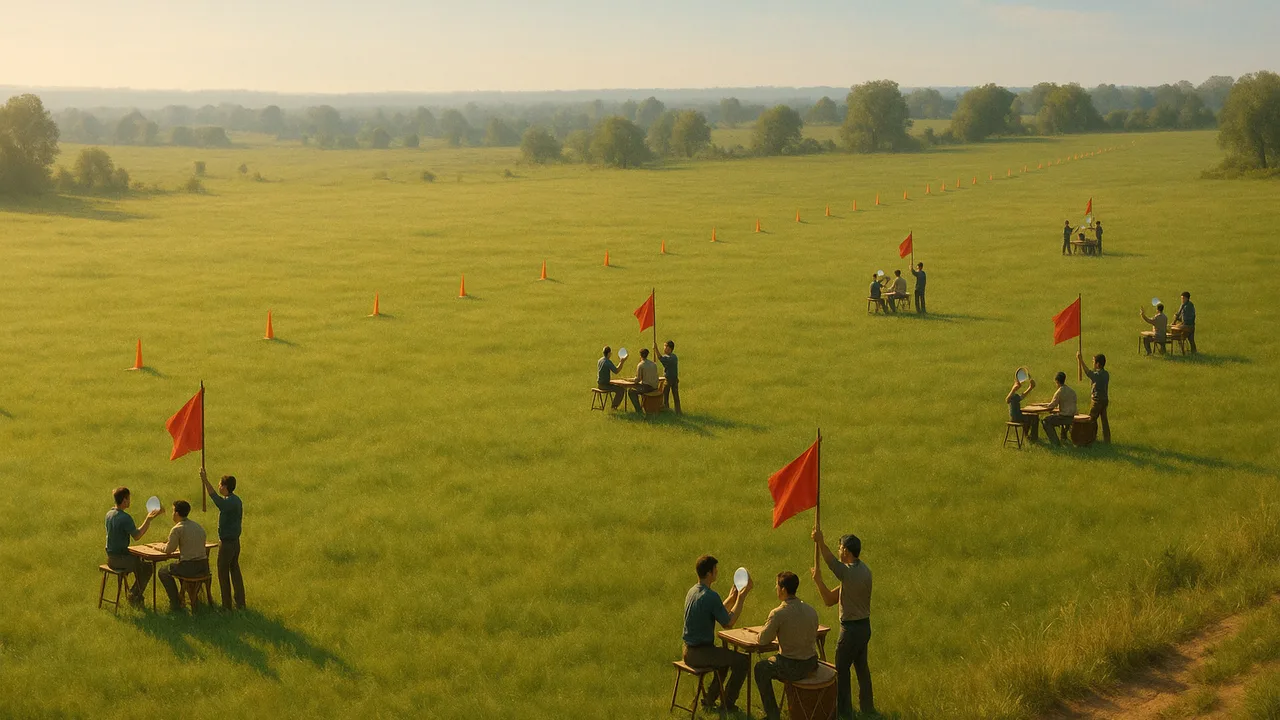
test every team’s signal code for accuracy and speed in a fair field test, and use the data to compare the solutions.
- I can test each solution in different situations and collect data to see how well it meets the criteria and constraints.
- I can use the data I collected to compare how well each solution meets the criteria and constraints of the problem.
- I can compare my solutions to see which one meets the goals and follows the rules best.
Phase 5: Prove It
Warm-Up ~5 min
Junior engineers, it is test day. Before we go outside or into the gym, think about what makes a test fair. Every team should be tested the same way.
Which test is fair for comparing two teams' codes?
Instruction ~10 min
The field test. We will test every code in a big open space, like the playground or gym. A sender stands far away. A receiver stands at the other end. Other classmates make noise and move around, like a real field day crowd.
How the test works. The sender gets a secret card with five messages in a mixed-up order. They send each one with the team’s code. The receiver writes what they think each message is. A timer counts the seconds for all five. Then we check: how many were right?
| Team / code | Signal type | Messages correct (out of 5) | Time for 5 messages (seconds) | Works for someone who cannot hear well? (yes / no) |
|---|---|---|---|---|
Worked example 1: reading the data. Mei’s light code got 5 out of 5 correct in 40 seconds. Malik’s flag code got 4 out of 5 correct in 30 seconds. Which is better? It depends on the criteria. For “Stop, we need help,” being correct matters most. So the light code may be the better choice for that message.
Worked example 2: change the situation. Engineers test in more than one situation. Ava’s team tried their light code in bright sun. The flashes were harder to see! Then they tried a flag in bright sun. The flag was easy to see. A cloudy or bright day can change which code works best. That is useful data, not a failure.
Compare the patterns. After the test, look across the class table. Which codes used light? Which used motion? Which used long and short signals? Look for what the most accurate codes have in common.
Guided Exercises ~15 min
Use the class data table to answer these as a team. The Reporter will share one answer with the class.
Independent Practice ~10 min
Now compare on your own.
Compare your team's code with one other team's code. Name one thing that is the same about the patterns and one thing that is different. Which meets the criteria and constraints better for field day, and why? Use your data.
Closure ~5 min
You tested every code the same way and collected real data. Next lesson, you present your best plan to the field day organizers.
Exit ticket: what do the most accurate codes in our class have in common? Name the pattern.
Teacher notes
Materials: each team’s signal tool and code key, secret message cards (5 messages, shuffled), stopwatches, cones to mark sender and receiver spots, a class data table on chart paper.
Setup: mark the same distance for every team. Assign crowd roles to teams that are not testing. If you go outside, test light codes in both sun and shade if time allows.
Listen for: “fastest wins” (weigh accuracy and the client’s needs too); teams that blame the receiver instead of looking at the pattern.
Support / stretch: pair a strong reader with each Recorder. Stretch: ask teams to graph accuracy for every code as a bar chart.