1.18 Peer Critique: I Like, I Wonder, What If
give and get kind, specific feedback on our prototypes and use it to find the parts that do not meet our criteria and constraints.
- I can share my ideas and findings about design solutions with others to help create more possible solutions.
- I can describe how I will collect evidence about how well my model or prototype meets the criteria and constraints.
- I can identify and describe specific parts of my model or prototype that do not meet the criteria or constraints.
- I can explain which parts of my model or prototype could be improved to better meet the criteria and constraints.
Phase 4: Build
Warm-Up ~5 min
Do Now. Read these two comments about a machine. Which one helps the team more?
Which comment is the most helpful feedback?
Instruction ~10 min
Junior engineers, real engineers share their work early. Other people see things we miss. Today teams trade places and give feedback. Feedback is helpful comments about how to make something better.
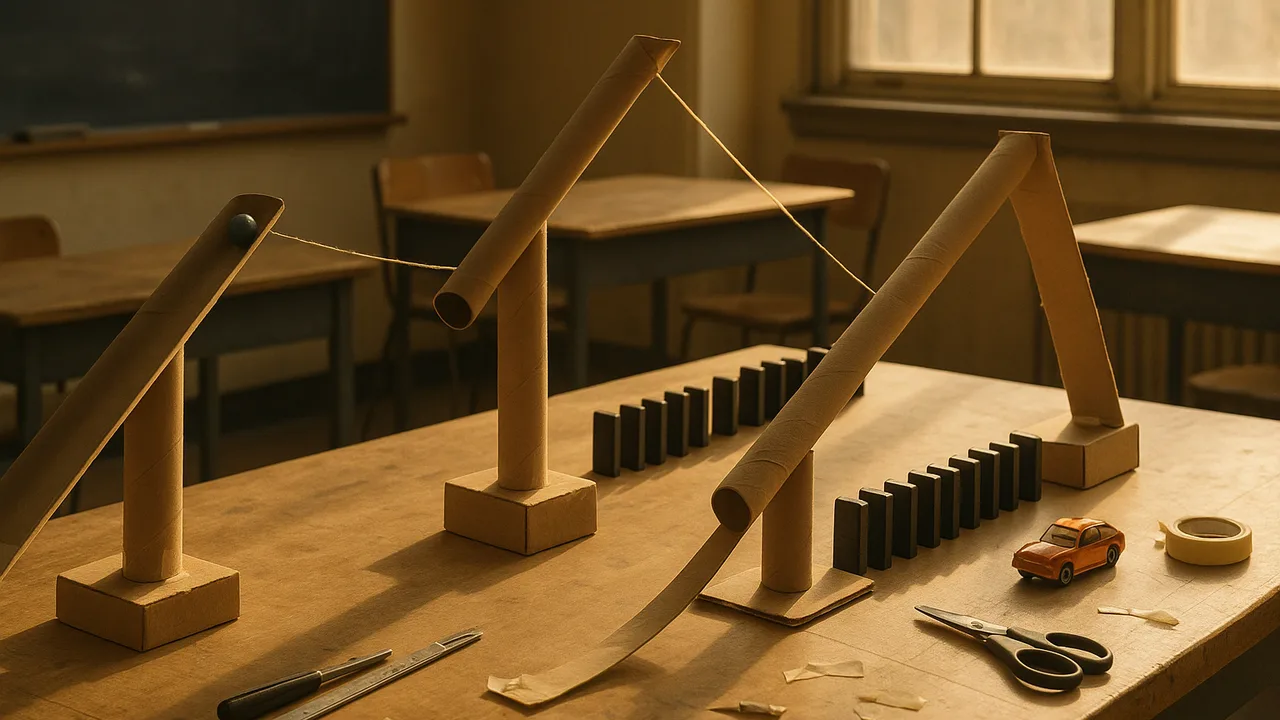
The protocol. One team runs its machine once. The visiting team watches closely for 3 minutes. Then the visitors give feedback for 3 minutes using three starters: I like…, I wonder…, and What if…. The builders only listen and write. Then the teams switch.
Watch for evidence. As you watch, check each criterion and constraint. Did energy pass along 4 or more times? Did the bell ring? Were the materials from the classroom? Where did it slow down or stop? Your notes are evidence that helps the builders find what to improve.
Worked example 1: Malik’s notes. Malik watched Ava’s machine. He wrote: “I like how the marble hits the first domino every time. I wonder if the car is too far from the bell, because it stopped just short. What if you moved the bell 5 cm closer?” Each comment points to a real part of the machine.
Worked example 2: Ava’s team sorts the feedback. Ava’s team got four comments. Two were about the car and the bell. That told them the car-to-bell transfer was the part that did not meet the criteria. They chose to fix that part first.
| Criterion or constraint | Met? (yes / no) | What I saw (evidence) |
|---|---|---|
| 4 or more energy transfers | ||
| Bell rings | ||
| Classroom materials only | ||
| Looks quick to set up |
Guided Exercises ~15 min
Practice the protocol before the real critique.
Independent Practice ~10 min
After the critique, sort what you heard.
List the feedback your team got. Circle the comment that points to the part that most needs to improve. Which criterion or constraint does that part not meet?
Write the feedback you gave another team. Was it kind, specific and helpful? How could it help them make a new solution?
Closure ~5 min
Feedback is a gift, junior engineers. Next time, we check what we know so far before we revise.
Exit ticket: what is the one part of your machine your team will fix first? What evidence tells you it needs fixing?
Teacher notes
Materials: each team’s prototype, the feedback table, a timer, sticky notes for comments.
Setup: pair teams ahead of time. Time it strictly: 1 minute to run, 3 to watch and note, 3 to give feedback, then switch.
Listen for: vague praise (“cool”); comments about decoration instead of energy transfers; builders defending instead of listening.
Support / stretch: give sentence-starter cards with blanks. Stretch: ask visitors to tie each “What if” to a science idea, like speed and energy.