1.07 Circuit Clues: Following Electric Current
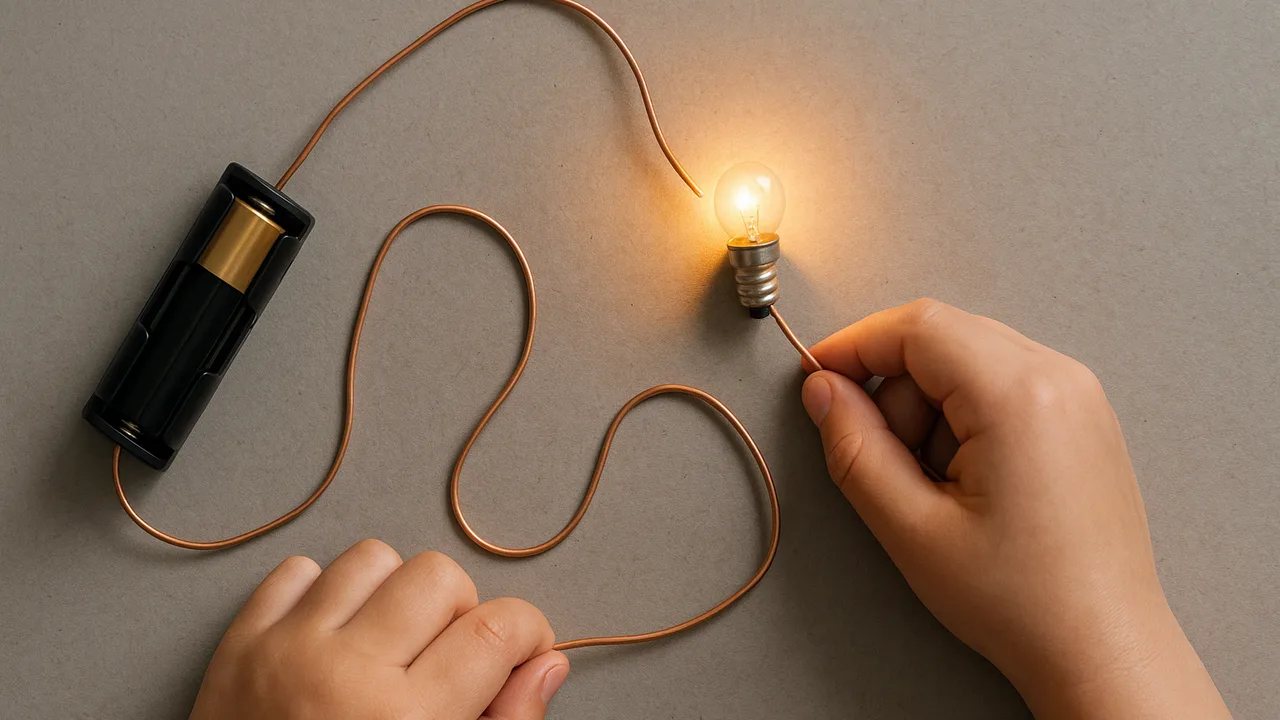
build a simple circuit and observe electric current carrying energy to make light, heat, sound or motion.
- I can describe what data we need to collect, like how objects move and collide before and after they interact.
- I can explain how to look for changes in sound, light, or heat before and after something happens.
- I can describe how to check for electric currents in wires and see how they connect one kind of energy to another, like turning on a light bulb.
- I can describe how I will observe and record data about how objects move and collide, including any sound or heat that happens.
- I can explain how to use tools and methods to find energy in the form of sound, light, or heat moving from one place to another.
- I can describe how to observe electric currents in wires and see energy like sound, light, heat, or motion caused by the current.
- I can make and record observations to show that energy is present when there are moving objects, sound, light, or heat.
- I can make and record observations to show that energy has moved from one place to another, like when a light bulb turns on or a ball starts moving after being hit.
Phase 2: Investigate
Warm-Up ~5 min
Do Now. The flashlight at our station lit up when the switch was on. But what was happening inside? Draw what you think is inside a flashlight.
You have a battery, two wires and a bulb. What do you need to make the bulb light?
Instruction ~10 min
Junior engineers, explore the loop. Each team gets one AA battery in a holder, two wires with clips, and a small bulb in a holder. Try to make the bulb light. Then try these changes, one at a time.
- Unclip one wire. What happens?
- Add a foil switch: two foil strips with a gap. Press them together.
- Touch the bulb gently after 30 seconds. Is it warm?
- If your teacher has one, swap the bulb for a small buzzer or motor.
| Test | Loop open or closed? | What happened? | Energy came out as (light / heat / sound / motion) |
|---|---|---|---|
| Bulb, both wires clipped | |||
| One wire unclipped | |||
| Foil switch pressed | |||
| Bulb after 30 seconds (touch) | |||
| Buzzer or motor (if available) |
Now we name it. A circuit is a closed loop. Electric current carries energy from the battery through the wires. At the bulb, the energy comes out as light and a little heat. A switch opens or closes the loop. We cannot see current. But we see what it does at the end of the wire.
Worked example 1: the missing clip. Jamal’s bulb would not light. He traced the loop with his finger: battery, wire, bulb, wire… and the second clip was loose. He clipped it, and the bulb lit. The loop was closed.
Worked example 2: one battery, different outputs. Mei’s team used the same battery three ways. With a bulb, they saw light. With a buzzer, they heard sound. With a small motor, a paper flag spun. The current carried energy each time. The part at the end decided what the energy did.
Guided Exercises ~15 min
Use your circuit table to answer these.
Independent Practice ~10 min
Explain your best observation.
What observation shows that energy moved from the battery to the bulb? Describe before and after.
Closure ~5 min
Electric current carries energy through a closed loop. Next time, we ask a bigger question: where does the energy for our school’s lights come from?
Exit ticket: what is the difference between an open circuit and a closed circuit?
Teacher notes
Materials (per team): one AA battery in a holder, two alligator clip wires, a small flashlight bulb in a holder or an LED, aluminum foil, an index card, tape. Optional: a small buzzer and a toy motor.
Setup: pre-build one working circuit to show. Check holders before class. LEDs only light one way round; flip them if they stay dark.
Listen for: “the battery has electricity inside that gets used up” (it stores energy that current carries); “current flows only to the bulb” (it flows around the loop). Avoid coin cells; they are a swallowing hazard.
Support / stretch: give a picture of a working circuit to copy. Stretch: add a second bulb and compare brightness.