1.10 Crash Course: Speed and Energy
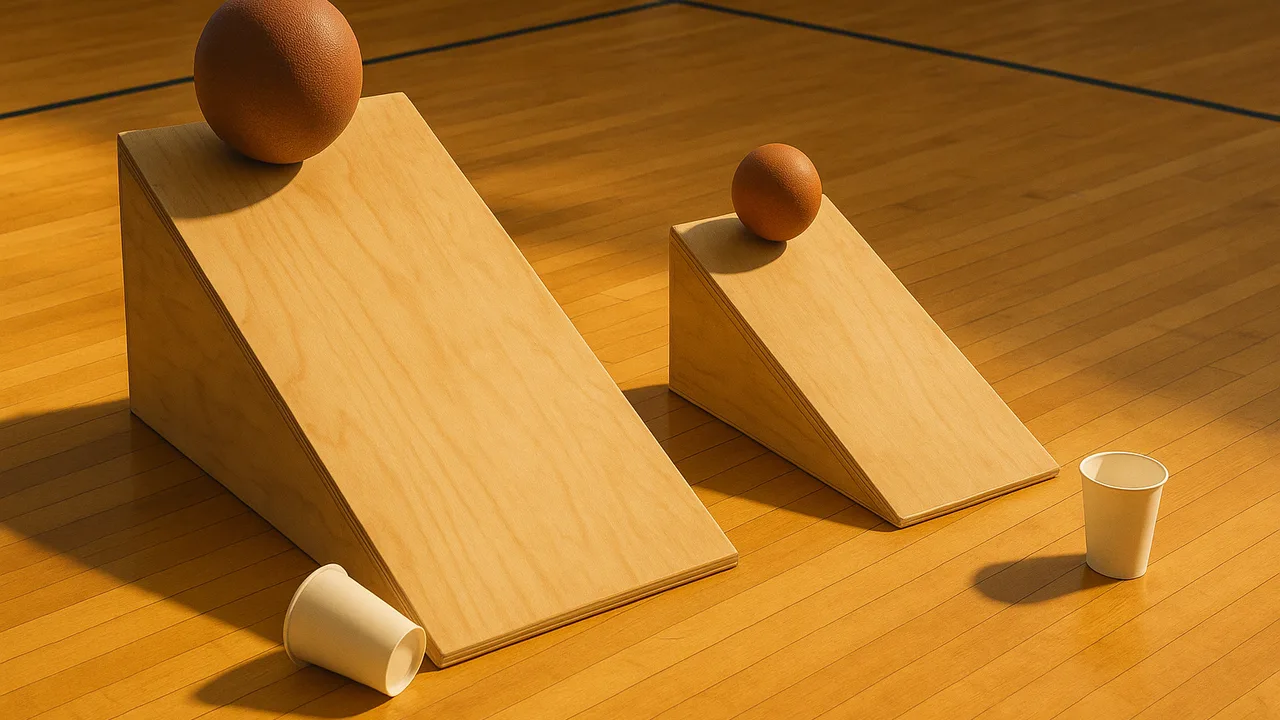
use our ramp and collision data to explain, in a CER, how an object’s speed is related to its energy.
- I can use evidence and my own thinking to explain how the speed of an object is related to its energy.
- I can explain that how an object moves can show how much energy it has.
- I can describe how a faster-moving object can make a bigger impact, like making more noise or moving another object farther.
- I can use evidence to show that because faster objects have a bigger effect on their surroundings, they have more energy from moving.
Phase 3: Make Sense
Warm-Up ~5 min
Do Now. Look at the class chart of everyone’s ramp middle values. Find the pattern with a partner.
What does the class chart show?
Instruction ~10 min
Now we can name what you found. The higher the ramp, the faster the marble was going at the bottom. The faster marble pushed the cup farther and made a louder sound. So a faster object has more energy. This energy of moving things is called motion energy.
Where did the speed come from? At the top of the ramp, the marble is sitting still. It has stored energy because it is up high. As it rolls down, stored energy changes into motion energy. A higher start means more stored energy, so more motion energy at the bottom. That is the roller coaster secret! The first hill gives the train its energy for the whole ride.
Worked example 1: the marble and the cup. Before the collision, the marble moves fast and the cup sits still. After the collision, the marble slows down and the cup slides. We hear a tap. A bigger slide and a louder tap are clues of more energy.
Worked example 2: a CER. Scientists explain with a Claim, Evidence, and Reasoning. Here is how Diego’s team wrote one.
- Claim: A faster marble has more energy.
- Evidence: From the 3-book ramp, the cup moved about 20 cm. From the 1-book ramp, it moved about 9 cm. The 3-book crash was louder.
- Reasoning: The taller ramp made the marble go faster. The faster marble moved the cup farther and made more sound. Making bigger changes takes more energy. So the faster marble had more energy.
Model it. Draw the ramp with three pictures: marble at the top, marble rolling, marble hitting the cup. Use arrows to show energy. Label each arrow: stored, motion, sound, or heat. A drawing like this is a model. It helps us see what we cannot see.
Guided Exercises ~15 min
Use your data and your model to answer these with your team.
Independent Practice ~10 min
Write your own CER. Use these sentence starters:
- Claim: I think that a faster object has ___ energy.
- Evidence: In our test, when the ramp was ___ books tall, the cup moved ___ cm. When it was ___ books tall, the cup moved ___ cm.
- Reasoning: This shows ___ because ___.
Write your CER: how is the speed of the marble related to its energy? Use numbers from your own table.
Closure ~5 min
You turned your data into an explanation, just like real scientists. Next time, we model all the ways energy moved at our stations and in our circuits.
Exit ticket: a slow car and a fast car each hit a block. Which probably moves the block farther, and what does that tell you about its energy?
Teacher notes
Materials: the class chart of middle values, the ramps from 1.03, chart paper and markers for models, devices for the PhET sim (it also runs well as a whole-class demo on one screen).
Setup: post the CER sentence starters. Keep the class chart visible.
Listen for: “the taller ramp made the marble heavier” (mass stayed the same; speed changed). Keep 4-PS3-1 qualitative; no equations.
Support / stretch: let some students give evidence as “far / farther” with a labeled drawing. Stretch: in the sim, add friction and explain why the skater stops climbing as high.