1.11 Energy Paths: Modeling Where Energy Goes
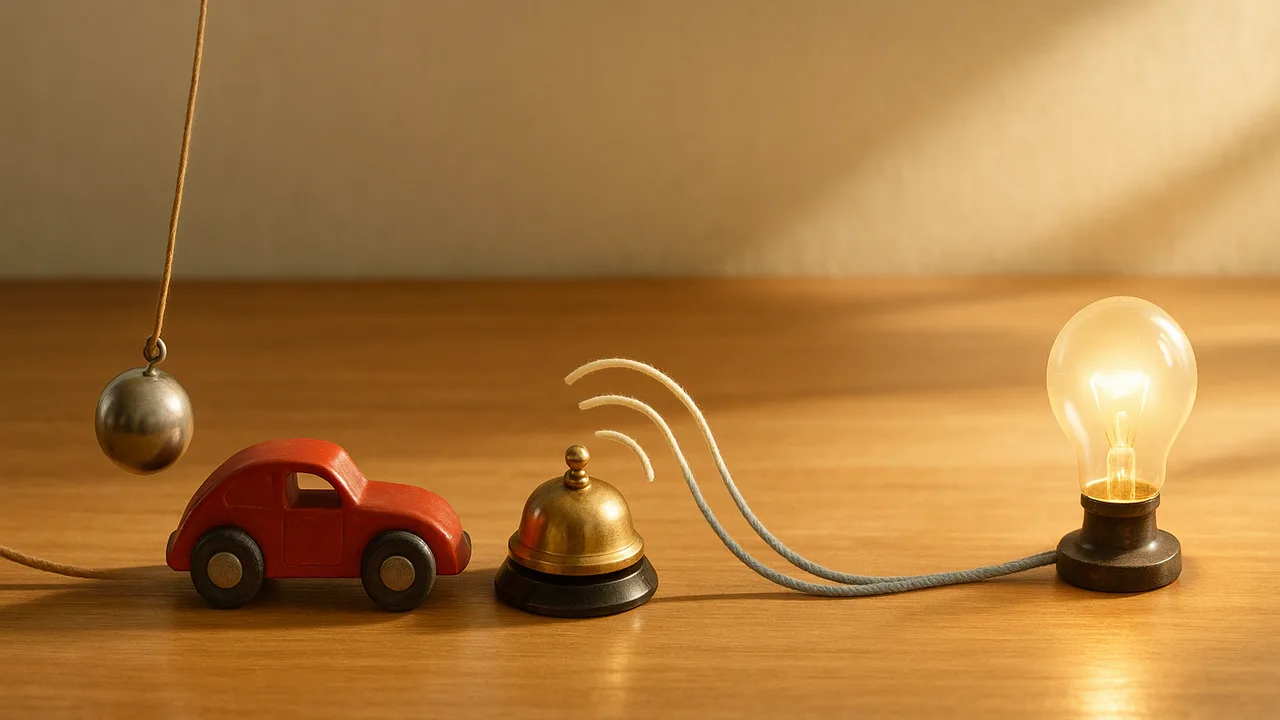
draw energy-path models that show energy moving from place to place by motion, sound, light, heat and electric current.
- I can explain how energy moves when objects collide, when light or sound travels, when electric currents make things happen, and when heat passes from one object to another.
- I can describe how motion, sound, heat, or light can change into a different type of energy after things interact, like when a moving ball hits another ball or when a sound makes something move.
- I can explain how my observations will help show that energy can move from place to place by sound, light, heat, or electric currents, like when a moving object turns on a light or when shining a light warms something.
Phase 3: Make Sense
Warm-Up ~5 min
Do Now. Look at your station notes and circuit drawing. Circle every place where energy moved from one thing to another.
A drum is hit and nearby rice jumps. Which path shows the energy?
Instruction ~10 min
Junior engineers, let’s make energy visible. We cannot see energy. But we can draw where it goes. An energy path is a model. It uses boxes for objects and arrows for energy moving between them. We label each arrow with how the energy moved.
Reading-like explanation: five ways energy travels. Energy moves from place to place in five ways you have seen. Moving objects carry it, like the marble that pushed the cup. Sound carries it through the air as vibrations, like the click that reached your ears. Light carries it, like sunlight warming dark paper. Heat moves it from warmer things to cooler things, like warm hands melting ice. Electric current carries it through wires, like the battery lighting a bulb. Energy often moves in more than one way at once. A glowing bulb sends out light and heat. A crash sends energy into the other object and into the air as sound.
Worked example 1: the flashlight path. Battery → (electric current) → bulb → (light) → wall. A second arrow: bulb → (heat) → air. Two arrows leave the bulb because energy went two ways.
Worked example 2: the sunny paper path. Sun → (light) → dark paper → (heat) → your hand. Mei’s evidence: the dark paper felt warmer after 5 minutes in the light than it did before.
Your turn. Pick three of our investigations and draw a path for each. Then add the evidence that proves each arrow.
| Investigation | Energy path (boxes and arrows) | Evidence for each arrow |
|---|---|---|
Guided Exercises ~15 min
Build and check energy paths with your team.
Independent Practice ~10 min
Model a path from real life.
Draw an energy path for a doorbell or a phone speaker. Label every arrow and give one observation as evidence.
Closure ~5 min
Energy paths make the invisible visible. Next time, we zoom in on the crashes in our machine.
Exit ticket: name the five ways energy can move, and give one example of any two.
Teacher notes
Materials: station notes from 1.04, circuit drawings from 1.07, test results from 1.05, chart paper, colored markers (one color per kind of arrow), devices for the sim.
Setup: model one path on the board first. Teams share one path in a gallery walk.
Listen for: arrows pointing the wrong way (from the bulb into the battery); “the energy is gone” at the end of a path (it spread out as heat or sound).
Support / stretch: give pre-drawn boxes and arrow-label stickers. Stretch: draw the whole chain-reaction plan as one long path.