1.03 Ramp Lab: How High, How Fast, How Far?
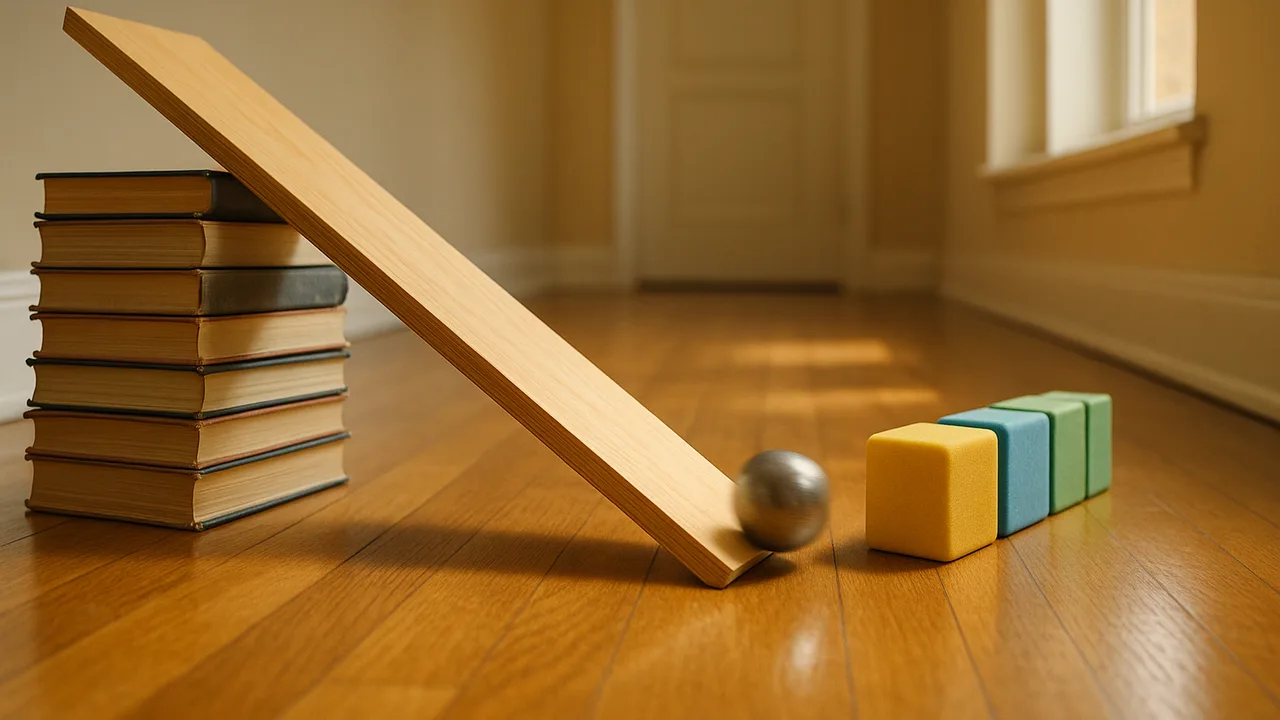
test how ramp height changes a ball’s speed and energy, and list our machine’s criteria and constraints.
- I can explain that how an object moves can show how much energy it has.
- I can describe how a faster-moving object can make a bigger impact, like making more noise or moving another object farther.
- I can use evidence to show that because faster objects have a bigger effect on their surroundings, they have more energy from moving.
- I can describe how many times I will do the experiment, what things I will keep the same, and how I will set it up.
- I can describe the limits on my design, such as how much it costs, what materials I can use, or how much time I have.
Phase 2: Investigate
Warm-Up ~5 min
Do Now. Today you explore first. We will name the big ideas later. Look at a ramp made of a ruler or folder. A paper cup sits on its side at the bottom. A marble will roll down and push the cup. Make a prediction.
If we make the ramp taller, what happens to the cup?
Instruction ~10 min
Junior engineers, today you are testers. A good test is a fair test. We change only one thing: the ramp height. Everything else stays the same. Same marble. Same cup. Same starting spot at the top of the ramp. Same floor.
How to run the ramp test. Stack books to make the ramp. Start with 1 book, then 2, then 3. Set the cup at the bottom with its open side facing the ramp. Let the marble go. Do not push it! Measure how far the cup slides, in centimeters. Do 3 trials at each height. That gives 9 trials in all.
Why 3 trials? Each trial can be a little different. The marble might wobble once. Three trials help us trust the pattern. To find the middle value, put the three numbers in order and pick the middle one.
| Ramp height | Trial 1 (cm) | Trial 2 (cm) | Trial 3 (cm) | Middle value (cm) | Speed at the bottom (slow / medium / fast) | Sound when it hit? (quiet / loud) |
|---|---|---|---|---|---|---|
| 1 book | ||||||
| 2 books | ||||||
| 3 books |
Worked example 1: reading sample data. Priya’s team tested a different marble. At 1 book, the cup moved 8, 10, and 9 cm. In order, that is 8, 9, 10. The middle value is 9 cm. At 3 books, the cup moved 21, 19, and 20 cm. The middle value is 20 cm. The 3-book marble looked faster, too. The faster marble pushed the cup farther. These are sample numbers. Your data will be your own.
Worked example 2: clues of energy. Jamal’s team noticed more than distance. The 3-book crash made a loud clack. The 1-book crash made a soft tap. Sound, motion and a bigger push are all clues. They tell us how much energy the marble had when it hit.
Define the problem. Engineers list criteria, the things a design must do. They also list constraints, the limits they must work within. Our criteria: pass energy at least 4 times and ring the bell. Our constraints: classroom materials only, and setup in 40 minutes. These limits fit what our client needs right now, for this year’s Family Science Night.
Guided Exercises ~15 min
Use your team’s data table to answer these. The Recorder reads the numbers out loud.
Independent Practice ~10 min
Look at your own team’s data table.
What pattern do you see between ramp height and how far the cup moved? Use numbers from your table.
List one more criterion or constraint you think our client would want. Is it something the machine must DO, or a LIMIT?
Closure ~5 min
You collected real data, and you saw clues of energy: motion, distance and sound. Next time, we visit energy stations to find energy that is not rolling at all.
Exit ticket: name one criterion and one constraint for our chain-reaction machine, and one thing we kept the same in the ramp test.
Teacher notes
Materials (per team): a ruler with a groove or a folded file folder as a track, 3 same-size books, one marble, one paper cup with a door cut in the rim, a meter stick or ruler, masking tape to mark the start line.
Setup: tape a start mark on each ramp and a cup mark at the bottom. Post a class chart for each team’s middle values.
Listen for: “Heavier balls always go faster” (we hold the marble the same today); “the energy is used up” (it moves into sound, heat, and the cup). Hold back the words stored energy and motion energy until 1.10; students have data first.
Support / stretch: pre-print the table and let some students record “short / medium / far” instead of centimeters. Stretch: test a 4-book ramp and predict the result first.