1.14 Ideate: Dream Up Our Chain-Reaction Machine
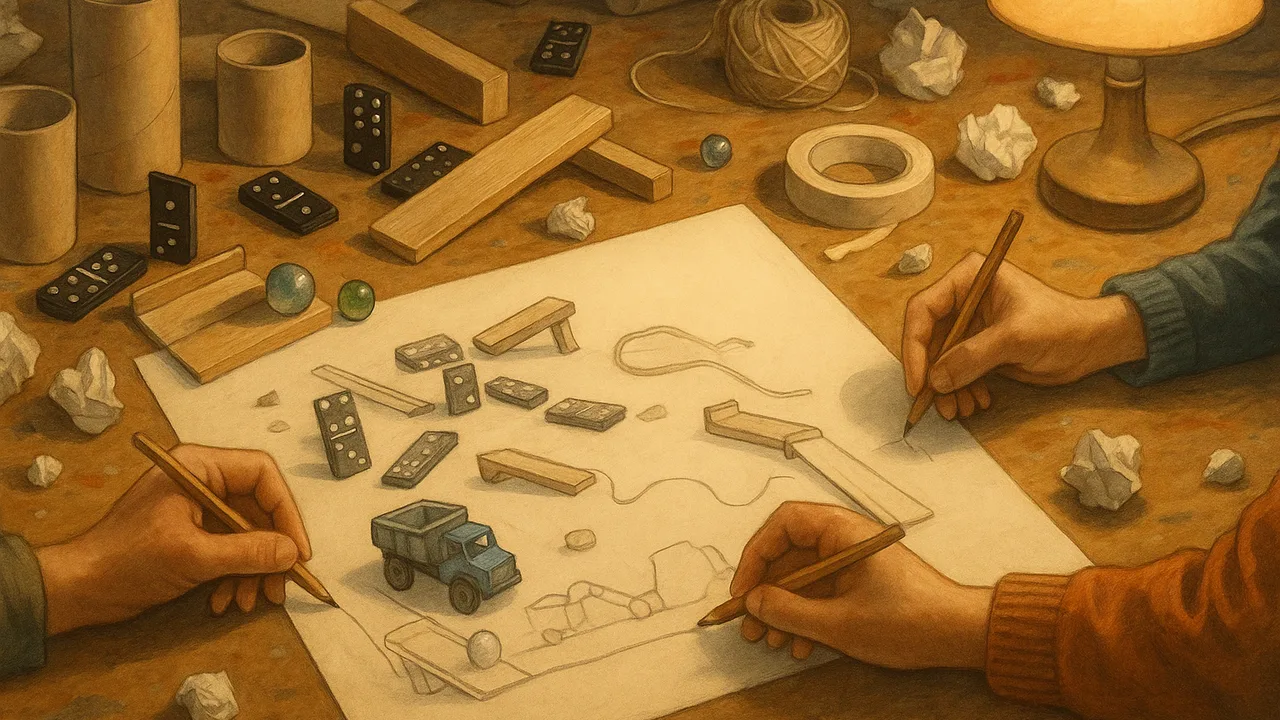
use what we know about energy to brainstorm machine ideas that fit our client’s criteria and constraints.
- I can list the features that a solution must have to solve the problem.
- I can define the limits for solving a problem, making sure it is about something people need or want right now.
Phase 3: Make Sense
Warm-Up ~5 min
Do Now. The kindergarten teacher sent a note: “The kids loved the flashlight station when they visited! Could the machine light up too?” Our client’s wants just grew again.
Is “light up” a new criterion or a new constraint?
Instruction ~10 min
Junior engineers, it is time to ideate. To ideate means to come up with many ideas. Good ideas are grounded in science. Everything we figured out becomes a design tool.
Reading-like explanation: our science toolbox. A higher start gives more stored energy, so a faster marble with more motion energy. Every collision passes energy along but loses some to sound and heat. Dominoes spaced too far apart cannot reach each other. A falling object can press a foil switch and close a circuit, so electric current lights a bulb. The bell is an energy changer: motion goes in, sound comes out.
Check the limits first. Our criteria: pass energy at least 4 times, ring the bell. A possible bonus criterion from the client: light up. Our constraints: classroom materials only, set up in 40 minutes, and safe near five-year-olds. These limits are about what our client needs right now, for this Family Science Night.
Worked example 1: an idea with its science. Priya sketched: marble down a 3-book ramp → 8 dominoes → toy car → bell. Science: the tall ramp gives a strong start, dominoes pass energy, the car carries it to the bell.
Worked example 2: checking against limits. Diego dreamed of a water wheel. Cool! But water near the kindergartners is a safety risk, and filling it takes time. It breaks two constraints. He kept the idea in his notebook for later and sketched a pinwheel turned by a falling book instead.
Brainstorm rules. Go for many ideas. Build on others’ ideas. No put-downs. Every idea names its science. Then each team picks two favorites to carry into the Build phase.
| Idea sketch | Energy science that makes it work | Meets criteria? (4 transfers / bell / light) | Meets constraints? (materials / 40 min / safe) |
|---|---|---|---|
Guided Exercises ~15 min
Brainstorm and check ideas with your team.
Independent Practice ~10 min
Sketch your own ideas.
Brainstorm at least 3 ideas for our chain-reaction machine. For each one, name the science that makes it work and one constraint it meets.
How confident are you that you can I can list the criteria and constraints for our machine.
Closure ~5 min
Our ideas are ready, and they are grounded in science. Next: your 3DX field trip along an energy trail, and then the Build phase begins.
Exit ticket: which idea is your favorite? Name one criterion it meets and one constraint you need to watch.
Teacher notes
Materials: sketch paper, sticky notes, all data and models from 1.03–1.13, the client note (write it yourself or ask the kindergarten teacher).
Setup: run a 6-minute silent sketch, then a 6-minute “Yes, and” round. Each team keeps two ideas for Build (part 2 compares them against criteria).
Listen for: ideas with no science named; ideas needing outlets or water. Gently redirect to the constraints.
Support / stretch: give a menu of parts with their science. Stretch: add a second energy changer and predict where energy loss is biggest.