1.01 The Mystery of the First Hill
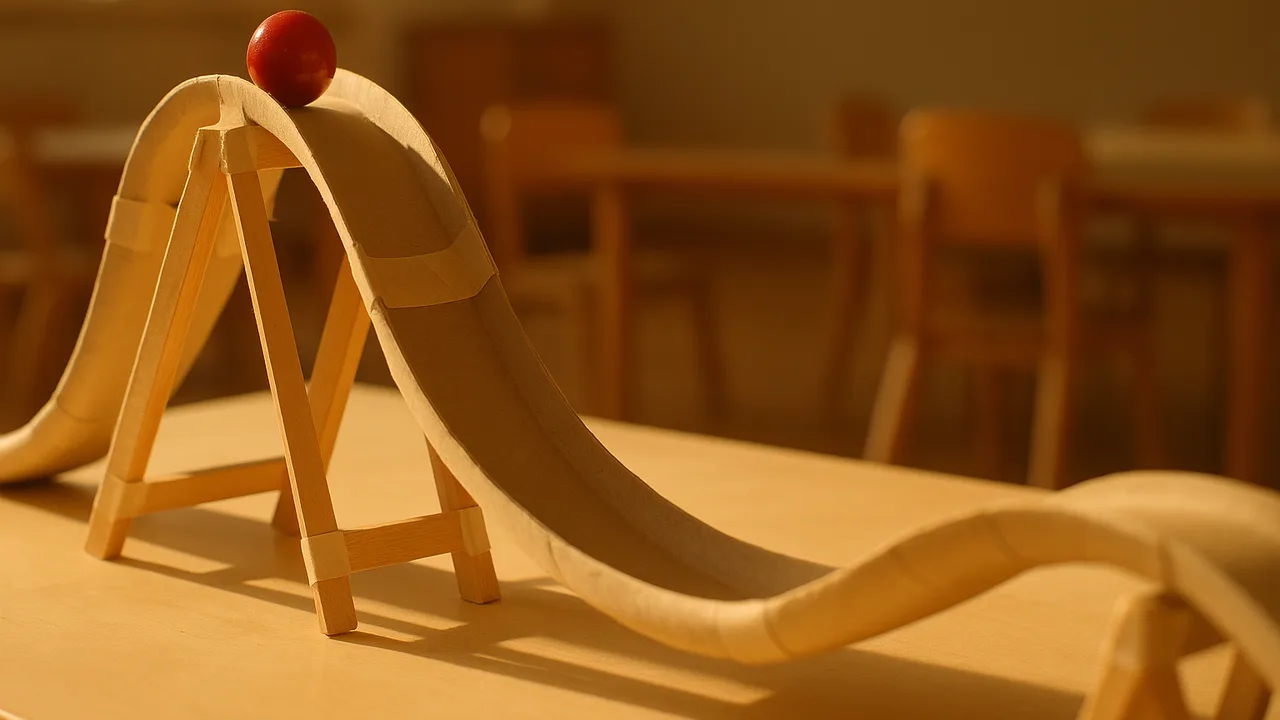
The Chain-Reaction Machine for Family Science Night
How can we build a machine that passes energy along at least four times to ring a bell?
The mystery: On a classic roller coaster, the first hill is the tallest point of the whole ride. The train is pulled up only once, so why can’t any hill after it be taller?
Questions we will figure out together in this unit:
- Why is the first hill of a coaster the tallest point?
- Does a ball rolling down a taller ramp go faster?
- Where does the energy go when two things crash?
- Can energy move as sound, light, or heat?
- How can we make a bell ring without touching it?
- Why do domino lines sometimes stop in the middle?
- Where does the energy for the school bell and lights come from?
- How do machines change one kind of energy into another?
explain the problem our kindergarten client needs us to solve and tell how a moving object shows that it has energy.
- I can use information I am given to explain a problem that comes from something people need or want.
- I can explain that when an object moves faster, it has more energy.
Phase 1: Spark
Warm-Up ~5 min
Do Now. Picture a roller coaster. A chain pulls the train slowly up the first big hill. Click, click, click. Then the train rushes down and races over the next hills. Many families in our area have ridden coasters at a big amusement park. Here is the strange part. On a classic coaster, the first hill is the tallest point of the ride. Make a guess before we learn anything new.
A coaster train is pulled up the first hill only once. Could the next hill be taller than the first one?
Instruction ~10 min
A message from our client. The kindergarten class and their teacher need our help. Family Science Night is coming soon. They want an exhibit that will make families say “Wow!” They asked for a chain-reaction machine. That is a machine where one thing pushes the next thing, over and over. At the very end, a bell rings.
Junior engineers, here is your mission. Build a machine that passes energy along at least four times and rings a bell. It must be made from classroom materials. It must be set up in 40 minutes, because that is how long we have before families arrive.
What is energy? Energy is what makes things move, light up, warm up, or make sound. We cannot see energy itself. But we can see what it does. A rolling ball has energy because it is moving. It can knock over a block. A ringing bell has energy, too. You can hear it.
Worked example 1: two rolling balls. Ava rolls a ball slowly at a block tower. One block wobbles. Jamal rolls the same ball fast. Three blocks fall over. Which ball had more energy? Jamal’s ball did. It was moving faster, and it made a bigger change. Faster moving objects have more energy.
Worked example 2: a domino line. Mei tips the first domino in a line of ten. Each domino falls and hits the next one. Energy moves from domino to domino down the line. Each time energy moves from one object to another, we call it an energy transfer. Mei’s line made nine transfers, because ten dominoes have nine places where one hits the next.
Back to the coaster. The first hill is where the train gets its energy. A motor and chain lift it up. After that, no motor pushes it. The train just uses the energy it got from that first hill. Our machine will work the same way. Its first push has to be big enough to last all the way to the bell.
Our teams. You will work in teams of four. Roles rotate every lesson, so everyone tries each job. The Materials Manager gets and returns supplies. The Recorder writes data in the notebook. The Tester runs each trial. The Reporter shares the team’s ideas with the class.
Guided Exercises ~15 min
Work through these with your team. Use the arrows to move from one to the next. Talk before you tap an answer.
Independent Practice ~10 min
On your own, add to our class Wonder Board.
Write one question you wonder about energy, coasters, or chain-reaction machines. Put it on a sticky note for the Wonder Board.
How confident are you that you can I can explain how a moving object shows it has energy.
Closure ~5 min
Today we met our client and our mission. We learned that faster objects have more energy, and that energy can move from one object to another. Next time, we will sort our Wonder Board and get our teams ready.
Exit ticket: in your own words, what does our client need, and why is it a problem engineers can solve?
Teacher notes
Materials: a set of dominoes or small books per team, a ball, a few wooden blocks, sticky notes, chart paper for the Wonder Board. Optional: a short coaster video of your choice (no ride statistics needed). If possible, invite the kindergarten teacher to deliver the request in person or by a short note.
Setup: post the Wonder Board and the driving question where they stay all unit. Assign starting roles and post a rotation chart.
Listen for: “The train gets more energy going down” (it changes from stored to motion energy; it does not gain new energy). Some coasters dive into ravines or launch with motors, but on a lift-hill coaster no later hill top rises above the lift hill. Keep 4-PS3-1 qualitative; no equations.
Support / stretch: give a sentence frame (“Our client needs ___ because ___”). Stretch: ask why the dominoes stop if they are spaced too far apart.