1.24 Showtime: Family Science Night
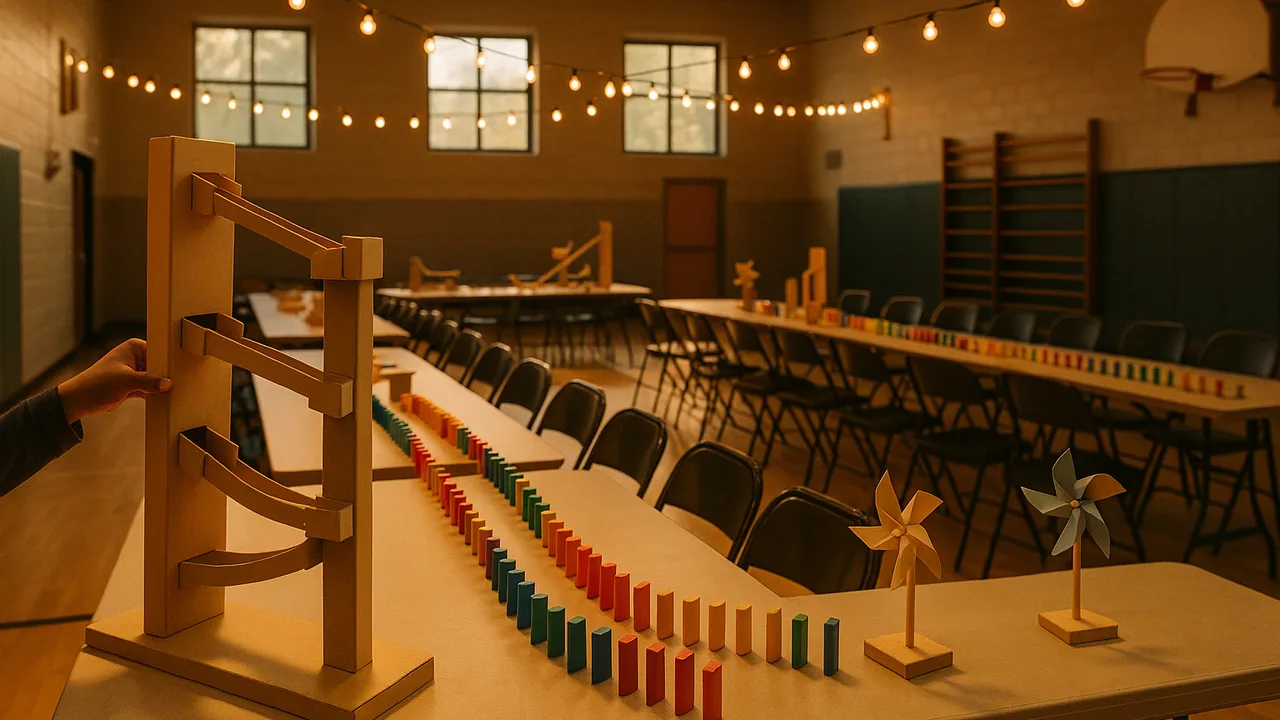
present our chain-reaction machine to our kindergarten client and families, and explain how energy moves at each step.
- I can test my device and use what I learn to fix problems or make it work better.
- I can share my ideas and findings about design solutions with others to help create more possible solutions.
Phase 5: Prove It
Warm-Up ~5 min
Do Now. Our audience is five and six years old. Read the sentences below. Which one would a kindergartner understand?
Which sentence is best for a kindergartner?
Instruction ~10 min
Junior engineers, it’s showtime! Tonight families visit our exhibit. Our kindergarten client gets to see the machine they asked for.
Your exhibit has three parts. 1. The working machine. 2. A poster with a numbered drawing of each energy transfer. 3. A short talk where every team member speaks.
Presenting to our client. Use short words. Point to each step as it happens. Say what energy is doing: “The marble rolls fast. It bumps the dominoes. Listen for the bell!” Let them count the transfers with you.
Worked example 1: Diego’s talk. “Look at the marble at the top. Watch it roll down fast. Bump! It hits the dominoes. Click, click, click. The last domino pushes the car. The car zooms and rings the bell. Ding! The bell changed moving energy into sound.”
Worked example 2: answering a grown-up. A parent asks, “How did you make it work every time?” Ava says, “At first our car fell off the track. We added pencil rails. Then the bell rang 3 times out of 3.” She used test data to explain the fix.
Share and borrow. Visit other exhibits when it’s not your turn. Write one idea you could use in a future design.
Guided Exercises ~15 min
Rehearse with your team before the families arrive.
Independent Practice ~10 min
After the show, reflect on the feedback from families.
What did the audience say or ask? Name one idea you saw at another exhibit that could make your machine better next time.
Project task: The Chain-Reaction Machine Exhibit
Test, revise and present your team’s chain-reaction machine at Family Science Night. Your exhibit includes the working machine, a simple poster and a short talk for the kindergarten class and families.
Submission workflow
- Run the test plan: time the setup and run the machine 3 times.
- Find the weak spot and make one revision. Test again and record the results.
- Make a poster with a numbered drawing of each energy transfer. Label your energy changer with the energy going in and coming out.
- Present to the kindergarten class and their families. Explain how the energy moves, step by step, until the bell rings.
How it is scored
| Criterion | What proficient looks like |
|---|---|
| Criteria and constraints | The machine makes 4 or more energy transfers, rings the bell, uses classroom materials, and sets up in 40 minutes or less. |
| Testing and revision | The team ran 3 recorded trials, named the weak spot, made one revision, and showed test data from before and after. |
| Energy science | The poster and talk correctly show energy moving between objects and name the energy changer’s input and output. |
| Communication | The talk uses simple words a kindergartner can follow, every team member has a speaking part, and the team shares one idea with or from another team. |
Closure ~5 min
You did it, junior engineers! You explained why a coaster’s first hill is the tallest point, tested how speed and energy are linked, and built a machine that passes energy along.
Exit ticket: what is one thing you would change if you built the machine again? Which question on our Wonder Board can you now answer?
How confident are you that you can I can test a design against its criteria and improve it.
Teacher notes
Materials: each team’s machine, poster paper and markers, a lidded box per team, table signs. Coordinate a time with the kindergarten teacher for a practice visit before Family Science Night.
Setup: use the first half of class for posters and a rehearsal. If Family Science Night is in the evening, run a classroom preview for the kindergarten class during the day and score the rubric then.
Listen for: talks that list objects but never say what the energy does; one student doing all the talking.
Support / stretch: give a presentation script with blanks. Stretch: prepare an answer to “Where does the energy go after the bell rings?” (into the air as sound, and a little heat).