2.05 Rope Waves and the Online Wave Lab
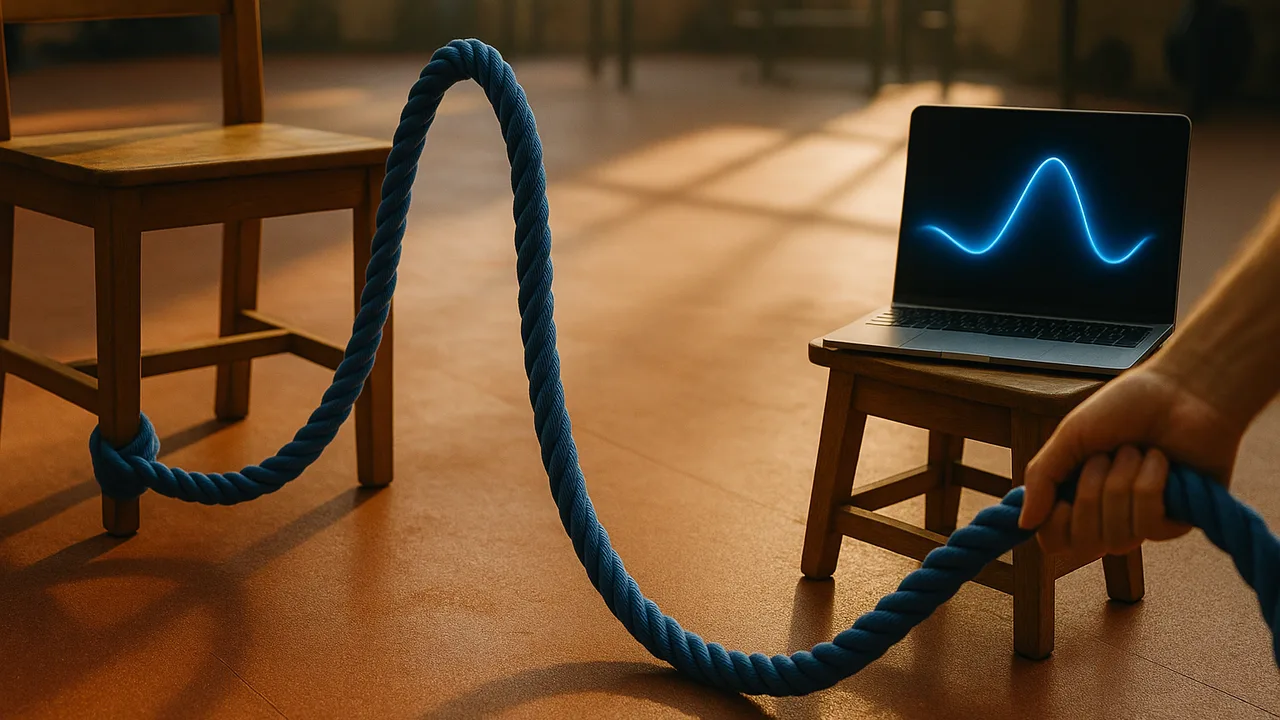
make rope waves and use an online wave model to compare waves with different heights and spacing.
- I can use my model to show that waves of the same kind can have different amplitudes and wavelengths, and explain how this changes how much an object moves.
- I can compare waves to find patterns and use those patterns to explain how amplitude and wavelength affect how much an object moves.
Phase 2: Investigate
Warm-Up ~5 min
Look back. Open your slinky table. Which shake made the tallest bumps? Which made the closest bumps?
Write one sentence about tall bumps and one about close bumps from your slinky data.
Instruction ~10 min
Rope waves. Now try a longer, heavier model. Tie one end of a jump rope loosely to a chair leg. The Tester holds the other end and kneels so the rope lies on the floor. Tape a paper flag to the middle of the rope.
- Flick the rope up once. Watch one bump travel to the chair.
- Shake it up and down with small, slow moves. Then big, slow moves.
- Shake it with small, fast moves.
- Each time, watch the flag. How far up and down does it move?
| Rope shake | Bump height (small / big) | Bump spacing (close / far) | How far did the flag move up and down? |
|---|---|---|---|
| One flick | |||
| Small, slow | |||
| Big, slow | |||
| Small, fast |
Worked example 1: the same pattern again. Ava compared her rope table with her slinky table. In both, bigger hand moves made taller bumps. In both, faster shakes made closer bumps. She wrote, “Rope and slinky follow the same pattern.” Finding the same pattern in two models makes our evidence stronger.
Worked example 2: watching the flag. Jamal saw the flag go up high and down low for the big shake. For the small shake, it barely moved. Taller waves moved the flag farther. That is a cause and an effect.
The online Wave Lab. A computer model lets you control the wave exactly. In the sim, a string moves when one end wiggles. You can set how big the wiggle is and how fast it repeats. Beads on the string show how each part moves.
Guided Exercises ~15 min
Open the sim and work with a partner. Then answer the questions.
Independent Practice ~10 min
Use what you found.
Two waves pass a paper flag on a rope. Wave 1 has tall bumps. Wave 2 has short bumps. Predict which moves the flag more, and use your data to say why.
How confident are you that you can I can compare waves and tell how their height changes how much an object moves.
Closure ~5 min
Three models, one pattern. Taller waves move things farther. Faster waves have closer bumps. Next lesson, we see if waves can push real objects.
Exit ticket: why do scientists like to test an idea with more than one model?
Teacher notes
Materials: jump ropes or 3 m lengths of soft rope, paper flags and tape, chairs, devices with the PhET Wave on a String sim (https://phet.colorado.edu/sims/html/wave-on-a-string/latest/wave-on-a-string_en.html). Rotate team roles today: Materials Manager, Recorder, Tester, Reporter. Each person gets a new job.
Setup: load the sim before class. Run rope stations in the hall or gym if floor space is tight. Teams rotate between rope and sim.
Listen for: “the bead moves to the end” (it moves up and down); confusing a faster wave with a taller one. Students may notice the sim has damping and tension settings; tell them to leave those alone today.
Support / stretch: model sim steps on the board. Stretch: in the sim, keep the wiggle size the same and change only the speed. Does the bead move farther, or just more often?