1.23 Test Day: Our Machine vs. the Criteria
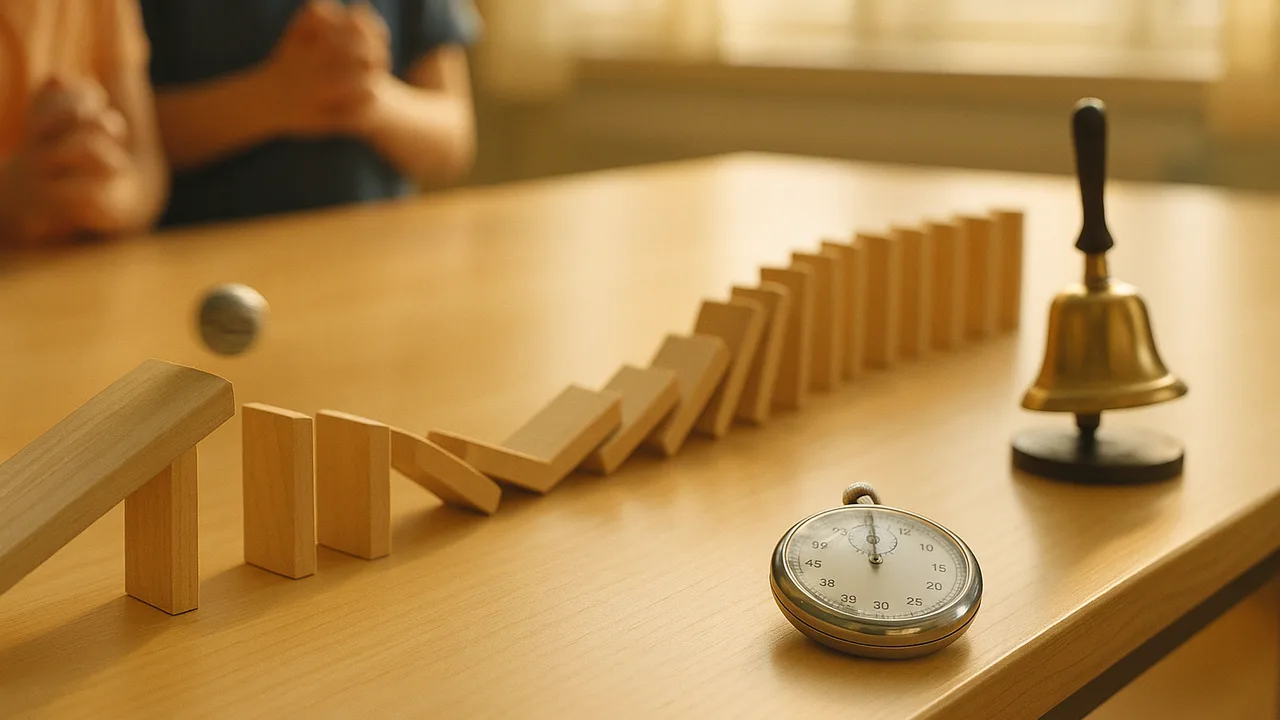
carry out our test plan, compare the results with every criterion and constraint, and revise our machine once.
- I can carry out my investigation and collect and record data by following my plan.
- I can check if my device meets the goals and follows the rules for materials and safety.
- I can use the data I collected to compare how well each solution meets the criteria and constraints of the problem.
Phase 5: Prove It
Warm-Up ~5 min
Do Now. Look at your notebook. Read our criteria and constraints out loud with your team. Which one do you think will be hardest to meet?
If we run our machine 3 times, how many times will the bell ring?
Instruction ~10 min
Junior engineers, the client is counting on us. Today we prove that our machine works. We follow the test plan we wrote. Then we fix one thing and test again.
The test plan. First, take the machine apart and time the setup from the start. Is it under 40 minutes? Next, run the machine 3 times. For each run, count the energy transfers and check the bell. Last, check that every material came from the classroom and that every safety rule is followed.
| Check | Run 1 | Run 2 | Run 3 | Met? (yes / no) |
|---|---|---|---|---|
| Number of energy transfers (need 4 or more) | ||||
| Bell rang? | ||||
| Where did it stop, if it failed? | ||||
| Setup time (need 40 min or less) | ||||
| Classroom materials and safety rules followed? | ||||
Worked example 1: finding the weak spot. Priya’s team ran their machine 3 times. The bell rang twice. On the run that failed, the toy car rolled off the side of the track. That is the weak spot. They taped two pencils along the edges as rails. They tested again, and the bell rang 3 times out of 3.
Worked example 2: too slow to set up. Malik’s team took 45 minutes to set up. That did not meet the constraint. They marked every part’s spot with tape and wrote numbers on each piece. The next setup took less time, and it met the 40-minute limit.
Compare the teams. After testing, teams post their results on the board. Which designs met every rule? Which ideas could other teams borrow?
Guided Exercises ~15 min
Use your test data table to answer these with your team.
Independent Practice ~10 min
Make your one revision, then retest.
What did you change, and what happened when you tested again? Does your machine now meet every criterion and constraint, including the safety rules? Use your data.
Closure ~5 min
Your machine is tested and ready. Next time, we share it with our client at Family Science Night.
Exit ticket: which idea did you see on another team's machine that you would borrow? Why would it help?
Teacher notes
Materials: each team’s machine and test plan from 1.22, a timer, extra tape, pencils for rails, a lidded box per team for small parts.
Setup: run setup timing as a real event: teams start with parts in a box. Post the test table and a class results chart. Allow one revision cycle.
Listen for: teams counting objects instead of transfers (a transfer is each hand-off between objects); teams calling a failed run a “bad” result rather than useful data.
Support / stretch: give the test table pre-labeled. Stretch: add a fifth transfer and test whether it still meets the 40-minute limit.