2.16 On and Off: Picture Codes in 1s and 0s
use a grid of 1s and 0s to send a picture, and explain how phones and computers use on-off patterns to send information.
- I can design at least two different ways to send the same message using patterns, like codes or signals.
- I can explain how my designs use patterns, such as 1s and 0s or flashes of light, to send information.
- I can describe how devices like cell phones or computers use patterns to send messages over long distances.
- I can find what is the same and what is different about the patterns used in my solutions to decide which way works better for sending information.
Phase 4: Build
Warm-Up ~5 min
Light switch thinking. A light switch has only two choices: on or off. Can only two choices send a whole picture? Guess below.
Can you send a picture using only two signals, on and off?
Instruction ~10 min
Two signals are enough. Computers use only two signals: on and off. People write them as 1 and 0. Long strings of 1s and 0s can stand for letters, pictures, and sounds. This kind of code is called binary code.
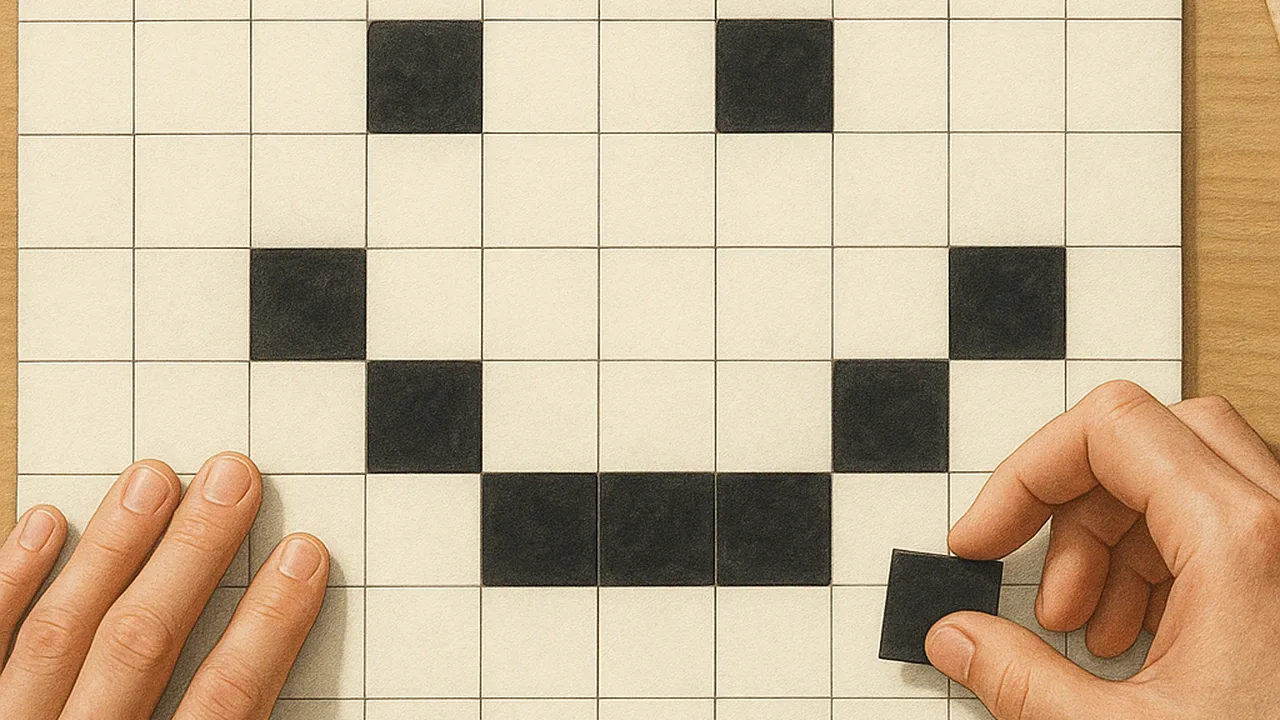
Worked example 1: a smiley in a grid. Mei draws a 5-by-5 grid. She colors some squares to make a smiley face. Then she writes each row as numbers. A colored square is 1. A blank square is 0.
| Row | Pattern |
|---|---|
| 1 | 0 0 0 0 0 |
| 2 | 0 1 0 1 0 |
| 3 | 0 0 0 0 0 |
| 4 | 1 0 0 0 1 |
| 5 | 0 1 1 1 0 |
Row 2 makes the eyes. Rows 4 and 5 make the smile. Mei reads the numbers to Diego. Diego colors his own blank grid. Now he has the same picture!
Worked example 2: sending it with light. Mei cannot shout across the gym. So she uses a flashlight. Light on means 1. Light off means 0. She counts “one, two” for each square so Diego knows when one square ends. The light pattern carries the picture across the room.
Same and different. Morse code and binary code are both on-off patterns. Morse code uses short and long signals. Binary uses on and off in equal time steps. Both need a code key that the sender and receiver share.
Real devices. Phones and computers send binary code over long distances. The 1s and 0s can travel as radio waves through the air, electric pulses in wires, or light pulses in glass cables. The pattern is the message.
Guided Exercises ~15 min
Partners sit back to back. The sender reads or flashes a grid. The receiver colors it. Then switch.
| Trial | How it was sent (spoken / flashlight) | Squares correct (out of 25) | What went wrong? |
|---|---|---|---|
| 1 | |||
| 2 | |||
| 3 |
Independent Practice ~10 min
Connect the grid to the field day project.
Write one field day message as on-off flashes, like 1 0 1 1. Explain how your pattern uses on and off to carry the message.
Name one device at home or school that sends messages as patterns. How does it send them far away?
Closure ~5 min
Two signals, on and off, can send a whole picture. Next lesson, we test codes that use sound and big motions.
Exit ticket: why did the sender need a steady count for each square? What would go wrong without it?
Teacher notes
Materials: printed 5-by-5 grids (several per student), crayons, flashlights, a timer for a steady beat.
Setup: model the smiley grid on the board. Let partners first speak the numbers, then try flashlight only.
Listen for: “0 means nothing is sent” (an off step is still information); losing count of squares (that is why timing matters).
Support / stretch: start with a 3-by-3 grid. Stretch: try a 7-by-7 grid and talk about why more squares make a sharper picture but take longer to send.