2.04 The Slinky Wave
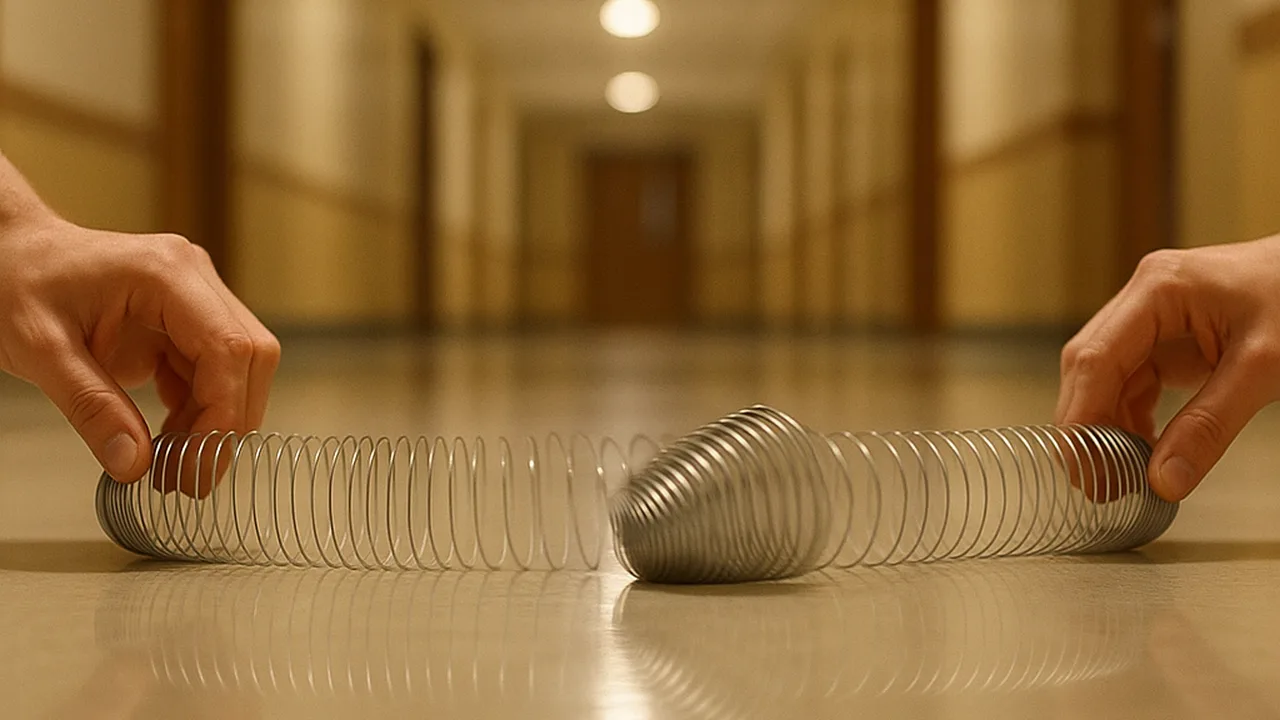
use a slinky model to make big, small, slow and fast waves and record how the bumps change.
- I can make a model to show what a wave is and how it works.
- I can point out the parts of a wave in my model, like amplitude and wavelength.
- I can show in my model how waves can make things move.
- I can use my model to show that waves of the same kind can have different amplitudes and wavelengths, and explain how this changes how much an object moves.
Phase 2: Investigate
Warm-Up ~5 min
Quick think. A slinky is a spring toy. It is also a great wave model. A model is a simpler copy that helps us study something real.
You tie a ribbon to the middle of a slinky and send a wave down it. What will the ribbon do?
Instruction ~10 min
The Slinky Wave investigation. Two partners stretch a slinky across the floor, about as long as two desks. Keep it flat on the floor. The Tester shakes one end side to side. The other partner holds the far end still. Tie a ribbon to one middle coil.
- Make a small shake: move your hand a little bit, at an easy speed.
- Make a big shake: move your hand far, at the same easy speed.
- Make fast shakes: small moves, but quicker. Look at how close the bumps are.
- Make slow shakes: small moves, but slower. Look at the bumps again.
- Each time, watch the ribbon. Does it travel to the far end, or wiggle in place?
| Shake | How tall were the bumps? (small / medium / big) | How close were the bumps? (close / far apart) | What did the ribbon do? |
|---|---|---|---|
| Small, easy | |||
| Big, easy | |||
| Small, fast | |||
| Small, slow |
Worked example 1: reading a slinky row. Priya’s team made a big, easy shake. The Recorder wrote “big” for the bumps, “far apart” for spacing, and “ribbon wiggled side to side, stayed in place.” That is a clear row. Words like these are all you need. No ruler today.
Worked example 2: changing one thing. Malik’s team changed how far the hand moved but kept the speed the same. Only the height of the bumps changed. Then they changed only the speed. Now the spacing changed. Changing one thing at a time is what makes a test fair.
Why a model? We cannot easily watch a pond wave up close. The slinky lets us slow things down and see every bump. Each coil is like a bit of water under the leaf.
Guided Exercises ~15 min
Look at your team’s slinky table. Use it to answer these.
Independent Practice ~10 min
Show what you saw.
Draw two slinky waves side by side: one from a big shake and one from a fast shake. Label what is different about the bumps.
Closure ~5 min
A bigger hand motion made taller bumps. Faster shaking put the bumps closer together. Next lesson, we try a rope and an online wave model.
Exit ticket: how is the ribbon on the slinky like the leaf on the pond?
Teacher notes
Materials: one metal or plastic slinky per team (a long jump rope works too), ribbon or tape flags. Rotate team roles today: Materials Manager, Recorder, Tester, Reporter. Each person gets a new job.
Setup: clear floor lanes. Plastic slinkies tangle less. Model one small and one big shake before teams start.
Listen for: “fast shakes make taller waves” (if the hand moves the same distance, speed changes spacing, not height). Hold off on naming amplitude and wavelength until lesson 2.06.
Support / stretch: pair a student who needs support with a steady Tester. Stretch: try a push-and-pull shake along the slinky (a compression wave) and describe how it looks different.