2.12 Modeling How We See
build a model that connects a light source, an object, the path of light and the eye, and write a CER about how we see.
- I can make a model that shows how light, objects, the path of light, and the eye are all connected when we see something.
- I can explain that we see objects because light enters our eyes.
- I can describe how light bounces off objects and then travels to our eyes.
- I can show that we can only see objects if light goes from a light source to the object and then to our eyes.
- I can use my model to show that we need light to reflect off an object and enter our eyes for us to see things that do not make their own light.
Phase 3: Make Sense
Warm-Up ~5 min
Look back. Find your shoebox drawing from lesson 2.07. Which way did your arrows point?
When we see a book, light travels from our eyes out to the book.
Instruction ~10 min
Reading: how do we see? Some things make their own light, like the Sun, a lamp or a flashlight. Most things do not. A book does not glow. We see the book because light from a source hits it and reflects, or bounces off. Some of that reflected light travels into our eyes. No light reaching the eye means no seeing. That is why the toy was invisible in the closed box.
Seeing is like a team with four parts. There is a light source. There is an object. There is a path the light follows. And there is an eye at the end. If any part is missing, we cannot see the object.
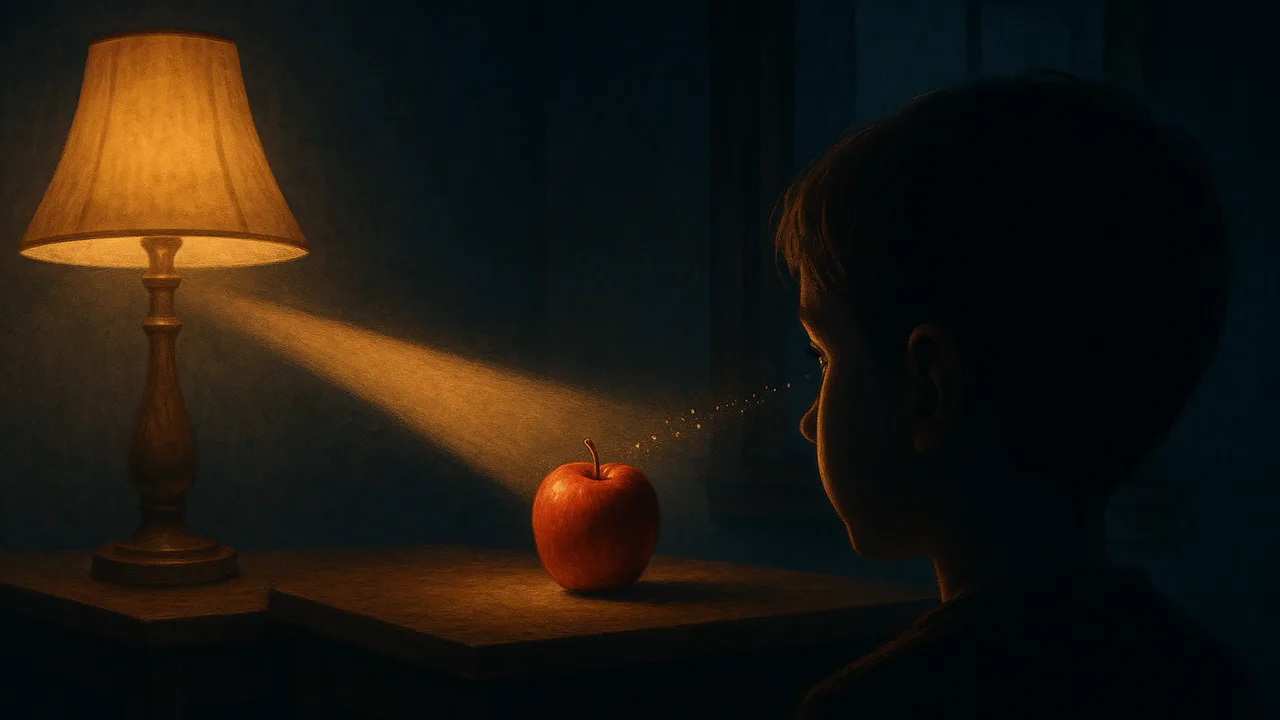
Worked example 1: a light model. Ava draws a model with three things: a lamp, an apple and an eye. She draws an arrow from the lamp to the apple. Then she draws a second arrow from the apple to the eye. The arrows show the path of light. They point toward the eye, never out of it.
Worked example 2: a CER. Here is how Diego wrote his explanation.
Claim: We see objects that do not make light only when light bounces off them into our eyes.
Evidence: In the closed shoebox, I could not see the toy. When the flashlight shone in, I could see it.
Reasoning: The toy does not make light. Light from the flashlight hit the toy and reflected out the peek hole into my eye. Without light, nothing reached my eye.
Worked example 3: a lit object versus a light source. Mei sees a lamp and a mug on her desk. For the lamp, she draws one arrow: lamp to eye. For the mug, she needs two arrows: lamp to mug, then mug to eye. Light sources need one arrow. Lit objects need two.
Guided Exercises ~15 min
Build your light model with your team. Then write your CER.
Independent Practice ~10 min
Fix a broken model.
Jamal drew an arrow from his eye to a ball. Explain what is wrong and draw a corrected model.
How confident are you that you can I can make a model that shows how light, objects, the path of light and the eye work together when I see.
Closure ~5 min
To see an object that does not glow, light must reflect off it and enter our eyes. Next lesson, we use our model to predict what happens when the light changes.
Exit ticket: draw the light path that lets you read a page in a book right now.
Teacher notes
Materials: shoebox drawings from 2.07, chart paper, markers, a CER anchor chart, sticky-note labels.
Setup: model a lamp-apple-eye drawing on the board. Have teams build the field day flag model on chart paper.
Listen for: arrows drawn from the eye out to the object; “we see because the object is bright” (light must still enter the eye). Do not teach how the eye works inside; that is beyond the grade 4 boundary.
Support / stretch: give a partly drawn model to fill in. Stretch: model how you see the Moon (sunlight reflects off it).