1.15 The Energy Changer: Two Designs, One Choice
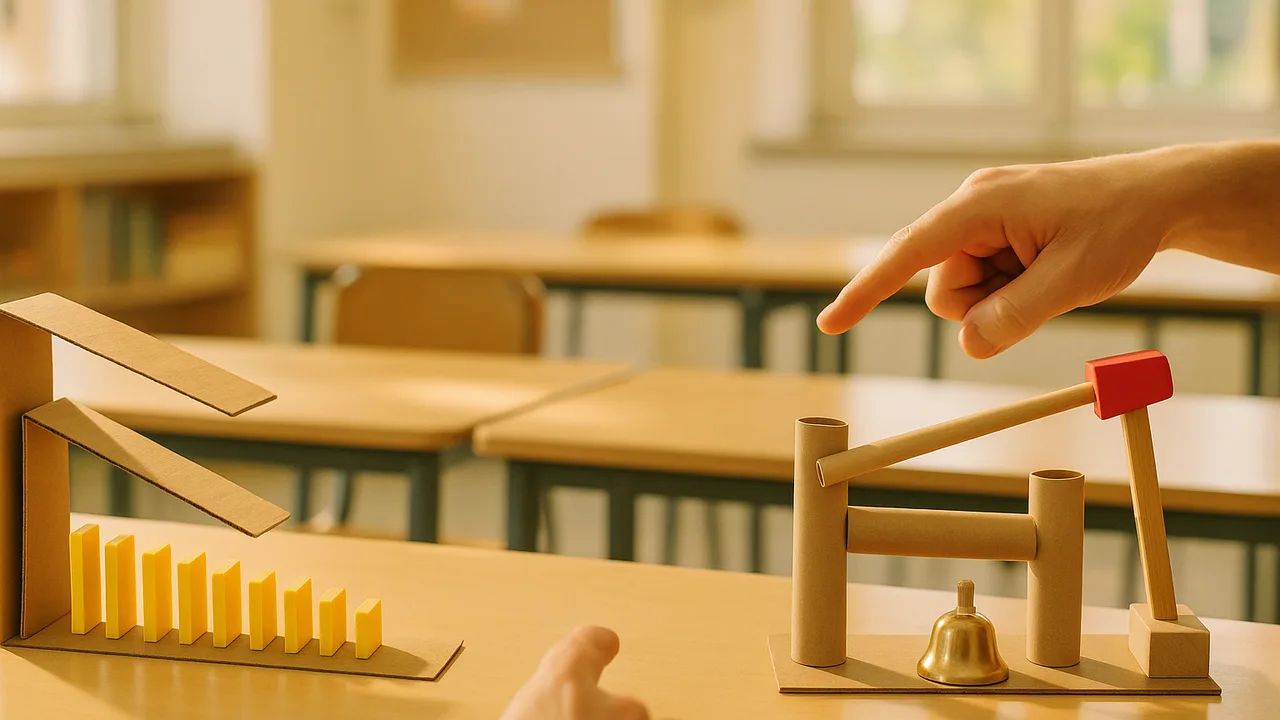
name the energy changer in a machine and compare two machine designs to choose the one that best fits our criteria and constraints.
- I can work with others to design a device that changes energy from one form to another.
- I can name the kind of energy the device starts with and the kind it changes into.
- I can identify the part of the device that makes the energy change happen.
- I can come up with at least two possible solutions to a problem using what I know about science.
- I can explain how each of my design solutions could solve the problem.
Phase 4: Build
Warm-Up ~5 min
Do Now. A bell is an energy changer. When a ball hits it, motion energy changes into sound energy. Think of other things at home that change energy from one form to another.
A doorbell button is pressed, and a chime plays. What does the doorbell change electric energy into?
Instruction ~10 min
Junior engineers, welcome to the Build phase. Our machine needs at least four energy transfers. It also needs one special part: an energy changer. That is a part that changes energy from one form to another. The bell at the end is one. You may add another.
Energy can change form. Motion energy can become sound, like a ball ringing a bell. Electric energy can become light, like a flashlight. Motion can become heat, like rubbing your hands. Light can become heat, like the paper in the sun.
Engineers draw more than one idea. Before they build, engineers sketch at least two designs. Then they compare them with the criteria and constraints. The best design is not always the fanciest one. It is the one that solves the client’s problem.
Worked example 1: Mei’s design A. Step 1: a marble rolls down a ramp. Stored energy becomes motion energy. Step 2: the marble hits a domino line. Motion energy moves domino to domino. Step 3: the last domino bumps a toy car. Step 4: the car rolls and hits the bell. Motion energy becomes sound energy. That is the energy changer! Mei counted the transfers: marble to domino, domino to domino, domino to car, car to bell.
Worked example 2: Mei’s design B. Design B has a pulley, a swinging pendulum and a long tube maze. It looks amazing. But Mei’s team guessed it would take about an hour to set up. Our constraint is 40 minutes. So the team chose design A. They kept one idea from B: the tube, because it keeps the marble on track.
| Check | Design A | Design B |
|---|---|---|
| Energy transfers (need 4 or more) | ||
| Rings the bell? | ||
| Classroom materials only? | ||
| Setup in 40 minutes or less? (your best guess) | ||
| Energy changer and its energy in / out |
Guided Exercises ~15 min
Work with your team. Use the design table to check each idea.
Independent Practice ~10 min
Choose your design and defend your choice.
Which design did your team choose? Explain how it solves the client's problem. Use at least one criterion and one constraint.
Name your energy changer. What energy goes in, and what energy comes out?
Closure ~5 min
You have a plan, junior engineers. Next time, we start building it one section at a time.
Exit ticket: what is one idea you gave up from your other design? Why was it worth giving up?
How confident are you that you can I can name the energy my device starts with and the energy it changes into.
Teacher notes
Materials: notebooks, the design table copied or projected, a desk bell and a flashlight to pass around, the team criteria cards from Investigate.
Setup: post the criteria and constraints where every team can see them. Give 8 minutes for two sketches, then 5 minutes to compare.
Listen for: “the battery makes energy” (it stores energy that changes form); students counting objects instead of hand-offs; teams choosing the flashiest design without checking setup time.
Support / stretch: give a planning sheet with four numbered boxes. Stretch: ask teams to name a trade-off in each design.