2.14 From Science to Signals
use what I know about waves and light to brainstorm at least three silent signal ideas and explain the science behind each one.
- I can describe how waves have patterns that repeat, like how amplitude and wavelength show up again and again.
- I can explain how waves can make objects move.
- I can tell how the movement of an object changes when the amplitude or wavelength of the wave changes.
- I can use my model to describe what happens to what we see if the light source is removed, blocked, or changed.
- I can use my model to show what happens if the eye is closed.
- I can use my model to explain how changing the path of light, like using mirrors or barriers, affects what we can see.
Phase 3: Make Sense
Warm-Up ~5 min
Quick review. Before we brainstorm, check what you know.
A flag waves back and forth with big sweeps. Why is it easier to see from far away than tiny wiggles?
Instruction ~10 min
Reading: from science to signals. You have learned two big ideas. First, waves are repeating patterns. A big amplitude makes a big, strong motion. Second, we see things when light reaches our eyes. A light source can send light straight to the eye. A lit object needs light to reflect off it.
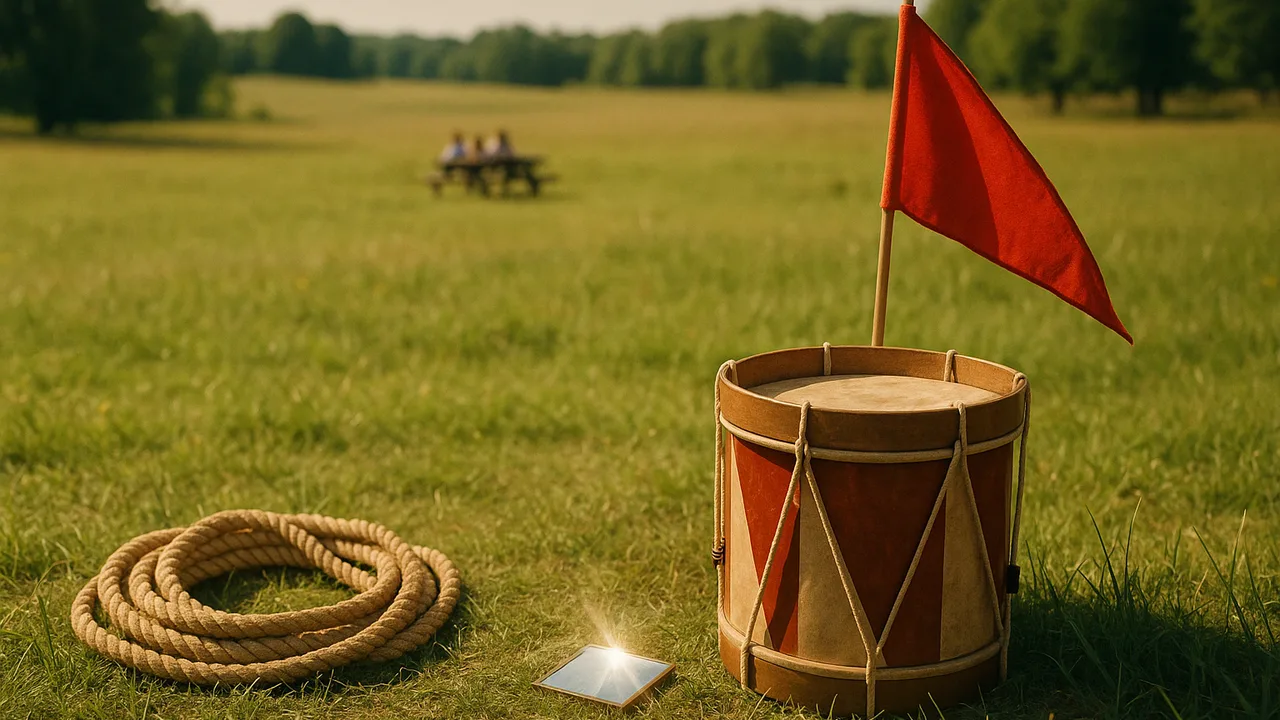
Engineers use science to come up with ideas. A flashlight beam travels straight to an eye, so it can be seen far away. A waving flag makes a big motion pattern people can see over a crowd. A drumbeat sends sound waves, and a big amplitude makes it louder. Each can make a pattern. Patterns are how we turn a wave or a light into a message.
Worked example 1: a flashlight idea. Jamal suggests a flashlight that blinks. The science: a flashlight is a light source, so its light goes straight to the watcher’s eye. A problem: on a very sunny day, a small flashlight may be hard to see. That is good to notice now.
Worked example 2: a flag idea. Priya suggests big, colored flags. The science: sunlight reflects off the flag into people’s eyes, and a big sweep is easy to spot. A problem: if a crowd stands in front, the light path is blocked. Maybe the flag should be raised high on a pole.
Brainstorm rules. Every idea counts. Go for many ideas. Build on a teammate’s idea with “Yes, and…” Pick the best ideas later, in the Build phase.
Guided Exercises ~15 min
With your team, test each signal idea against the science and the criteria list.
Independent Practice ~10 min
Ideate. Now pick your own best ideas and back them with science.
Write at least 3 silent signal ideas for field day. For each one, name the kind of signal (light, motion, or sound with a visual backup) and the science that makes it work. Example: “A flashlight blinking a pattern. Light travels straight to the eye.”
For one of your ideas, explain what could stop it from working, like a barrier or a cloudy day, and how you could fix it.
Closure ~5 min
Waves have amplitude and wavelength. We see objects when light enters our eyes. Now your team has a pile of signal ideas grounded in science. First, take your 3DX field trip inside the human eye. Then the Build phase begins, and you turn one idea into a real code.
Exit ticket: which of your signal ideas do you like best? Give one science reason it would work on field day.
Teacher notes
Materials: team criteria and constraints lists from 2.09, light and wave models from 2.10 to 2.13, chart paper, sticky notes, a timer.
Setup: post brainstorm rules. Give each team a stack of sticky notes, one idea per note, so ideas can be sorted in the Build phase.
Listen for: ideas that only use sound (push for a visual backup for the classmate who cannot hear well); ideas that shine light at faces (revisit the safety constraint). Save code design and comparing solutions for the Build phase.
Support / stretch: give picture prompts (flag, flashlight, colored card, drum). Stretch: combine two ideas into one signal that still works if one part fails.