2.15 Cracking the Code
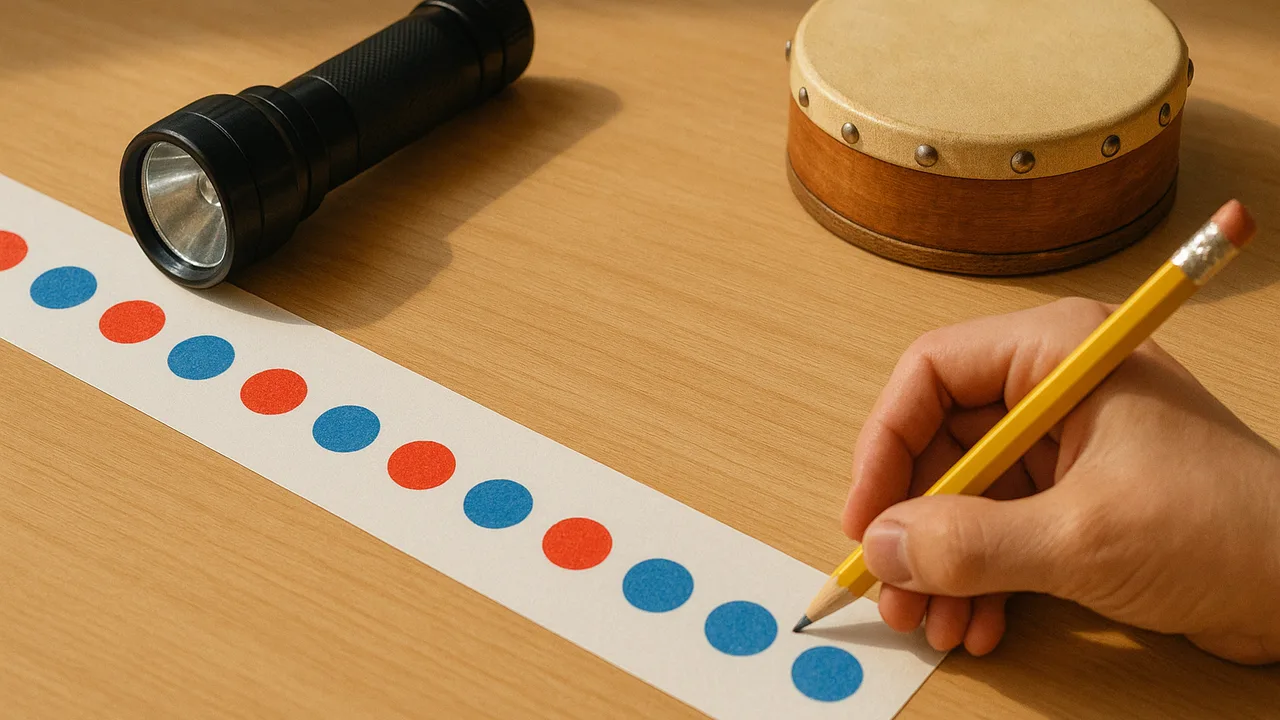
design a pattern code that sends field day messages, and design a second way to send the same messages.
- I can design at least two different ways to send the same message using patterns, like codes or signals.
- I can explain how my designs use patterns, such as 1s and 0s or flashes of light, to send information.
- I can describe how devices like cell phones or computers use patterns to send messages over long distances.
- I can come up with at least two possible solutions to a problem using what I know about science.
- I can explain how each of my design solutions could solve the problem.
Phase 4: Build
Warm-Up ~5 min
Code breaker challenge. Your teacher flashes a flashlight. Short flash = dot. Long flash = dash. The code is: three short, three long, three short. Do you know this famous signal?
Three short flashes, three long flashes, three short flashes. What does it mean?
Instruction ~10 min
Junior engineers, it is time to build. You know how waves move and how light reaches your eyes. Now you will use that science to send messages.
A code is a set of patterns that stand for messages. The pattern can be made of anything you can turn on and off, or change: light flashes, flag waves, drumbeats, or arm motions. Both people must know the code ahead of time. That chart is called a code key.
Simple codes are easier to read. Field day needs about four or five messages, not a whole alphabet. Give each message its own short pattern. Keep patterns very different so nobody mixes them up.
Worked example 1: a light code. Priya’s team picks a flashlight. Their code key looks like this.
| Message | Light pattern |
|---|---|
| Start the race | 1 long flash |
| Come to the water station | 2 short flashes |
| Line up | 3 short flashes |
| Stop, we need help | many fast flashes |
Each pattern is different, so it is hard to confuse them. A person who cannot hear well can see every one.
Worked example 2: the same messages, a new way. Jamal’s team sends the same four messages with a big orange flag. One big circle means start. Two waves overhead mean water. A flag held straight out means line up. Fast side-to-side waves mean help. Same messages, different pattern. Engineers often design two or more solutions and compare them.
Build it. Each team builds a first prototype: the signal tool plus a code key card. Test it across the classroom. Can a partner read three messages without peeking at your card?
Guided Exercises ~15 min
Use these to plan and check your team’s code before you build. The Tester tries each pattern with a flashlight or hands.
Independent Practice ~10 min
On your own, explain your two designs.
Describe your two code designs. For each one, explain how it would solve the field day problem, including for the classmate who cannot hear well.
How confident are you that you can I can design two different ways to send the same message.
🔎 Mini case study: Morse code and the telegraph ~5 min
In the 1830s and 1840s, Samuel Morse and his partner Alfred Vail worked on the electric telegraph. A telegraph sends electric pulses down a long wire. At the other end, the pulses make clicks. But clicks alone do not say anything. They needed a code.
Their answer was a code of short and long signals, called dots and dashes. Each letter got its own pattern. Common letters got short patterns. The letter E is just one dot. That made messages faster to send. In 1844, a message traveled by telegraph wire from Washington, D.C. to Baltimore, Maryland.
Later, ships used the same code with flashing signal lamps. Sailors could talk ship to ship at night with no wire at all. The idea is the same as your field day code. A simple on-and-off pattern can carry a message far away.
Think about it: Why did giving common letters the shortest patterns make Morse code faster? How could you use that idea in your field day code?
Closure ~5 min
Your team has a first prototype and a second idea. Next lesson, we look at the simplest pattern of all: on and off.
Exit ticket: which field day message would you give the shortest pattern? Use the Morse code idea to explain why.
Teacher notes
Materials: flashlights, colored paper or fabric flags (a dowel and a bandana work), index cards for code keys, a Morse code chart to display.
Setup: assign new team roles. Model one code key on the board before teams start. Give each team two index cards: one per design.
Listen for: patterns that are too similar (3 vs. 4 flashes is hard from far away); codes that only use sound (remind teams of the classmate who cannot hear well); the idea that a code must spell letters (whole-message signals are fine).
Support / stretch: offer a starter code key with two messages filled in. Stretch: have teams spell one short word in real Morse code.