1.04 Energy Stations: Sound, Light, Heat and Current
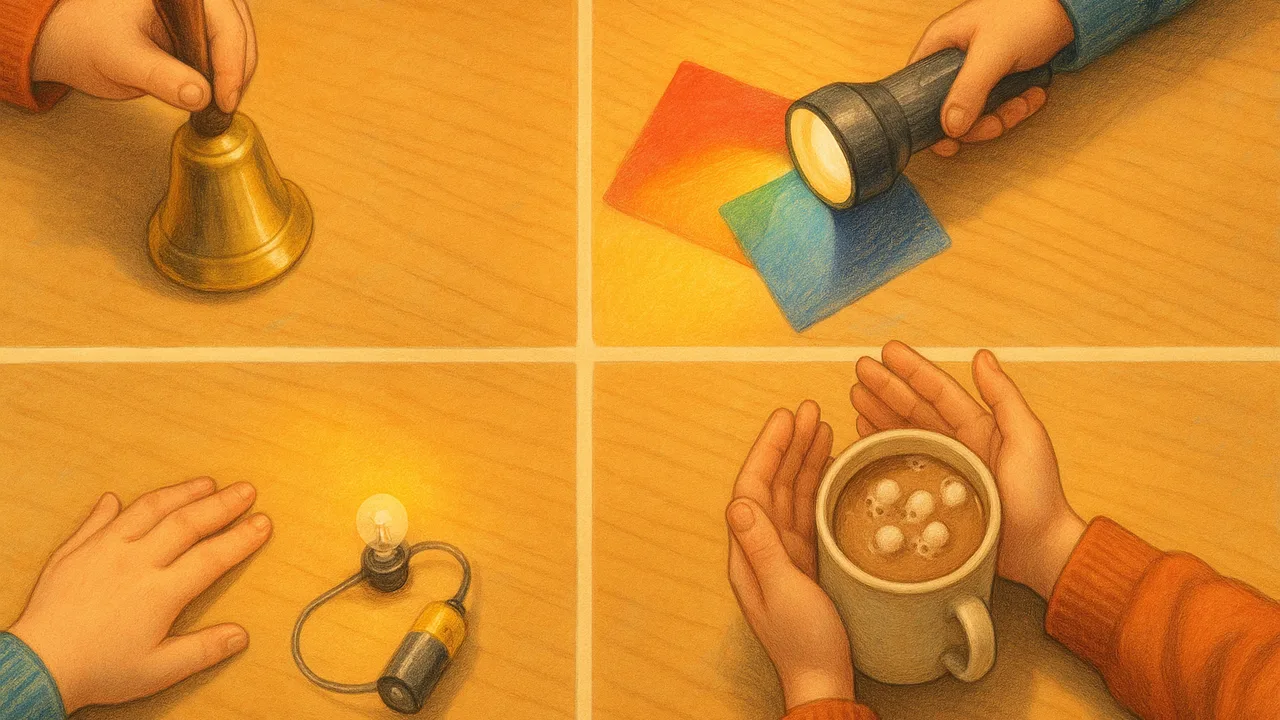
observe and record energy moving from place to place as sound, light, heat and electric current at four stations.
- I can explain how energy moves when objects collide, when light or sound travels, when electric currents make things happen, and when heat passes from one object to another.
- I can describe how motion, sound, heat, or light can change into a different type of energy after things interact, like when a moving ball hits another ball or when a sound makes something move.
- I can describe what data we need to collect, like how objects move and collide before and after they interact.
- I can explain how to look for changes in sound, light, or heat before and after something happens.
- I can describe how to check for electric currents in wires and see how they connect one kind of energy to another, like turning on a light bulb.
- I can make and record observations to show that energy is present when there are moving objects, sound, light, or heat.
- I can make and record observations to show that energy has moved from one place to another, like when a light bulb turns on or a ball starts moving after being hit.
Phase 2: Investigate
Warm-Up ~5 min
Do Now. Yesterday, energy rolled down a ramp. But can energy move when nothing rolls at all? Hold your hand near a lamp that is on. What do you feel?
Can energy move from one place to another without any object rolling or sliding?
Instruction ~10 min
Junior engineers, explore first. Your team visits four stations. You get about 5 minutes at each one. At every station, look for a change before and after. Write where the energy started and where it went.
- Bell station: tap a bell. Then gently touch it with one finger. Can you feel it buzz? Now hold a paper strip near a speaker playing music. Does it shake?
- Flashlight station: switch the flashlight on and off. Shine it on your hand for 30 seconds. Then open the battery door with your teacher. Find the battery, the wires or metal strips, and the bulb.
- Rubbing station: touch your palms to your cheeks. Then rub your palms fast for 10 seconds and touch your cheeks again.
- Sunny window station: set a dark paper and a white paper in the sun or under a lamp. After a few minutes, touch both.
| Station | Before (what I noticed) | After (what changed) | Energy started in… | Energy went to… | It moved as (sound / light / heat / current / motion) |
|---|---|---|---|---|---|
| Bell | |||||
| Flashlight | |||||
| Rubbing hands | |||||
| Sunny window |
Worked example 1: a station note. Malik wrote: “Flashlight. Energy started in the battery. It moved through the wire as electric current. It came out as light. My hand felt a little warm.” That note names where the energy started, how it moved, and where it went.
Worked example 2: a before-and-after clue. Mei put rice on plastic wrap stretched over a bowl. She banged a pot lid nearby. The rice jumped! Before: rice sitting still. After: rice bouncing. Sound carried energy through the air and moved the rice.
Now we can name it. Energy moves from place to place in many ways. Moving objects carry it. Sound carries it through the air. Light carries it, even from the Sun. Heat moves it from warm things to cooler things. Electric current carries it through wires.
Guided Exercises ~15 min
Check your station notes with your team.
Independent Practice ~10 min
Pick your two best station notes.
For one station, write what you saw BEFORE and AFTER. Where did the energy start, and where did it go?
Which station could become a step in our chain-reaction machine? Explain how.
Closure ~5 min
Energy does not have to roll to move. It can travel as sound, light, heat and electric current. Next time, your team will plan its own test.
Exit ticket: name two ways energy moved at our stations, and give one observation for each.
Teacher notes
Materials: a desk bell, a small speaker or phone with low music, paper strips, two flashlights, a sheet of black paper and a sheet of white paper, a sunny sill or desk lamp, a bowl with plastic wrap and dry rice for the demo, a timer.
Setup: label stations 1–4 and rotate every 5 minutes. Run the rice drum as a whole-class demo in the instruction segment.
Listen for: “heat and light are the same thing” (light can turn into heat when it is absorbed); “the battery has light inside it” (the battery stores energy that current carries to the bulb).
Support / stretch: give a word bank for the last column. Stretch: find a station where energy moved in TWO ways at once (the bulb makes light and a little heat).