2.17 Drumbeats and Big Motions
test sound and motion codes, and explain how a bigger amplitude makes a sound wave move things more.
- I can describe how waves have patterns that repeat, like how amplitude and wavelength show up again and again.
- I can explain how waves can make objects move.
- I can tell how the movement of an object changes when the amplitude or wavelength of the wave changes.
- I can use my model to show that waves of the same kind can have different amplitudes and wavelengths, and explain how this changes how much an object moves.
- I can describe the limits for my design, such as how far the message needs to go, how to keep it safe, and what materials I can use.
Phase 4: Build
Warm-Up ~5 min
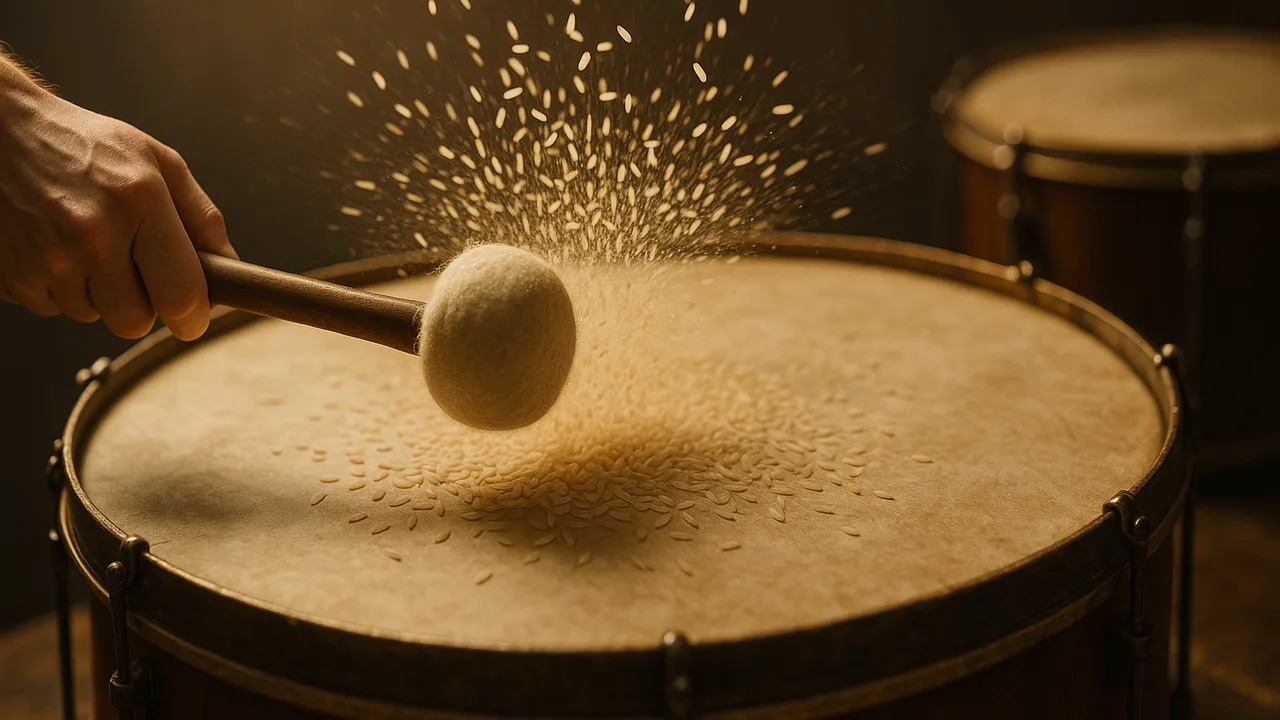
Rice on a drum. Your teacher stretches plastic wrap over a bowl and sprinkles rice on top. Then they tap a pan nearby. Watch the rice.
Your teacher taps the pan softly, then hard. What will the rice do?
Instruction ~10 min
Sound is a wave. When a drum is hit, its top shakes back and forth very fast. That shaking pushes on the air. A sound wave travels out in every direction. When it reaches the plastic wrap, it makes the plastic shake too.
Worked example 1: soft and loud. Malik taps the drum softly. The rice wiggles a little. He hits it hard. The rice jumps high. A hard hit makes a wave with a bigger amplitude. We hear a bigger amplitude as a louder sound. The rice moves more because the wave carries more energy.
Worked example 2: a drum code. Ava’s team makes a drum code. One loud beat means start. Two quick beats mean water. A long drumroll means help. It works in a quiet hall. But on a loud field, beats get lost in the noise. And the classmate who cannot hear well may miss it. So Ava’s team adds a backup: they raise a colored paddle with every beat.
Big motions. Motion codes use arms, flags, or paddles. Big motions are easier to see from far away than small ones. Bright colors help too. Light from the Sun reflects off the flag and travels to the receiver’s eyes.
Constraints matter. Every signal type has limits. Sound can be drowned out. Light can be hard to see in bright sun. Motions need open space. Today you will test each one and record its limits.
| Signal | Rice movement (small / medium / big) | Could you read it across the room? (yes / no) | Could you read it with crowd noise? (yes / no) | One limit we noticed |
|---|---|---|---|---|
| Soft drum beats | ||||
| Loud drum beats | ||||
| Small arm motions | none | |||
| Big flag motions | none |
Guided Exercises ~15 min
Use your data table to answer these as a team.
Independent Practice ~10 min
Choose your team’s best signal type so far.
Compare a sound code and a motion code for field day. Explain how each could solve the problem, and name one limit of each.
Closure ~5 min
Sound, light, and motion can all carry patterns. Each has limits. Next lesson, we test our prototypes against the criteria and constraints.
Exit ticket: explain how changing the amplitude of a sound wave changed how much the rice moved.
Teacher notes
Materials: a bowl, plastic wrap, rubber band, dry rice, a metal pan and wooden spoon (or a hand drum), colored paddles or flags, chart paper.
Setup: do the rice drum as a demo, then let teams test signal types at stations. Assign one team to be “crowd noise” for each test.
Listen for: “the air travels from the drum to the rice” (the wave travels, the air mostly shakes in place); “louder means faster” (louder means bigger amplitude). Keep it qualitative.
Support / stretch: offer a word bank (soft, loud, small, big). Stretch: ask why you can see a far-away drummer hit the drum a moment before you hear it (light travels much faster than sound).