2.06 Waves That Move Things
test how waves of different heights move objects, and use the words amplitude and wavelength to describe my data.
- I can describe how waves have patterns that repeat, like how amplitude and wavelength show up again and again.
- I can explain how waves can make objects move.
- I can tell how the movement of an object changes when the amplitude or wavelength of the wave changes.
- I can compare waves to find patterns and use those patterns to explain how amplitude and wavelength affect how much an object moves.
Phase 2: Investigate
Warm-Up ~5 min
Big question. Can a wave push something over, even if it does not carry it away?
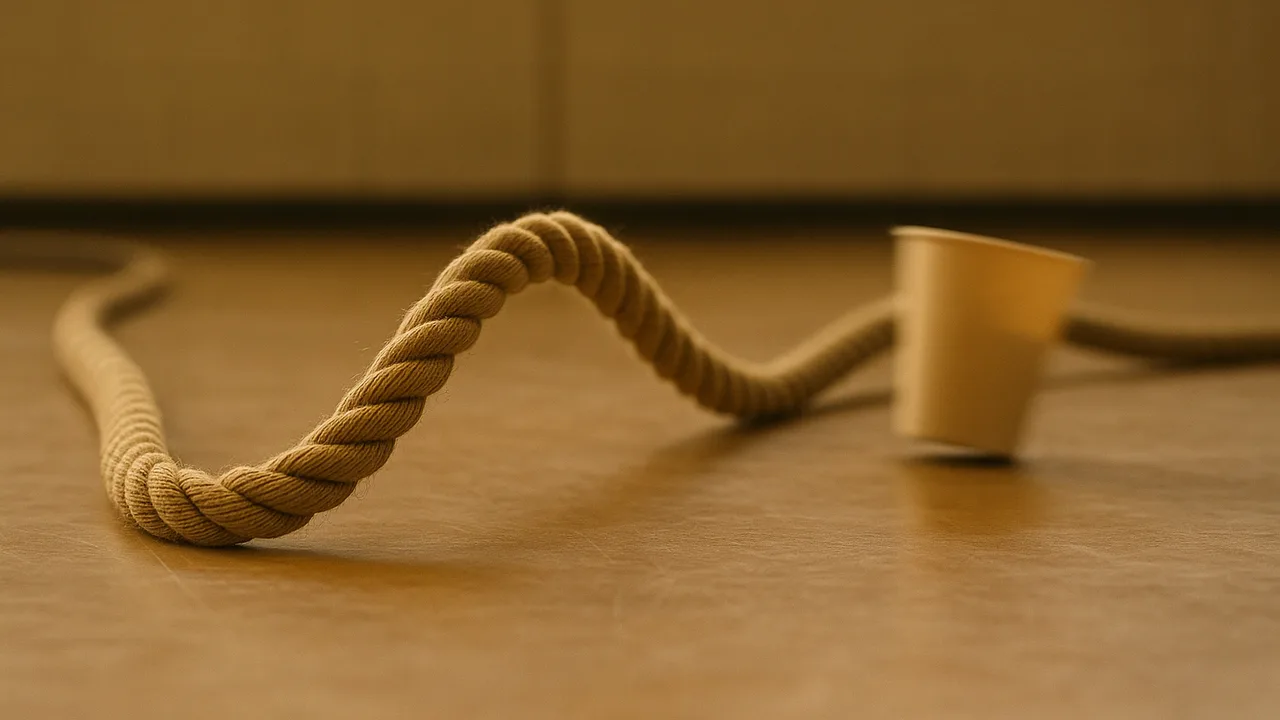
A paper cup sits at the end of a rope lying on the floor. You send one small bump, then one big bump. Which knocks the cup over?
Instruction ~10 min
The Wave Push investigation. Lay a rope on the floor. Set a light paper cup right at the far end, touching the rope. In the tub, float a foil boat with three pennies in it.
- Rope: send one small bump. Did the cup move? Then one medium bump, then one big bump.
- Tub: make one small wave by pushing the water gently with a ruler. Then a big wave with a bigger push. How much did the boat rock?
- Run each test 2 times to check your results.
| Test | Wave height (small / medium / big) | Trial 1: what did the object do? | Trial 2: what did the object do? |
|---|---|---|---|
| Rope and cup | small | ||
| Rope and cup | medium | ||
| Rope and cup | big | ||
| Tub and boat | small | ||
| Tub and boat | big |
Now we can name it. You have explored waves in four models. Scientists have names for what you saw. Amplitude is how far a wave moves up or down from its resting line. Your “tall bumps” had a big amplitude. Wavelength is the distance from the top of one bump to the top of the next. Your “close bumps” had a short wavelength.
Worked example 1: the cup test. Diego’s small bump only wiggled the cup. His big bump knocked it over both times. He wrote, “Bigger amplitude moved the cup more.” He used the new word to describe his data.
Worked example 2: the boat test. Mei’s boat rocked a little with the small wave. With the big wave, it rocked a lot and a penny slid. But the boat did not sail across the tub. Waves move objects as they pass. They carry energy, not the boat.
Back to the client. Could a wave be part of our signal? A big waving flag makes a big motion people can see. Add one idea to your criteria and constraints list.
Guided Exercises ~15 min
Use your Wave Push data and the new words.
Independent Practice ~10 min
Explain your data in your own words.
Use the word amplitude to explain how the size of a wave changes how much it moves an object. Use one row of your data as proof.
Closure ~5 min
Waves move objects as they pass. Bigger amplitude, bigger push. Next lesson, we switch to light. Can you see in the dark?
Exit ticket: draw a wave. Mark its amplitude and its wavelength.
Teacher notes
Materials: ropes, light paper cups, tubs of water, foil squares for boats, pennies, rulers, towels. Rotate team roles today: Materials Manager, Recorder, Tester, Reporter. Each person gets a new job.
Setup: pre-fold foil boats if time is short. Draw a large wave on the board for naming amplitude and wavelength after the tests.
Listen for: amplitude measured from bottom to top of a bump (it is from the resting line); “the wave carried the boat”. Keep everything qualitative: no numbers or formulas.
Support / stretch: give a labeled wave picture to glue in notebooks. Stretch: predict what a very long wavelength wave would do to the boat compared with a short one, then test it.