2.21 Seeing the Signal: Light Paths, Alarms and Fiber
use a light model to explain what makes a signal easy or hard to see, and use research to explain the cause and effects of the field day problem.
- I can use my model to describe what happens to what we see if the light source is removed, blocked, or changed.
- I can use my model to show what happens if the eye is closed.
- I can use my model to explain how changing the path of light, like using mirrors or barriers, affects what we can see.
- I can use information from research to explain what causes a problem and what effects it has.
- I can use scientific facts I have learned to help me understand the problem.
Phase 4: Build
Warm-Up ~5 min
Think back. Your flag is easy to see on a sunny day. Your flashlight is not. Why? Use what you know about light.
On a very sunny day, why is a flashlight signal hard to see?
Instruction ~10 min
Every visual signal needs a light path. We see an object when light travels from a source, reflects off the object, and enters our eyes. A light source, like a flashlight, can send light straight to the eye. If anything breaks the path, the signal is lost.
Worked example 1: the blocked signal. Diego waves a flag at field day. A tall tent stands between Diego and the receiver. Sunlight still hits the flag, but the reflected light cannot reach the receiver’s eyes. The fix: stand on a hill, or use a mirror to bounce the light around the tent.
Worked example 2: cause and effect. Mei’s team does some research. They read how field days work and how noise travels. They list causes and effects.
| Cause | Effect on messages |
|---|---|
| Crowd cheering and whistles | Spoken messages get lost |
| A classmate cannot hear well | Sound-only signals miss them |
| Bright sun | Small flashes are hard to see |
| Tents and crowds in the way |
Real visual alarms. Many schools and public buildings have fire alarms that flash a bright strobe light as well as sounding. People who cannot hear the alarm can still see it. The flashes are bright and quick, so they stand out. This is the same need as our client’s.
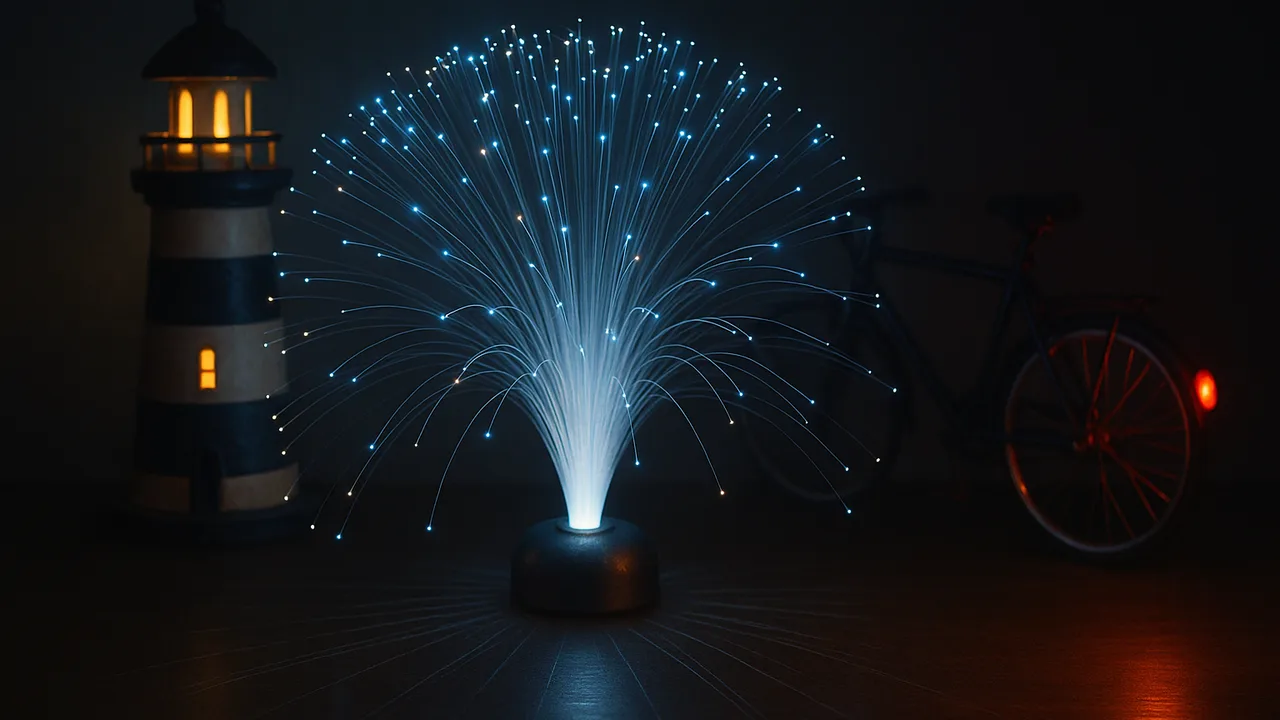
Extension: light in a glass thread. Fiber-optic cables are thin strands of glass. Light pulses travel inside them, bouncing off the inside walls of the glass again and again. The pulses are on-off patterns, like your flashlight code. They carry phone calls, videos, and web pages over long distances.
Guided Exercises ~15 min
Mini-test: block it or bend it. Set a flag card on a desk. Shine a flashlight on it. Then try each change and record whether the receiver can still see it.
| Change | Can the receiver see the card? (yes / no) | Why? (draw or describe the light path) |
|---|---|---|
| Flashlight off, room dark | ||
| Book stands between card and eye | ||
| Mirror bounces light around the book | ||
| Receiver closes eyes |
Independent Practice ~10 min
Use your research for your design.
Explain the main cause of the field day message problem and two of its effects. Use a fact from today's research, like the visual alarm example.
Based on the light path, what is one change that would make your signal easier to see? Explain why.
Closure ~5 min
A visual signal needs a clear light path, and research helps us understand the problem. Next lesson, you revise your code and rehearse for the field test.
Exit ticket: what would a telecommunications technician check if a light signal stopped arriving? Use the words “light path.”
Teacher notes
Materials: flashlights, small safety mirrors, flag cards, books for barriers. Optional: a picture of a classroom fire-alarm strobe; a fiber-optic toy lamp if you have one.
Setup: darken the room for the mini-test. Point out your own classroom’s fire-alarm strobe if there is one.
Listen for: arrows drawn from the eye out to the object (light goes into the eye); “the light stops in the sun” (it is still there but does not stand out). Keep fiber optics as an extension: no need to name “total internal reflection.”
Support / stretch: give a partly drawn light model. Stretch: research how lighthouses make their light visible far out on the water.