2.03 Ripples and the Leaf
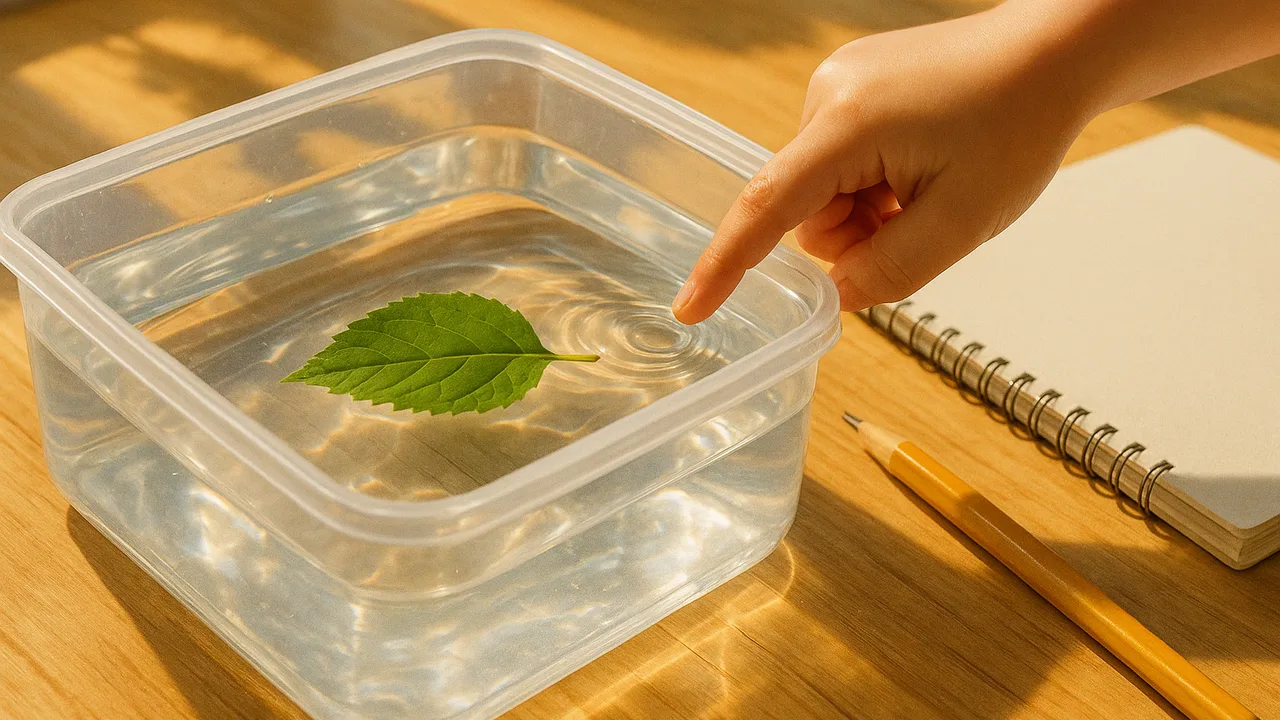
test how small and big ripples make a floating leaf move, and record what I see in a data table.
- I can use my model to show how a wave moves and how it makes an object move as it passes.
- I can explain how a wave starts, like by shaking a rope or disturbing water.
- I can show the repeating pattern that happens when a wave travels.
- I can describe how waves have patterns that repeat, like how amplitude and wavelength show up again and again.
- I can explain how waves can make objects move.
- I can tell how the movement of an object changes when the amplitude or wavelength of the wave changes.
Phase 2: Investigate
Warm-Up ~5 min
Remember the mystery? The leaf bobbed but did not leave. Today you test it for real. First, make a prediction.
You drop a marble, then a big rock, into the same tub. Which makes the floating leaf bob more?
Instruction ~10 min
Explore first. Today you are scientists. You will try things, watch closely, and write down what you notice. We will give the big ideas their science names later. For now, use your own words, like “tall” and “short.”
The Ripple Tub investigation. Each team gets a clear tub half full of water. Float a leaf or a foam piece near one end. Put a strip of tape on the outside of the tub at the water line. That tape is your “resting line.”
- The Tester drops a marble at the other end from the same low height. Watch the leaf.
- Drop a larger stone from the same height. Watch the leaf again.
- Tap the water with one finger, once. Then tap it again and again, at a steady beat.
- Each time, notice: How high did the leaf go above the tape? Did it move toward the far end, or stay?
| What started the wave | How tall were the ripples? (small / medium / big) | How much did the leaf bob? (a little / a lot) | Did the leaf travel or stay? |
|---|---|---|---|
| Marble | |||
| Large stone | |||
| One finger tap | |||
| Steady finger taps |
Worked example 1: writing a good row. Diego’s team dropped the marble. The Recorder wrote “small ripples, leaf bobbed a little, stayed.” That row is clear. It tells what happened, not what they hoped.
Worked example 2: spotting a pattern. With steady taps, Mei saw ring after ring after ring. The leaf went up, down, up, down. She wrote, “The bobbing repeats each time a ripple comes.” A repeating pattern is a big clue about waves.
Back to the client. Every design has criteria (what it must do) and constraints (its limits). Start a list for the silent signal now. You will add to it all phase.
| Criteria: our signal must… | Constraints: our limits are… |
|---|---|
| be seen across the whole field | no phones, no shouting |
Guided Exercises ~15 min
Use your Ripple Tub data to answer these. The Recorder checks each answer against the notebook.
Independent Practice ~10 min
Think on your own about your data.
Draw the leaf at the resting line, then at its highest point after the marble, and after the stone. What pattern do you see?
How confident are you that you can I can explain how a wave starts and how it moves a floating object.
Closure ~5 min
A bigger disturbance made bigger ripples, and the leaf bobbed more. But it stayed in place. Next lesson, we make waves on a slinky.
Exit ticket: finish this sentence. “The leaf did not float away because…”
Teacher notes
Materials: one clear plastic tub per team, water, leaves or foam pieces, marbles, larger smooth stones, masking tape, towels. Rotate team roles today: Materials Manager, Recorder, Tester, Reporter. Each person gets a new job.
Setup: fill tubs to about half before class. Put towels under each tub. Mark a low drop height (a few finger widths above the water) on a card so trials are fair.
Listen for: “the wave pushes the leaf” (it moves it up and down, not across); “the stone made faster waves” (it made taller ones). Do not name amplitude yet.
Support / stretch: give a word bank (small, big, a little, a lot, stayed, moved). Stretch: ask what changes if two teammates drop stones at the same time from opposite ends.