1.09 Pinwheel Power and Cookie Mining
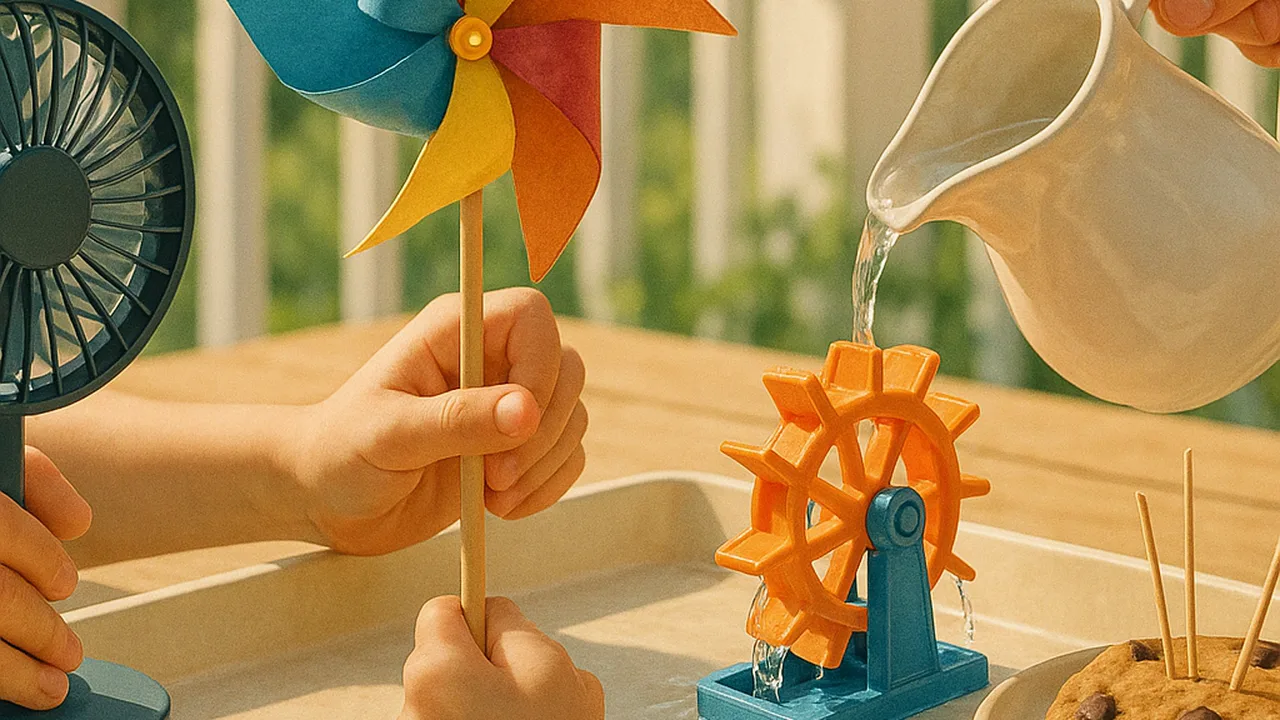
test models of wind and water power, model how mining changes the land, and sort energy resources into renewable and nonrenewable.
- I can use information I find to give evidence about how using an energy resource affects the environment.
- I can use information to tell if an energy resource is renewable or not.
- I can explain how technology can help reduce or change the environmental effects of using an energy resource.
- I can describe how using different energy resources causes different effects on the environment.
- I can explain how technology helps people get and use energy resources and how that affects the environment.
Phase 2: Investigate
Warm-Up ~5 min
Do Now. Blow gently on a pinwheel. Now blow harder. What changes? What would happen if you stopped blowing?
Which will spin a pinwheel faster: a soft breath or a hand fan waved hard?
Instruction ~10 min
Junior engineers, two labs today. First, we test models of wind and water power. Then, we model what happens when people dig a resource out of the ground.
Lab A: pinwheel power. Tape a small paper flag to one blade so you can count turns. Count how many times it spins in 10 seconds. Test three “wind” speeds: a soft breath, a hard breath, and a hand fan waved hard. Then hold the pinwheel over a tub and pour a cup of water onto the blades. That models a water turbine.
| Energy source | Spins in 10 s (trial 1) | Trial 2 | Trial 3 | Middle value | Will nature replace it soon? (yes / no) |
|---|---|---|---|---|---|
| Soft breath (gentle wind) | |||||
| Hard breath (strong wind) | |||||
| Hand fan | |||||
| Pouring water |
Lab B: cookie mining. Your cookie is the land. The chocolate chips are coal. Use only a toothpick to “mine” the chips. Then try to put the cookie back the way it was. Draw the cookie before and after.
| Cookie mining | Before | After |
|---|---|---|
| Drawing of the land | ||
| Chips (coal) left in the cookie | ||
| Could you fix the land? How? | ||
Now we name it. Some resources are renewable. Nature replaces them quickly. Wind keeps blowing, the Sun keeps shining, and rivers keep flowing. Others are nonrenewable. Coal and natural gas took a very long time to form. Once we dig or pump them out, they are gone for a very long time.
Worked example 1: reading the pinwheel data. Ava’s pinwheel spun 6 times with a soft breath and 15 times with the hand fan. She wrote, “Stronger wind gave more spins. A real turbine makes more electricity in strong wind. But when the wind stops, it stops too.”
Worked example 2: what the cookie shows. Jamal’s cookie crumbled into pieces. He could not fit it back together. He said, “Digging coal changes the land. The chips are gone, and the cookie can’t make new ones.” Real mining companies today must fill in and replant some land after mining, but the land is not the same as before.
Guided Exercises ~15 min
Use both data tables to answer these with your team.
Independent Practice ~10 min
Use your evidence.
Pick one renewable and one nonrenewable resource. Use evidence from today's labs to explain which group each one belongs in.
Closure ~5 min
Our investigations are done! We tested ramps, stations, collisions, circuits and energy resources. Next, in Make Sense, we turn all this data into explanations.
Exit ticket: name one way using an energy resource can change the environment.
Teacher notes
Materials: one paper or plastic pinwheel per team, a hand fan or folder, a cup of water, a plastic tub, paper towels, one chocolate chip cookie and two toothpicks per student, paper plates.
Setup: check food allergies first; swap in a seed-free granola bar or clay with beads if needed. Run Lab A and Lab B as two 10-minute rotations.
Listen for: “renewable means no effects at all” (every resource has some effect); “coal will grow back” (not in human time). Keep reclamation general; we make no claims about specific mines.
Support / stretch: let students tally spins with marks. Stretch: predict how a turbine on a high ridge compares to one in a valley.