2.07 The Shoebox Mystery: Seeing in the Dark
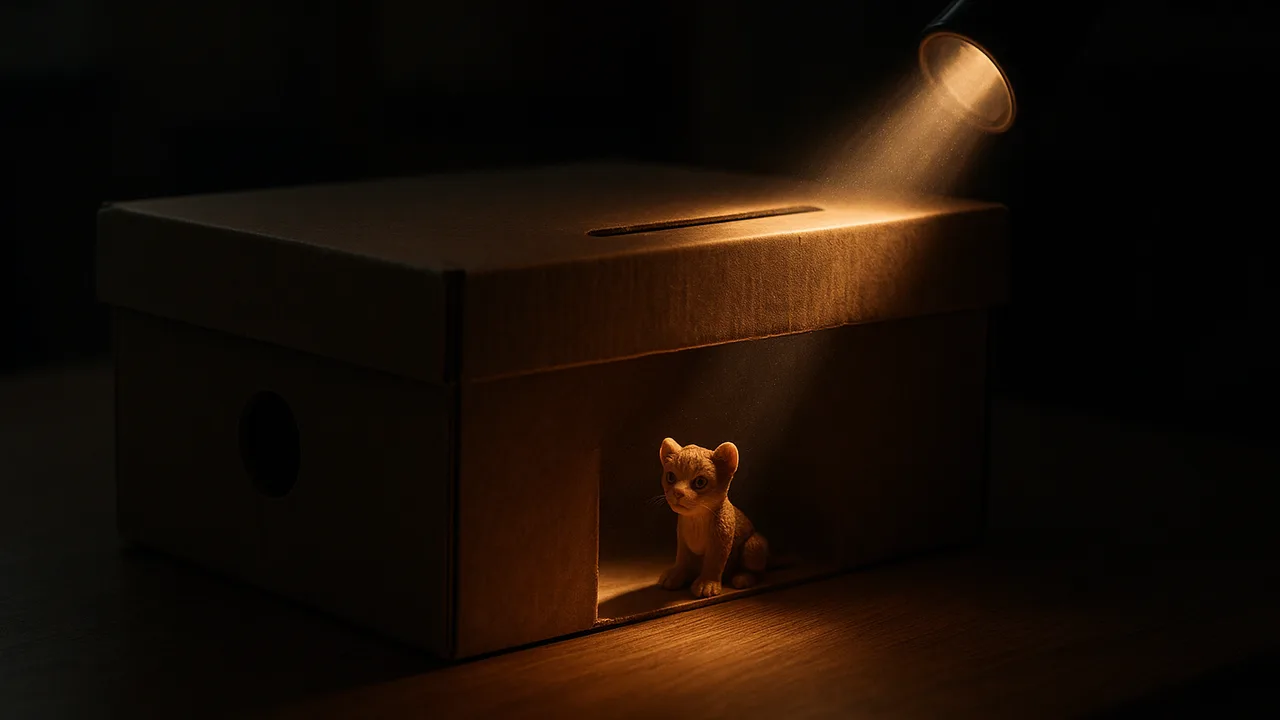
test whether I can see an object in the dark and in the light, and trace the path light takes to my eye.
- I can explain that we see objects because light enters our eyes.
- I can describe how light bounces off objects and then travels to our eyes.
- I can show that we can only see objects if light goes from a light source to the object and then to our eyes.
- I can use my model to show that we need light to reflect off an object and enter our eyes for us to see things that do not make their own light.
Phase 2: Investigate
Warm-Up ~5 min
Quick think. Close your eyes. Can you see your pencil? Open them. Now you can. What changed?
You are in a room with no windows. The lights go fully off. Can you see a red ball on the table?
Instruction ~10 min
Explore first. Today you test light, not waves on a rope. Write what you see. We will explain it together later.
The Shoebox investigation. Each team gets a shoebox with the lid taped on. There is a small toy inside. One end has a peek hole. The other end has a flap you can open.
- Keep the flap closed. Look through the peek hole. Can you see the toy? What color is it?
- Open the flap a little to let room light in. Look again.
- Shine a flashlight into the open flap. Look again.
- Keep the flashlight on, but cover the peek hole with your hand. Can you see the toy now?
- Now look with your eyes closed while the flashlight shines in.
| Test | Could you see the toy? (yes / a little / no) | Where did the light come from? | Draw the light’s path |
|---|---|---|---|
| Flap closed | |||
| Flap open, room light | |||
| Flashlight in flap | |||
| Peek hole covered | |||
| Eyes closed |
Worked example 1: reading a light row. Jamal looked in the closed box and wrote “no.” With the flashlight in, he wrote “yes: light went in the flap, hit the toy, then came out the peek hole to my eye.” He traced a path with his finger. That path is evidence.
Worked example 2: the dim row. With only room light, Priya wrote “a little. I could see a shape but not the color well.” Less light got in, so less light reached her eye. Her answer is honest data, even though it is in between.
Light sources. Some things make their own light. The Sun, a lamp and a flashlight are light sources. The toy is not. Keep that in mind as you look at your table.
Guided Exercises ~15 min
Use your Shoebox table to answer these.
Independent Practice ~10 min
Draw your evidence.
Draw the shoebox from the side. Show the flashlight, the toy and your eye. Use arrows to show the path the light took when you saw the toy.
How confident are you that you can I can explain that we see objects because light enters our eyes.
Closure ~5 min
No light, no seeing. Light had to reach the toy and then reach your eye. Next lesson, we use mirrors to steer light where we want it.
Exit ticket: a cat sits in a dark closet. Can you see it? What would you need to change?
Teacher notes
Materials: one shoebox per team with a peek hole (about the size of a pencil) on one end and a cut flap on the other, small toys, flashlights, tape. Rotate team roles today: Materials Manager, Recorder, Tester, Reporter. Each person gets a new job.
Setup: build and tape boxes ahead of time. Seal light leaks with tape. Dim the room lights if possible.
Listen for: “my eyes shoot light at things”; “I could see it a little because my eyes got used to it” (only if some light leaked in). Do not explain reflection yet; let the data lead.
Support / stretch: give sentence frames for the light path (“Light went from ___ to ___ to ___”). Stretch: put a white toy and a dark toy in the same box. Which is easier to see in dim light?