4.09 Preparedness Night: Technical Brief on Waves at Work
write and defend a technical brief that explains, with calculations and cited evidence, how devices use wave behavior and wave interactions with matter to transmit and capture information and energy.
- I can communicate technical information about at least two technological devices, using at least two different formats such as oral, graphical, textual, or mathematical explanations.
- I can fully describe how each device works, including one device that uses the photoelectric effect, and cite where I found my information.
- I can identify and explain the wave behavior or the absorption of photons and production of electrons that each device uses.
- I can qualitatively describe how basic physics principles were used in the design and development of each device to make it work.
- I can discuss the real-world problem or need that each device addresses, and explain how people or society depend on it.
Phase 5: Prove It
Warm-Up ~5 min
Do Now. In one sentence each, say what your backup alert link does and what your second device does. Which one uses the photoelectric effect?
A solar panel produces no electricity on a cloudy day, because clouds block all photons.
Instruction ~10 min
Preparedness night. Your team built and improved a backup alert link in lessons 4.07 and 4.08. Tonight the emergency office’s residents and county board members read your technical brief and watch your demonstration. The brief covers at least two devices, one of which must use the photoelectric effect; your alert link can be one of them.
Class criteria and constraints for the backup alert link (set in 4.02, weighted in 4.07). Criteria: (1) it sends a 16-bit test code across at least 5 m with zero bit errors in 3 of 3 trials; (2) it runs at 1 bit per second or faster; (3) it works with normal room lights on; (4) it includes a parity bit that flags any single-bit error. Constraints: classroom or household materials only (LEDs, flashlights, phone apps, cardboard tubes, small solar cells); no lasers aimed across the room; sound no louder than normal speech; battery power of 9 V or less, never an outlet; at most 10 sample budget points; two build periods.
Your task. Write a technical brief that explains, for an informed non-specialist reader such as a school board member or a city emergency manager, how one real device uses wave behavior to transmit and capture information and energy. Choose earthquake early warning, fiber-optic internet, solar cells, or a medical imaging method (ultrasound or X-ray). The brief must contain at least three calculations from this unit and an evaluation of one published claim about your device.
What a strong technical brief does. It states the problem the device solves, explains the wave physics step by step, uses numbers to show why the design works, names the limits, and cites sources. Each paragraph should answer one question. Diagrams do real work: a labeled ray diagram or a time-distance graph can replace a page of text.
Calculations you can build on.
- Earthquake early warning: warning time from typical P and S speeds (6 and 3.5 km/s): at 50 km the unit model gives 7.6 s and at 100 km 21.9 s; a late-alert zone of about 23 km; digital delivery by fiber (2.45 ms per 500 km).
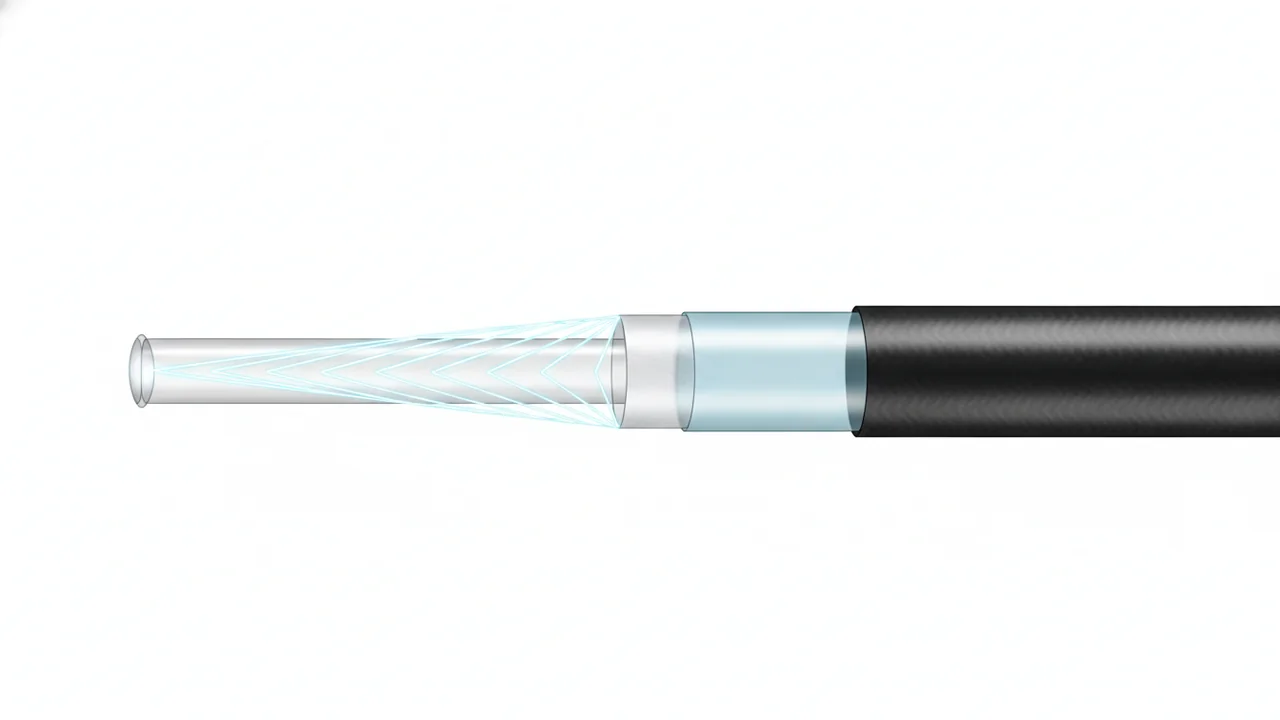
- Fiber optics: critical angle at a core-cladding boundary, 80.6° for indices 1.48 and 1.46 (typical), speed of light in the core c/n, bit rate and the time to send a file.
- Solar cells: silicon’s band gap of about 1.12 eV means only photons with λ below hc/E = 1108 nm can free an electron; compute photon energies across the spectrum and explain why excess photon energy becomes heat.
- Ultrasound imaging: sound travels about 1540 m/s in soft tissue (OpenStax); at 5.0 MHz, λ = 0.308 mm, which sets the smallest detail the image can resolve. Echo time gives depth: d = vt/2.
Evaluating a claim. Pick one published claim about your device, for example that 5G towers cause illness, that solar panels do not work on cloudy days, or that an early-warning system will warn everyone before any shaking. Ask: Who published it, and what is their evidence? Does it agree with the physics (photon energy, intensity, wave speed)? Does it agree with other reliable sources such as USGS, NOAA, the FCC, NIH or peer-reviewed studies? State whether the claim is supported, partly supported or unsupported, and why.
Process. Plan, draft, get peer review, revise, then defend your brief in a short presentation. Keep a log of every source and every number you use.
Adding your own device. If your alert link is one of your two devices, its calculations can come from your log: bit rate, travel time over 5 m (light: about 17 ns; sound: about 15 ms), the noise margin, the bit error rate, and, for a light pipe, the critical angle. The second device must use the photoelectric effect if your link does not.
Guided Exercises ~15 min
Rehearse the brief’s calculations and your defense.
Independent Practice ~10 min
Finish Stage 1 if needed, then Stages 3 and 4 of the task below.
Stage 1 plan: name your device, the three calculations you will include (with the formula and data source for each), the diagram you will draw, and the published claim you will evaluate with at least two sources you will check it against.
Final brief paragraph: for each device, explain the cause-and-effect chain from wave to useful result, why people depend on it, and one limit or risk.
Technical Brief and Preparedness-Night Defense: Waves at Work
Task: Write a technical brief for residents and county board members that explains how at least two devices use wave behavior and wave interactions with matter to transmit and capture information and energy. Choose from earthquake early warning, fiber-optic internet, a solar cell, an ultrasound or X-ray imaging system, and your team’s backup alert link; at least one device must use the photoelectric effect. Include (1) a labeled diagram for each device (ray diagram, time-distance graph or signal chain); (2) at least three calculations from this unit (v = fλ, t = d/v, Snell’s law or critical angle, E = hf, bit rate), each shown step by step with units and a cited data source; (3) why the device uses digital information or a particular frequency band; (4) the real need each device meets and how people depend on it; (5) an evaluation of one published claim about a device for validity and reliability; and (6) the devices’ limits. Label every number as sourced (USGS, NOAA, NIST, OpenStax, FCC) or illustrative. 1,000–1,400 words.
Choose where your link data come from. Both earn full credit. Route 1: your own version 1 and version 2 logs. Route 2: the sample data from lessons 4.07 and 4.08 (design B: off 0.12 V, on 0.48 V, threshold 0.30 V, 2 errors in 51 bits; version 2 with a light-blocking tube: off 0.03 V, on 0.46 V, 0 errors in 102 bits at up to 2 bits/s). Recompute every margin and error rate yourself.
Submission workflow
- Stage 1 — Plan. Devices, three planned calculations with formulas and data sources, a sketch of each diagram, and the claim you will evaluate with two sources to check it against.
- Stage 2 — Peer-reviewed draft. A partner recomputes every calculation, checks each source and marks any unclear step; you answer each note in a revision log.
- Stage 3 — Revised final. 1,000–1,400 words with the diagrams, calculations, claim evaluation, limits and a source list.
- Stage 4 — Presentation or defense. Five minutes with a live demonstration of the link (or a recording), explaining your devices and answering two questions about your physics or sources; a recorded presentation earns equal credit.
How it is scored
| Criterion | What proficient looks like |
|---|---|
| Wave explanation (HS-PS4-5) | Explains accurately how each device uses wave behavior or photon absorption to transmit and capture information and energy, with the cause-and-effect chain. |
| Calculations (HS-PS4-1) | At least three correct calculations, set up from the physics, with units, sourced inputs and a sentence interpreting each. |
| Wave and photon models (HS-PS4-3, HS-PS4-4) | Uses the wave model and the photon model where each is more useful, and relates frequency or photon energy to the effect on matter. |
| Digital information (HS-PS4-2) | Explains why the device uses digital signals, with one advantage and one risk. |
| Evaluating claims | Judges one published claim’s validity and reliability against physics and at least two reliable sources, with a clear verdict. |
| Communication | Two or more formats; clear for a non-specialist; sources cited; defended well. |
Closure ~5 min
Your brief explains the waves that keep a community informed. Next lesson: the unit checkpoint. Then the 360° field trip.
Exit ticket: which Wonder Board question can you now answer with your own data? Write the question and your answer.
How confident are you that you can I can communicate, with calculations and evidence, how devices use waves to transmit and capture information and energy.
Teacher notes
Materials: links from 4.07–4.08, the 5 m test path, rubric copies for guests, devices for source checks. Reading: OpenStax Physics (high school) and College Physics 2e wave, optics and quantum chapters (CC BY 4.0); USGS, NOAA, NIST and FCC pages (public domain).
Timing: Poly ran this task over three sessions. Here the link is built in 4.07–4.08; this lesson is the brief and the defense. Allow a second period for drafting and peer review if needed.
Listen for: calculations with no source; “radiation” used as if all of it ionizes; a sound link offered as the photoelectric device.
Support / stretch: students without a working link use Route 2 for full credit. Stretch: compare your link’s bit rate with a fiber link’s and explain the physical limits on each.