3.10 Unit 3 Checkpoint: Electricity and Magnetism
show what I know about electric and gravitational forces, circuits and energy models, currents and magnetic fields, field energy and induction, and using a simulation to evaluate designs.
- I can use the gravitational or electrostatic force formulas to calculate and predict the force between two objects.
- I can use my model to support the claim that the change in energy stored in the field matches the change in energy of the objects.
- I can interpret the results of the simulation and predict how proposed solutions will affect the systems involved.
Phase 5: Prove It
Warm-Up ~5 min
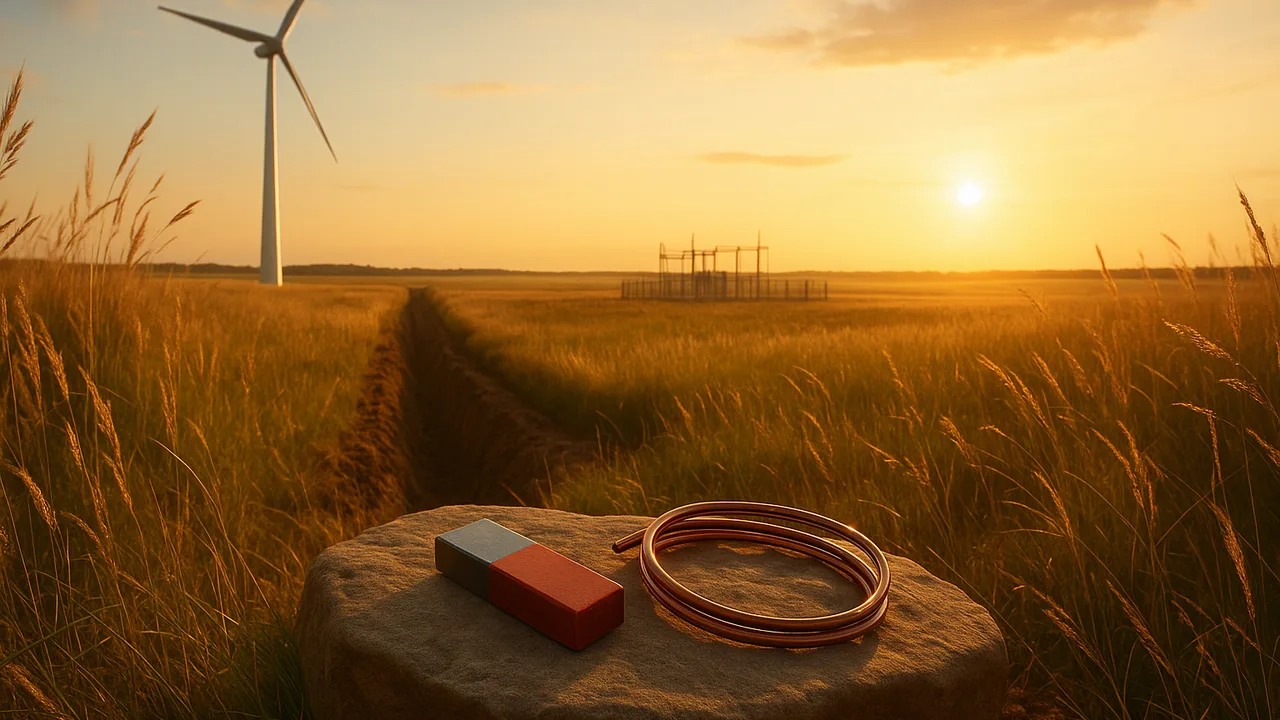
Do Now. Back to the phenomenon: in two sentences, explain to a neighbor how the doorknob spark and the ridge-top wind farm are explained by the same physics.
A magnet held still inside a coil keeps inducing a current.
Instruction ~10 min
Grid engineers, this is the unit checkpoint. Part A is multiple choice with data. Part B is a scenario set where several questions share one situation. Part C is short constructed responses, each scored 0–3. Use k = 8.99 × 10⁹ N·m2/C2, G = 6.674 × 10⁻¹¹ N·m2/kg2, e = 1.602 × 10⁻¹⁹ C and μ0 = 4π × 10−7 T·m/A. Show units.
How a 0–3 answer is scored. 3: correct claim, correct calculation or model with units, and reasoning that names the system, the forces or fields and the energy flows. 2: correct claim with a small error or incomplete reasoning. 1: a partly correct idea with major gaps. 0: incorrect or blank.
Worked example: from 2 points to 3. Question: “Two carts with like magnetic poles facing are pushed together and released. Explain the energy change.” A 2-point answer: “They fly apart because like poles repel, so potential energy turns into kinetic energy.” A 3-point answer adds the field and the accounting: “Pushing the carts together did work that was stored in the magnetic field between them. When released, the repulsive force from the field acts on each cart in opposite directions, so the field’s energy decreases by the same amount the carts’ kinetic energy (plus a little thermal energy from friction) increases.”
Scenario set data (sample data) for questions 15–20. A class models a wind farm-to-village link on a 12 V AC scale model with a 10 Ω village load and ideal transformers. Criteria: at least 95% delivered; budget at most 12 points.
| Design | Change | Predicted delivered | Simulated delivered | Cost (points) |
|---|---|---|---|---|
| P | 1:5 pair, 10 Ω line | 96.2% | 96.2% | 7 |
| Q | 1:10 pair, 10 Ω line | 99.0% | 50.0% | 8 |
| R | 1:10 pair, 5 Ω line | 99.5% | 99.5% | 11 |
| S | 5 Ω line, no transformers | 66.7% | 66.7% | 7 |
Guided Exercises ~15 min
Parts A and B: answer on your own. Your teacher reviews answers after everyone finishes.
Independent Practice ~10 min
Part C: constructed responses, each scored 0–3.
21. A proton is held fixed. A second proton is released from rest 2.0 nm away. Define the system, draw a one-dimensional model showing the forces and the field, calculate the field energy at 2.0 nm and at 4.0 nm, and use it to find the free proton's kinetic energy at 4.0 nm. Explain how the field's force causes the energy change. (0–3)
22. Plan an investigation to show that a changing magnetic field near a coil produces a current only while the field changes. Name the circuit, the source of the changing field, the detector and its position, how you will measure the current, whether you will work alone or in a team, two sources of error and one refinement. (0–3)
23. A 6.0 V battery runs a 330 Ω and a 470 Ω resistor in parallel for 2.0 minutes. Define the system and the zero of potential, write the energy equation, calculate the battery's energy output and each resistor's share, and state one assumption that limits your model. (0–3)
24. Using the scenario table, recommend one design to the village. Explain what the simulation shows, one prediction about the real system the simulation cannot make, one option whose costs outweigh its benefits, and two limits of the simulation. (0–3)
Closure ~5 min
Finished, engineers. Your results guide re-teaching before Unit 4. Next: the Phase 5 field trip.
Exit ticket: which question was hardest, and which idea from this unit do you want to practice again?
How confident are you that you can I can explain electric and magnetic interactions with forces, fields and energy, and use a simulation to evaluate designs.
Teacher notes
Materials: printed checkpoint, calculators, scoring guide for items 21–24.
Setup: about 45 minutes. Item tags: HS-PS2-4 (1a: 2, 21; 1b: 3; 1c: 1, 2; 2a: 1, 2; 3a: 4; 3b: 3; 3c: 2, 5; 3d: 5, 21); HS-PS3-1 (1a: 23; 2a: 6, 23; 2b: 7, 23; 3a: 8, 23; 3b: 9, 23); HS-PS2-5 (1a: 12, 14; 2a: 10, 22; 3a: 10, 22; 3b: 22; 4a: 22; 5a: 11, 22; 5b: 11, 22); HS-PS3-5 (1a, 2a, 3a, 3b: 5, 21; 3c: 14, 21); HS-ETS1-4 (1a: 15; 2a: 16; 3a: 17; 3b: 18, 24; 3c: 19, 24; 3d: 20, 24). Answer key notes: item 2 F = 0.999 N ≈ 1.0 N. Item 21: U = ke2/r = 1.15 × 10⁻¹⁹ J at 2.0 nm and 5.77 × 10⁻²⁰ J at 4.0 nm, so KE = 5.77 × 10⁻²⁰ J. Item 23: I = 30.9 mA, 6.0 × 0.0309 × 120 = 22.3 J; 330 Ω branch 13.1 J, 470 Ω branch 9.2 J.
Listen for: unconverted μC and nm; “current is used up”; simulation results reported as certain.
Support / stretch: read items aloud on request and provide an equation sheet. Stretch: in item 21, find the free proton’s speed at 4.0 nm.