2.09 Delivery Day: Design, Test and Defend the Cool Carrier
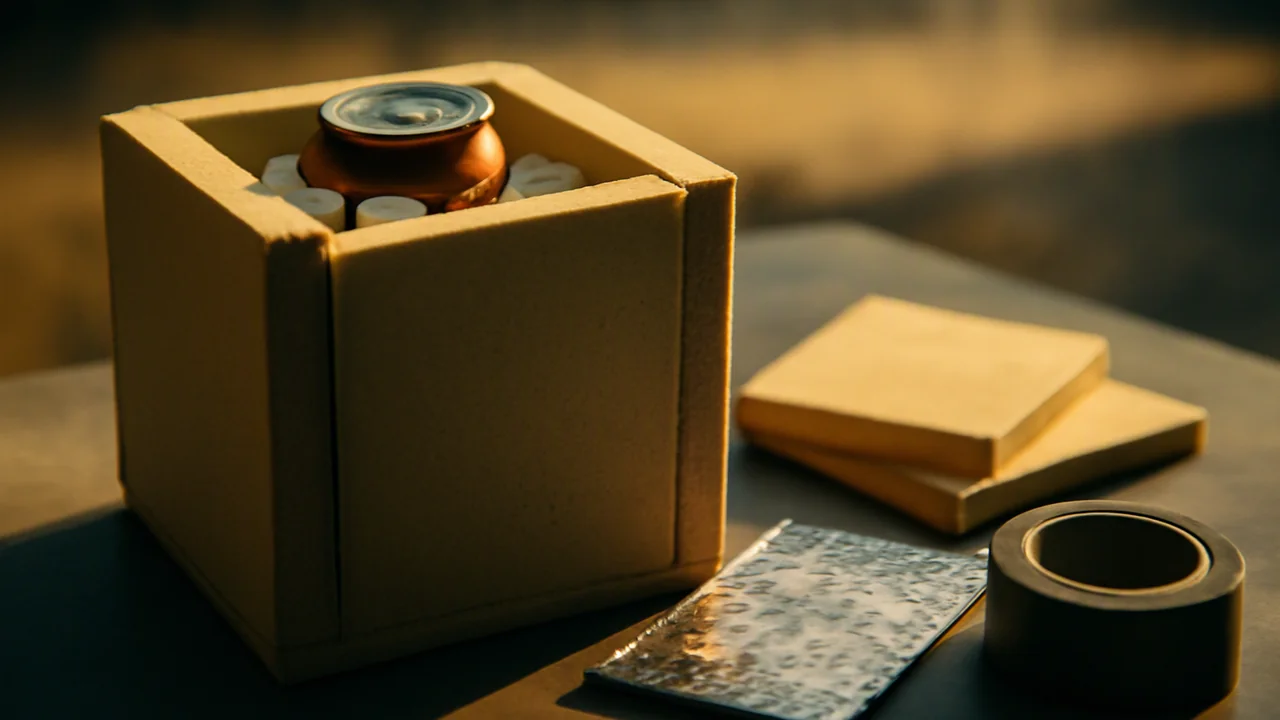
design, build and test an insulated container against prioritized criteria and constraints, model its energy flows, and evaluate trade-offs with measured data.
- I can specify both qualitative and quantitative criteria and constraints that solutions to the problem must meet.
- I can communicate scientific and technical information about a designed material using at least two different formats, such as oral, graphical, textual, or mathematical methods.
- I can fully describe the structure, properties, and design of a chosen material and cite where my information comes from.
- I can collect and record the data needed to calculate the change in thermal energy for each component in the system.
Phase 5: Prove It
Warm-Up ~5 min
Do Now. From your iteration log, write your version 2 hold time and your model’s predicted hold time. Which criterion is closest to failing?
Which is a criterion rather than a constraint for the cold-drink container?
Instruction ~10 min
Today you deliver. Your team built and tested versions 1 and 2 in 2.07 and 2.08. Today you run the final hold-time test, finish the design report and defend your Cool Carrier to the food bank’s volunteer coordinators (your teacher, visitors or a recorded panel). The challenge below is the brief your work answers.
Class criteria and constraints for the Cool Carrier (set in 2.02, ranked in 2.07). Criteria: (1) a 355 mL can of water starting at 5 °C stays below 10 °C for at least 90 minutes in a lamp-heated test box at 35–40 °C; (2) it is reusable: five test runs with no more than 10 minutes lost from the hold time; (3) a volunteer can carry it in one hand and open it in under 5 seconds. Constraints: empty mass no more than 400 g; fits inside a 25 cm cube; materials cost no more than $5 at the sample class prices; no electricity; at most 200 g of ice, sealed in a bag; no dry ice and no chemical cold packs that must be opened.
The design challenge. On a hot summer afternoon, a canned drink left in a delivery bag or a backpack warms quickly. Your team designs, builds and tests a container that keeps a 355 mL can cold for as long as possible, or (option B) a small passive-cooling model house that stays coolest under a lamp “sun”. You will specify criteria and constraints (HS-ETS1-1), test with measured data, and evaluate trade-offs among your designs (HS-ETS1-3).
Criteria and constraints. A criterion is a measurable goal: “the drink stays below 10 °C for at least 90 minutes in a 38 °C test box.” A constraint is a limit: materials cost under $5, mass under 400 g, fits in a backpack side pocket, reusable, no electricity. Prioritize them: which criterion would you give up a little of to meet another?
An energy-flow model to guide design. Model the container as a foam box, 15 cm on a side, with walls 2.0 cm thick. Its surface area is 6 × 0.152 = 0.135 m2. With 38 °C outside and 4 °C inside, the conduction rate is P = kAΔT/d = (0.033)(0.135)(34)/0.020 = 7.57 W. If the box holds 200 g of ice, melting it takes Q = mLf = (0.200)(334,000) = 66,800 J, so the ice lasts about 66,800/7.57 = 8,820 s, or 2.5 hours. Doubling the wall thickness halves P and doubles the time to 4.9 hours, but makes the box bulkier and heavier. That is a trade-off.
Why ice is so effective. Cooling the can itself (0.355 kg, treated as water) from 30 °C to 4 °C removes (0.355)(4186)(26) = 38,637 J. Ice absorbs 334,000 J/kg just melting, plus 4186 J/kg for each kelvin its meltwater then warms, so about 110 g of ice melting and warming to 4 °C would do the job (ignoring leaks). Phase change stores a lot of energy at a constant temperature.
What your model leaves out. The slab formula ignores corners, lids and seams (where most leaks happen), radiation from a hot car interior, and the air films on the surfaces. Your measured warming curve tests the model: if your drink warms faster than predicted, find the leak.
Evaluating trade-offs. Compare at least two designs in a decision matrix: score each against weighted criteria (performance, cost, mass, size, reusability, environmental impact of the materials) and justify the weights. A reflective outer layer may cut radiation in sunlight but add cost; a thicker wall helps conduction but not a leaky lid. Report which design you would recommend and what you gave up.
Communicating. Your final report includes the problem statement with prioritized criteria and constraints, a labeled design drawing, an energy-flow diagram of the system, your predicted and measured warming curves, the decision matrix, and a paragraph linking the molecular structure of your insulating material to its function.
Guided Exercises ~15 min
Rehearse your defense with these checks.
Independent Practice ~10 min
Finish and submit Stage 3 and Stage 4 of the task below.
Draft your decision matrix: list at least four weighted criteria, score your two designs and the bare control, and write two sentences explaining your heaviest weight.
Materials paragraph: explain, at the molecular level, why your main insulating material works, and communicate it in a second format (a labeled diagram or a calculation) with its sources cited.
Design Report and Delivery-Day Defense: The Cool Carrier
Task: Design, build and test a container that keeps a 355 mL can of cold water (or drink) below 10 °C for as long as possible in a warm test environment (a sunny spot or a lamp-heated box at about 35-40 °C). Option B: build a shoebox model house and test roof color, insulation and shading to keep its inside air coolest under a lamp. Test at least two versions of your design against a bare control.
Your report must include: prioritized criteria and constraints with numbers (HS-ETS1-1); a labeled design drawing; an energy-flow model naming conduction, convection and radiation paths; a predicted time from P = kAΔT/d and latent heat where you use ice; measured warming curves for each version and the control; a weighted decision matrix and trade-off evaluation (HS-ETS1-3); and an explanation of why your insulating material’s molecular structure works (HS-PS2-6).
Safety: goggles when handling water near lamps; lamps under 60 W incandescent-equivalent and never touching cardboard; no dry ice or chemical cold packs you open. Students who cannot build at home may use school materials during lab time.
Submission workflow
- Stage 1 — Plan. Problem statement, prioritized criteria and constraints with numbers, two sketched designs, the model prediction for each, and the test procedure (control, measurement interval, test environment).
- Stage 2 — Peer-reviewed draft. Build and test version 1; a partner team checks your calculations and tries to find a leak or flaw in your test; submit their notes and your revision plan.
- Stage 3 — Revised final. Test the improved version, compare prediction with measurement, complete the decision matrix and the full report.
- Stage 4 — Presentation or defense. A 4-minute design defense, live or recorded (equal credit), answering one question about your trade-offs and one about your energy model.
How it is scored
| Criterion | What proficient looks like |
|---|---|
| Criteria and constraints (HS-ETS1-1) | Measurable, prioritized criteria and realistic constraints tied to the client’s heat problem. |
| Energy-flow model (HS-PS3-4, CCC.5) | Correct model of all transfer paths, with a quantitative prediction from conduction and latent heat. |
| Testing and data | Controlled test with a bare control, repeated readings, clear warming curves and uncertainty. |
| Trade-off evaluation (HS-ETS1-3) | Weighted decision matrix with justified weights; recommendation names what was given up. |
| Materials explanation (HS-PS2-6) | Explains the insulating material’s function from its molecular-level structure. |
| Communication | Clear, organized report with a procedure others could follow; defense answers questions accurately. |
Closure ~5 min
You turned thermal physics into a carrier that could help real deliveries. Next: the unit checkpoint, then the 360° field trip.
Exit ticket: what is one trade-off your team accepted, and would the food bank agree with it? Why?
How confident are you that you can I can specify criteria and constraints, predict and test an insulated design, and evaluate trade-offs with data.
Teacher notes
Materials: carriers from 2.07–2.08, lamp test box with a thermometer, cans of water chilled to 5 °C, ice in sealed bags, rubric copies.
Timing: Poly ran this task over four sessions. Here, planning and versions 1–2 happen in 2.07–2.08; start the 90-minute hold test at the start of the period (or the period before) and present while it runs. Let the lesson span two periods if needed.
Listen for: claims without the bare control; “the foam makes cold”; criteria quoted without numbers.
Support / stretch: students who cannot build at home use school materials during lab time. Stretch: estimate how many grams of ice the carrier needs for a 3-hour route using the measured leak rate.