2.06 Inside the Insulation: Model Revision, CER and Ideate
revise my two-scale model of energy flow into a carrier, explain with a CER how an insulating material’s molecular structure sets its function, plan a fair test, and brainstorm carrier designs.
- I can describe how attractive and repulsive electrical forces between molecules affect the arrangement and structure of a designed material, such as whether it forms a solid, liquid, gas, network solid, or polymer.
- I can describe how electrostatic forces at the atomic and molecular scale result in contact forces like friction, normal forces, or stickiness that we observe on the macroscopic scale.
- I can develop models that identify and describe all parts of a system and its surroundings, showing how energy flows between them.
- I can clearly represent both macroscopic (large-scale) and molecular/atomic (small-scale) views of a system in my models.
- I can show in my models how energy appears in different forms at both the macroscopic scale (like motion, sound, light, thermal energy, potential energy, or energy in fields) and the molecular/atomic scale (like kinetic energy of particles, potential energy from positions in fields, and energy in fields).
Phase 3: Make Sense
Warm-Up ~5 min
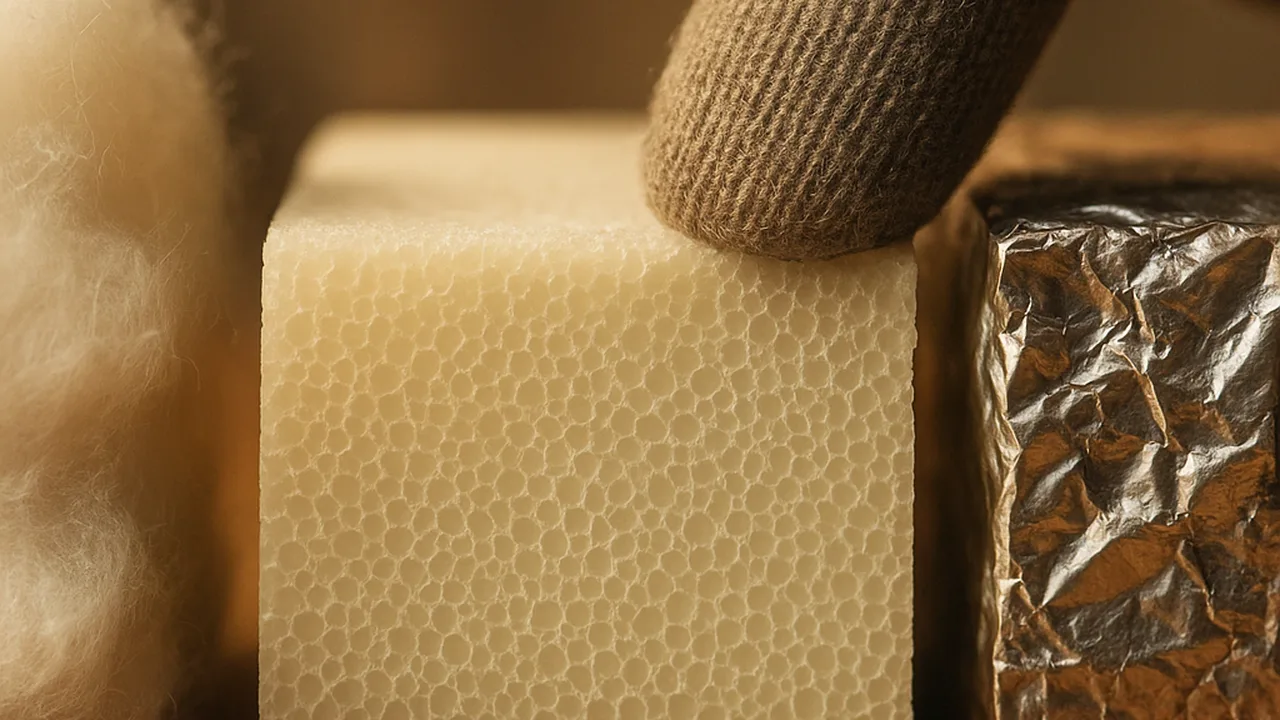
Do Now. Squeeze a piece of packing foam and a piece of solid plastic of the same size. Which is lighter, which squashes, and what is inside the foam that is not inside the solid?
Polystyrene foam and a solid block of polystyrene are made of the same molecules. Why does the foam insulate far better?
Instruction ~10 min
Pulling the unit together. The dark roof (2.01) showed the three transfer paths. Calorimetry (2.03) showed energy lost equals energy gained in a nearly closed system. The second law (2.04) set the direction: hot to cold, toward uniform temperature. The materials workshop (2.05) showed that structure controls how fast energy moves. Today we revise one model of the carrier at two scales, explain insulation with a CER, plan a fair test, and generate design ideas.
Forces between molecules build the material. Polystyrene is a polymer: long chains of carbon and hydrogen atoms. Within a chain, atoms share electrons in strong covalent bonds. Between chains, weaker electrical attractions hold the chains close, so at room temperature the plastic is a solid rather than a liquid. In foam, the solid plastic forms thin walls around tiny gas-filled cells. Silica aerogel is a network solid: silicon and oxygen atoms bonded in a continuous 3D web full of nanometer-scale pores. Metals are different again: their outer electrons are free to move through the whole solid, which is why metals conduct both electricity and thermal energy well.
From atoms to everyday forces. The same electrical forces explain contact forces you can feel. When the lid presses on the carrier’s rim, electrons in the surface atoms repel each other, giving the normal force. Friction and the “grip” of a rubber seal come from attractions and repulsions between surface molecules where they touch. A soft seal that squeezes into the rim’s bumps blocks air flow, which is why a good seal stops convection leaks.
Worked example 1: model revision (sample values). Jamal’s first model had one arrow: “heat leaks in”. His revision splits it by path and scale: about 7.6 W by conduction through 2 cm foam walls (from the 2.05 formula for a 15 cm box at 38 °C outside and 4 °C inside); an unknown amount by convection at the lid gap; some by radiation from the lamp onto the outer surface. A zoom circle at the wall shows fast air molecules outside hitting the foam, energy passing slowly through thin polymer walls and still gas, and slower molecules inside. A second zoom circle at the ice shows water molecules leaving the ice crystal as it absorbs energy, with no temperature rise until it has all melted.
Worked example 2: a CER on the insulating material. Claim: closed-cell foam insulates better than corrugated cardboard of the same thickness. Evidence (sample data): in a warming-curve test, a can in foam took 34 min to warm by 5 °C, in cardboard 19 min, bare 7 min. Reasoning: foam’s cells are closed, so the gas cannot circulate (no convection) and conduction must cross many thin polymer walls and still gas, which conducts poorly. Cardboard’s flutes are open channels, so air can move and carry energy by convection.
Worked example 3: planning a fair hold-time test. System: carrier + can + ice bag, inside a lamp box held at 35–40 °C. Initial conditions: can at 5 °C, 200 g ice. Data: can temperature every 5 minutes, box temperature, masses of can and ice, and how much ice is left at the end. Control: a bare can in the same box. Trials: at least two per version. To reduce apparent energy loss from the data, seal the thermometer hole and record the box temperature, because a warmer box pushes energy in faster.
Ideate. Quantity first; build on others’ ideas; every idea names the path it blocks (conduction, convection or radiation). Aim for at least eight ideas per team.
| Idea | Path it blocks | Material and its structure | Science reason | Cost / mass |
|---|---|---|---|---|
| 1 | ||||
| 2 | ||||
| 3 | ||||
| 4 | ||||
| 5 | ||||
| 6 | ||||
| 7 | ||||
| 8 |
Guided Exercises ~15 min
Revise your model with your team, then work these cards.
Independent Practice ~10 min
Write the CER, then run the brainstorm.
CER (communicate it in two formats: a paragraph AND a labeled diagram or a calculation): choose one insulating material (closed-cell foam, aerogel, a double-pane gap or wool fabric). Describe its intended function, its structure at the molecular and microscopic scale, and how that structure produces its properties. Cite at least one source. Starters: “The material is designed to…”, “Its structure is…”, “Because the molecules…”.
Ideate: list at least eight carrier ideas in the table. Star the three your team will score in the decision matrix next lesson.
Closure ~5 min
Our model now runs from the lamp to the ice crystal. Next phase we build and test carriers.
Exit ticket: which of your starred ideas blocks the biggest path in your revised model, and why?
How confident are you that you can I can explain how a material's molecular structure sets its insulating function and model energy flow at two scales.
Teacher notes
Materials: samples of packing foam, solid plastic, corrugated cardboard, foil, wool or fleece; magnifiers; models and data from 2.01–2.05; brainstorm tables.
Setup: model revision 15 min, CER 15 min, test plan and brainstorm 15 min. The 34/19/7-minute times are sample data.
Listen for: “foam traps cold”; confusing bonds within chains with attractions between chains; tests that change two things at once.
Support / stretch: give a structure-function-property organizer and a labeled polymer diagram to annotate. Stretch: research why some coolers use vacuum panels and explain them with particle collisions.