4.08 Critique and Iterate: Gallery Critique, Error Test and Version 2
give and use evidence-based critique, test version 1 of our alert link against every criterion, and build and explain an improved version 2 in more than one format.
- I can communicate technical information about at least two technological devices, using at least two different formats such as oral, graphical, textual, or mathematical explanations.
- I can fully describe how each device works, including one device that uses the photoelectric effect, and cite where I found my information.
- I can identify and explain the wave behavior or the absorption of photons and production of electrons that each device uses.
- I can qualitatively describe how basic physics principles were used in the design and development of each device to make it work.
- I can identify and communicate the cause and effect relationships that allow each device to function.
Phase 4: Build
Warm-Up ~5 min
Do Now. Write your version 1 bit-error count for all three trials. Which criteria does it already meet?
A link sends 3 trials of 17 bits (16 plus parity) with 2 bits in error. Its bit error rate is out of 51, about %.
Instruction ~10 min
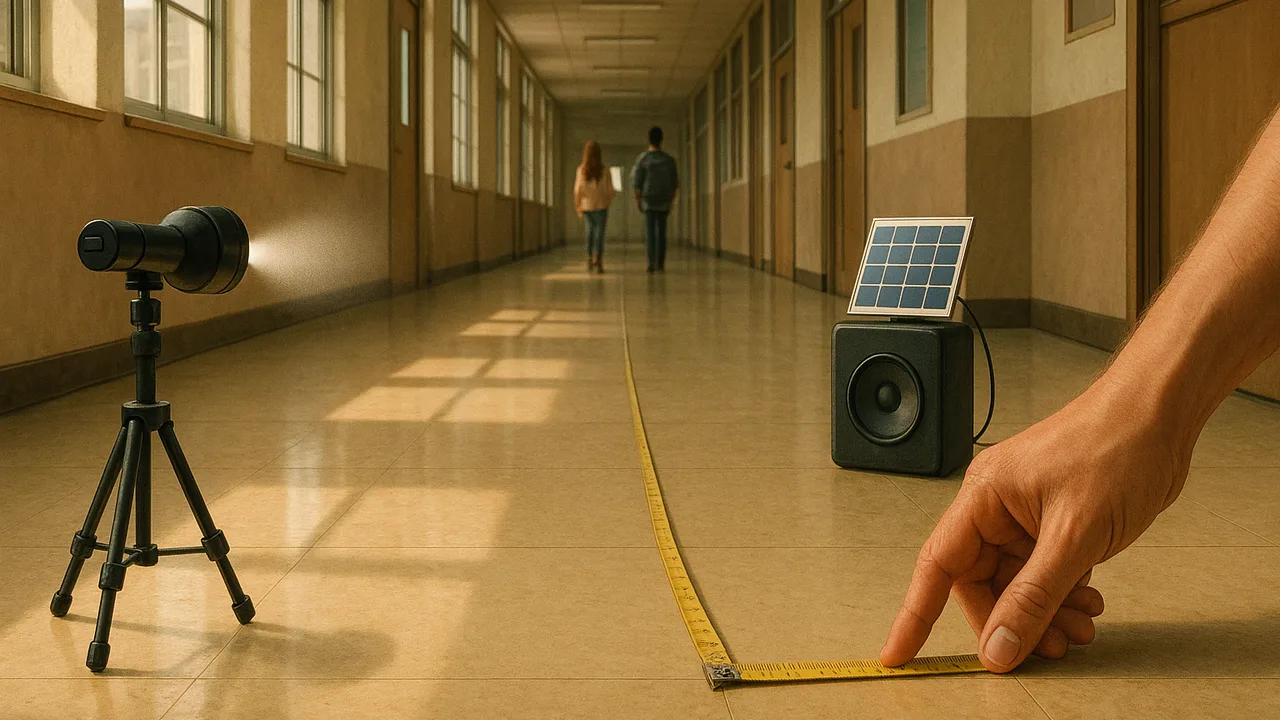
Class criteria and constraints for the backup alert link (set in 4.02, weighted in 4.07). Criteria: (1) it sends a 16-bit test code across at least 5 m with zero bit errors in 3 of 3 trials; (2) it runs at 1 bit per second or faster; (3) it works with normal room lights on; (4) it includes a parity bit that flags any single-bit error. Constraints: classroom or household materials only (LEDs, flashlights, phone apps, cardboard tubes, small solar cells); no lasers aimed across the room; sound no louder than normal speech; battery power of 9 V or less, never an outlet; at most 10 sample budget points; two build periods.
Gallery critique (15 minutes). Each team runs its link once for visitors and posts its diagram, error log and matrix. Visitors leave one “I like” tied to data, one “I wonder” about a source of error, and one “What if” with a specific change. The home team sorts notes into “change now”, “test later” and “no”.
Test against every criterion.
| Criterion or constraint | Target | Version 1 | Met? | Version 2 | Met? |
|---|---|---|---|---|---|
| Bit errors over 5 m | 0 in 3 of 3 trials | ||||
| Bit rate | ≥ 1 bit/s | ||||
| Room lights on | works | ||||
| Parity check | flags single errors | ||||
| Budget | ≤ 10 points |
Worked example 1: version 2 from evidence (sample data). Amara’s design B had 2 errors in 51 bits. Both were 0s read as 1s, during trials when a classmate walked past a window. Critique: “I wonder if room light is reaching the cell.” Version 2 put the solar cell at the end of a 30 cm black cardboard tube aimed at the LED. Off reading fell to 0.03 V, on stayed at 0.46 V, and the threshold moved to 0.25 V: the margin grew from 0.18 V to 0.21–0.22 V while the noise from room light shrank. Result: 0 errors in 51 bits, and the team doubled the rate to 2 bits/s with 0 errors in a further 51 bits.
Worked example 2: explaining it two ways. The team’s brief describes the link in words (the cause-and-effect chain), in a graph (solar-cell voltage against time with the threshold line and each bit labeled) and in numbers (margins, error rate, bit rate). Different readers trust different formats, so a technical brief uses more than one.
Why reliability matters. An alert system is only useful if it is stable: a link that reads 96% of its bits correctly will garble about one 17-bit alert in two, because 0.9617 ≈ 0.50. The same trade-off runs through every digital system we depend on: more check bits and slower rates buy reliability; faster rates with less checking buy speed.
Guided Exercises ~15 min
Use your criteria table and critique notes.
Independent Practice ~10 min
Build and test version 2, then update the design log.
Design log: version 2 data, the criteria table for both versions, and an explanation of your link in two formats (for example a labeled voltage-time graph and a written cause-and-effect chain). End with two sentences on why a stable backup link matters to people in an emergency.
🔎 Mini case study: From lossy glass to the internet’s backbone: Charles Kao and optical fiber ~8 min
By the 1960s, engineers knew light could carry far more information than radio, and that glass fibers could guide light by total internal reflection. The problem was loss: the glass of the day absorbed and scattered so much light that a signal faded within meters.
In 1966 Charles Kao and George Hockham published an analysis showing that the loss came mainly from impurities in the glass, not from glass itself, and that purer glass could carry light for kilometers. They set a target for how low the loss had to be for fiber to compete with copper cable. In 1970 researchers at Corning Glass Works made fiber that beat that target. Further rounds of improvement followed, and today optical fibers carry most long-distance internet traffic. Kao shared the 2009 Nobel Prize in Physics for this work.
Think about it: Which wave behavior keeps light in a fiber, and what had to be iterated to make it practical? How is that like the change your team made to its link?
Closure ~5 min
Version 2 is tested and explained in more than one format. Next: the technical brief and preparedness night.
Exit ticket: which critique note changed your link most, and what did your error count show after the change?
How confident are you that you can I can test a signal link against criteria, explain its physics in more than one format and improve it with evidence.
Teacher notes
Materials: links from 4.07, black cardboard tubes, spare LEDs and resistors, sticky notes in three colors, criteria tables, goggles.
Setup: gallery walk 15 min, plan 5 min, version 2 build and test 20 min, log 10 min. All link readings are sample data. The case study’s dates (1966, 1970, 2009) are well documented; avoid adding specific loss figures.
Listen for: claims of improvement from a single trial; parity described as error correction; changing several things at once.
Support / stretch: assign each visitor one role (error checker, physics checker, budget checker). Stretch: add a second parity bit for each half of the message and test whether it locates an error to one half.