2.03 Specific Heat by the Method of Mixtures
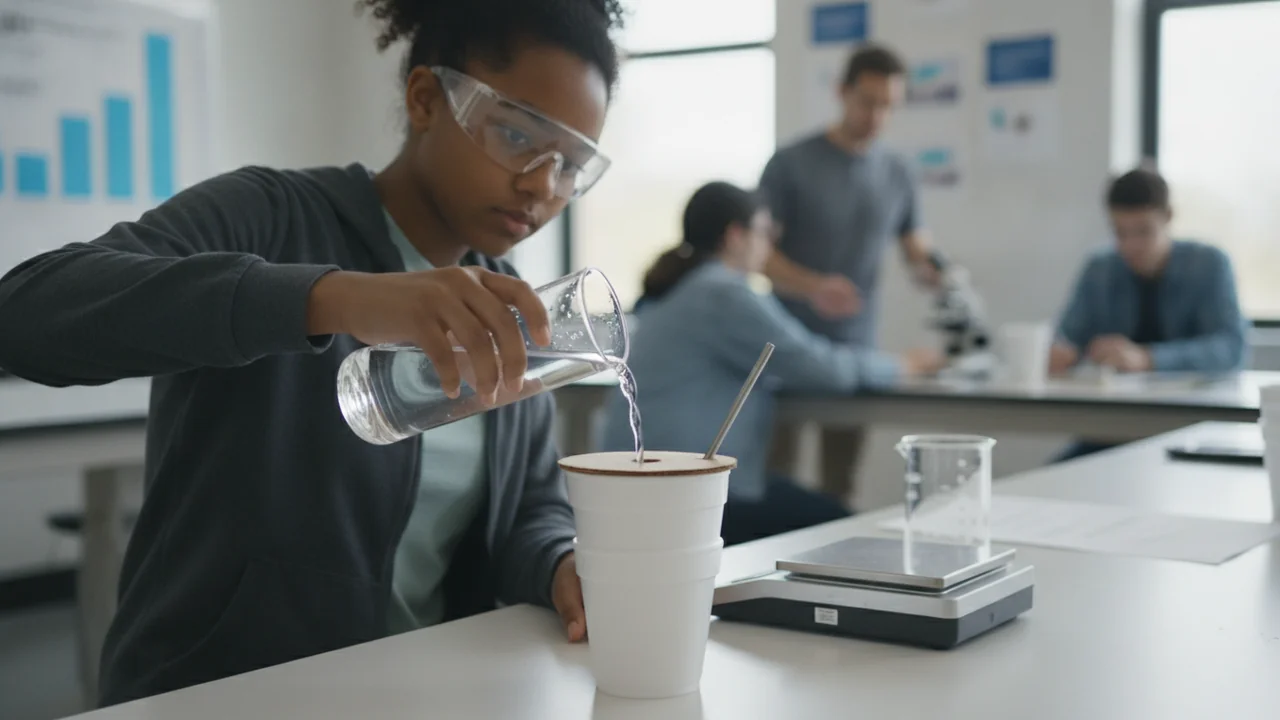
measure the specific heat of a metal with a foam-cup calorimeter, compare it with the accepted value, and explain the size and direction of experimental error.
- I can plan an investigation to measure how the temperature of a hot object decreases and the temperature of a cold object increases when they are combined in a closed system.
- I can use temperature data and heat capacity values from scientific sources to show that the thermal energy lost by the hot object equals the energy gained by the cold object, resulting in a more uniform energy distribution.
- I can collect and record the data needed to calculate the change in thermal energy for each component in the system.
- I can identify possible reasons why energy might appear to be lost from my closed system and suggest changes to my experiment to reduce these losses.
Phase 2: Investigate
Warm-Up ~5 min
Do Now. Our carrier will use ice and water to stay cold. Before the lab: if you drop hot metal into cool water in a foam cup, what two things must you measure to know how much energy the water gained?
You drop 300 g of steel at 88 °C into 200 g of water at 21 °C. Where will the final temperature land?
Instruction ~10 min
The idea. If a hot object and a cool object are sealed together in an insulated container, energy leaves the hot one and enters the cool one until they reach the same temperature (thermal equilibrium). If no energy escapes, the energy lost by the hot object equals the energy gained by the cool one. This is the method of mixtures, and it lets you measure the specific heat of a metal with a foam cup and a thermometer.
The equation. For a metal sample (mass mm, starting temperature Tm) dropped into water (mass mw, starting temperature Tw) that settles at Tf:
mmcm(Tm − Tf) = mwcw(Tf − Tw)
Both sides are written as positive quantities: energy lost equals energy gained. Solving for the unknown: cm = mwcw(Tf − Tw) / [mm(Tm − Tf)].
Worked example (illustrative data). A 300 g bundle of steel bolts is heated in teacher-poured kettle water to 88.0 °C, then moved quickly into 200 g of water at 21.0 °C in a foam-cup calorimeter. The mixture settles at 30.0 °C.
- Energy gained by water: (0.200)(4186)(30.0 − 21.0) = 7,534.8 J.
- Temperature drop of the steel: 88.0 − 30.0 = 58.0 K.
- csteel = 7,534.8 / (0.300 × 58.0) = 433 J/(kg·K).
- The accepted value for iron and steel is 452 J/(kg·K), so the percent error is (433 − 452)/452 = -4.2%.
Predicting before measuring. Use the accepted value to predict the final temperature first: Tf = (mmcmTm + mwcwTw)/(mmcm + mwcw) = 30.34 °C. The measured 30.0 °C is lower, which is what you expect if some energy escaped: the bolts cooled in the air while being moved, and the cup and thermometer absorbed a little.
Why the result is so sensitive. The water only warmed by 9.0 K. A thermometer error of just ±0.1 °C on Tf moves the answer from 427 to 439 J/(kg·K), a spread of about ±1%. That is why you stir, read the highest steady temperature, use a large mass of metal and a small mass of water, and repeat the trial.
Direction of errors. Energy lost to the surroundings makes Tf too low and your c too low. Hot water clinging to the metal carries extra energy into the cup and makes c too high. Deciding which effect dominated is part of your analysis.
Misconception check. The metal and water end at the same temperature, but they do not change temperature by the same amount: water’s large specific heat means it changes far less for the same energy.
Lab procedure: Specific Heat of a Metal by the Method of Mixtures
Question. What is the specific heat capacity of aluminum, steel or copper hardware, measured by mixing hot metal with cool water, and how close does it come to the accepted value?
Materials.
- Two nested foam cups with a cardboard lid (the calorimeter)
- Metal washers, bolts or nuts of one metal (aluminum, steel or copper), 150-300 g, tied with string
- Digital thermometer or probe reading to 0.1 °C
- Kitchen or lab scale reading to 0.1 g
- Hot water: hot tap water or water from an electric kettle poured by the teacher, in an insulated container (no open flames)
- Tongs, heat-resistant gloves, graduated cylinder, paper towels
Procedure.
- Mass the metal sample. Tie it with string so it can be lifted.
- Place the sample in the insulated container; the teacher covers it with hot water. Wait at least 5 minutes, then record the water temperature: this is the metal’s starting temperature Tm.
- Mass the empty nested cups, add about 150-200 g of cool tap water, mass again, and record the water temperature Tw once it is steady.
- Predict Tf with the accepted specific heat before you mix.
- Lift the metal out, shake it once over the hot container, and lower it into the calorimeter within 3 seconds. Put the lid on with the thermometer through it.
- Stir gently and record the temperature every 10 s until it has stayed steady (or started to fall) for 60 s. Record the highest steady temperature as Tf.
- Repeat for a second trial (and a second metal if time allows). Compute c for each trial and the percent difference from the accepted value.
Data table.
| Trial | Metal | mm (kg) | Tm (°C) | mw (kg) | Tw (°C) | Predicted Tf (°C) | Measured Tf (°C) | c (J/(kg·K)) | % difference |
|---|---|---|---|---|---|---|---|---|---|
| Illustrative | steel | 0.300 | 88.0 | 0.200 | 21.0 | 30.3 | 30.0 | 433 | -4.2% |
| Illustrative | aluminum | 0.150 | 87.5 | 0.200 | 21.0 | 30.2 | 30.5 | 930 | +3.4% |
| 1 | |||||||||
| 2 |
Accepted values (OpenStax College Physics 2e, Table 14.1): aluminum 900, iron/steel 452, copper 387, water 4186 J/(kg·K). The two illustrative rows are not real measurements.
Analysis.
- Claim, evidence, reasoning: state your measured specific heat and which accepted value it supports. Use your data table as evidence and conservation of energy as the reasoning.
- Uncertainty: redo the calculation with Tf 0.1 °C higher and 0.1 °C lower. How large is the resulting range in c, and does it include the accepted value?
- Sources of error: the illustrative steel result is low and the aluminum result is high. For each, name the error that most likely pushed it that way (energy lost to air, cup and thermometer; hot water carried on the metal) and explain the direction.
- Design: name one change to the procedure that would reduce your largest source of error, and predict how it would change your result.
Other routes to the same data. Use the PhET Energy Forms and Changes simulation (Intro screen) to put an iron and a brick block on heaters and watch the energy chunks, then complete the analysis with the provided class data set from your teacher (masses and temperatures from last year’s trials) instead of your own measurements. A simulation does not replace the lab for credit when an in-person make-up session is possible.
Guided Exercises ~15 min
Use the illustrative row first, then your own data.
Independent Practice ~10 min
Write the lab conclusion.
Write your lab conclusion (claim, evidence, reasoning) in 150-200 words. Include your percent difference, your ±0.1 °C uncertainty range, and the one error source you think mattered most, with the direction it pushed your result.
Show with your own numbers that the energy lost by the metal is about equal to the energy gained by the water. Explain why the two are not exactly equal, and what that tells you about the system's boundary.
Closure ~5 min
Energy lost by the hot object equals energy gained by the cold one, as long as the system is closed. Next: why it always flows that way.
Exit ticket: name one source of error in today's lab and the direction it pushes the measured specific heat.
How confident are you that you can I can measure a metal's specific heat by the method of mixtures and explain the size and direction of my errors.
Teacher notes
Materials: see the lab list. Only the teacher pours from the kettle.
Timing: Poly ran this lab over two 50-minute periods. Run one trial per team and pool class data, or let this lesson span two periods.
Listen for: both sides of the equation written with signs that cancel; reading Tf before it settles; “the water and metal changed by the same number of degrees”.
Support / stretch: give a worked template with the illustrative row. Stretch: include the cup’s own heat capacity in the energy balance.