4.07 Design and Prototype: Competing Alert Links and a Decision Matrix
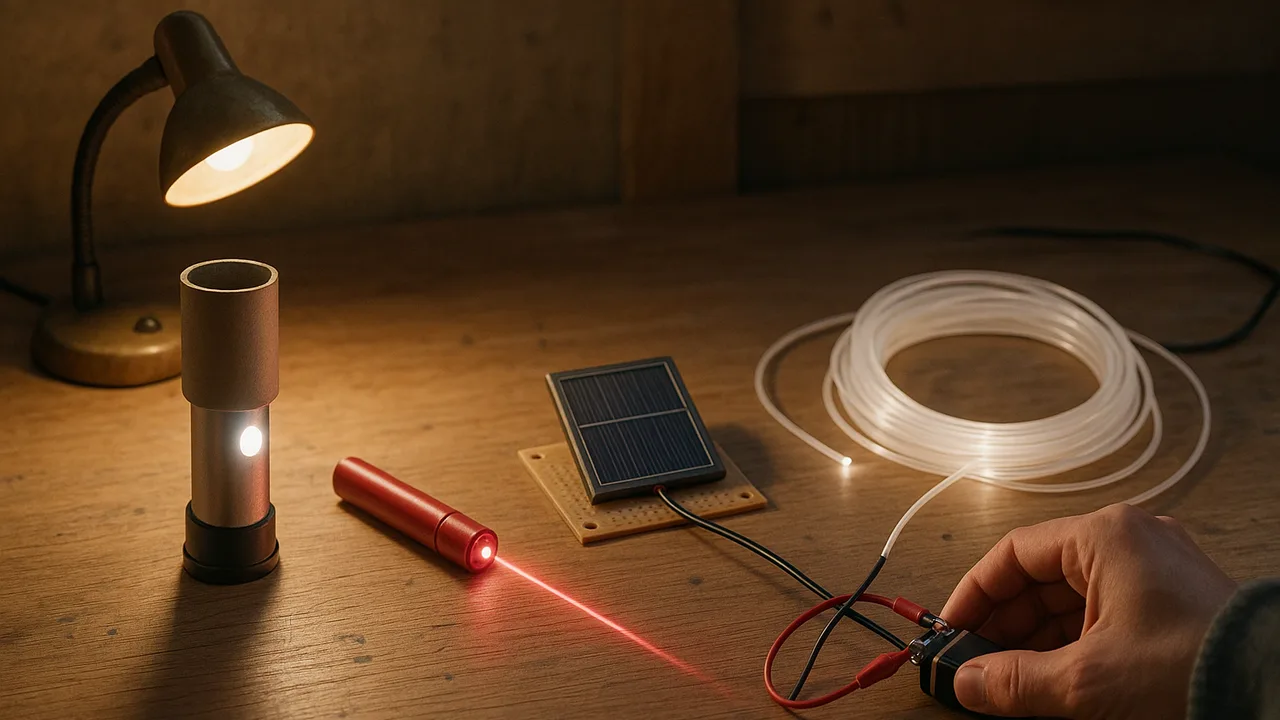
turn our brainstormed ideas into competing backup alert links, explain the wave behavior or photon interaction and the cause-and-effect chain each relies on, rank them in a weighted decision matrix, and build version 1.
- I can identify and explain the wave behavior or the absorption of photons and production of electrons that each device uses.
- I can qualitatively describe how basic physics principles were used in the design and development of each device to make it work.
- I can discuss the real-world problem or need that each device addresses, and explain how people or society depend on it.
- I can identify and communicate the cause and effect relationships that allow each device to function.
Phase 4: Build
Warm-Up ~5 min
Do Now. Look at your starred Ideate list. For your favorite design, finish the chain: “The sender changes…, the wave carries…, the receiver detects… because…”
A sound link sends tones across 5 m (343 m/s). How long does each tone take to arrive, and does that delay limit a 2 bit/s link?
Instruction ~10 min
Class criteria and constraints for the backup alert link (set in 4.02, weighted in 4.07). Criteria: (1) it sends a 16-bit test code across at least 5 m with zero bit errors in 3 of 3 trials; (2) it runs at 1 bit per second or faster; (3) it works with normal room lights on; (4) it includes a parity bit that flags any single-bit error. Constraints: classroom or household materials only (LEDs, flashlights, phone apps, cardboard tubes, small solar cells); no lasers aimed across the room; sound no louder than normal speech; battery power of 9 V or less, never an outlet; at most 10 sample budget points; two build periods.
Weighting the criteria. The emergency office cares most that an alert arrives exactly right. Sample weights: error-free delivery 35%, works in room light 25%, bit rate 20%, cost and simplicity 20%. Criteria (1) and (4) and every constraint are pass or fail.
Four competing designs and the physics of each.
- A: flashlight to phone light sensor. A phone’s ambient-light sensor is a photodiode: absorbed photons free electrons and make a current that the phone reports in lux. Cause and effect: light on → more photons → more freed electrons → higher reading → above threshold → bit 1.
- B: LED to small solar cell and multimeter. The same photoelectric chain, read as a voltage. Silicon needs photons above about 1.12 eV, so any visible LED works.
- C: two sound tones to a phone spectrum app. A 1,000 Hz tone means 1 and a 2,000 Hz tone means 0. Wave behavior: the tones travel as longitudinal pressure waves at 343 m/s with wavelengths 0.343 m and 0.172 m; the app sorts them by frequency, so room noise at other frequencies matters less.
- D: LED into a clear acrylic rod to a solar cell. Light hitting the rod’s wall beyond the critical angle (about 42° for acrylic) reflects totally and stays inside, like an optical fiber, and room light is mostly kept out.
Worked example 1: setting a threshold (sample data). Amara’s team built design B. With the LED off, room light gives the solar cell 0.12 V; with it on, 0.48 V; flicker and hand shake add about ±0.05 V. They set the threshold halfway, at 0.30 V. The margin from either level to the threshold is 0.18 V, more than three times the noise, so each bit should read correctly. This is the same idea that makes digital signals robust: the receiver only has to decide above or below.
Worked example 2: a decision matrix (sample scores, 1 to 5).
| Design | Error-free (35%) | Room light (25%) | Bit rate (20%) | Cost and simplicity (20%) | Weighted total |
|---|---|---|---|---|---|
| A: flashlight to phone sensor | 3 | 2 | 3 | 5 | 3.15 |
| B: LED to solar cell | 4 | 3 | 4 | 4 | 3.75 |
| C: two tones | 4 | 5 | 3 | 4 | 4.05 |
| D: acrylic light pipe | 5 | 5 | 4 | 2 | 4.2 |
Design D wins on these weights, but it needs a 5 m rod or a chain of shorter ones and costs the most. Design C is a close second and does not use photons at all, so a team choosing it must still cover the photoelectric effect with a second device in the brief. Test the weights before committing.
Why the county needs this. If a storm takes down the cell network, a building can still pass a short code room to room or across a parking lot by light or sound. Hospitals, schools and shelters depend on simple, independent backups for exactly this reason.
Build version 1. Build the top-ranked design you can afford, send the 16-bit test code plus parity three times over 5 m, and log every bit: sent, received, correct or not.
| Trial | Bits sent | Bits in error | Parity flagged? | Time (s) | Bit rate (bits/s) |
|---|---|---|---|---|---|
| 1 | |||||
| 2 | |||||
| 3 |
Guided Exercises ~15 min
Plan, explain and rank before you build.
Independent Practice ~10 min
Build and test version 1; log every bit.
Design log: version 1 results for three trials (bits in error, parity flags, bit rate), a labeled diagram of the signal chain from switch to decision, and a cause-and-effect explanation of how each part makes the next one work.
Closure ~5 min
Version 1 is built and its errors are on paper. Next lesson: critique, a test against every criterion, and version 2.
Exit ticket: what caused your link's worst error, and which part of the signal chain will you change first?
How confident are you that you can I can explain the wave behavior and cause-and-effect chain a signal link uses, and rank designs in a weighted decision matrix.
Teacher notes
Materials: LEDs, 470 Ω resistors, 9 V batteries and snaps, push switches, small solar cells, multimeters, flashlights, cardboard tubes, clear acrylic rods if available, phones with light-sensor and spectrum apps, goggles.
Setup: all readings, costs and scores are sample values. Teams without phones use design B or D. Mark a 5 m test path with tape.
Listen for: “the light carries electricity”; thresholds set at the “on” level; sound links described as photons.
Support / stretch: give a signal-chain template. Stretch: measure how the solar cell’s “on” voltage falls with distance and predict the longest working link.