2.05 Particles, Pressure, Heat Pumps and Insulating Materials
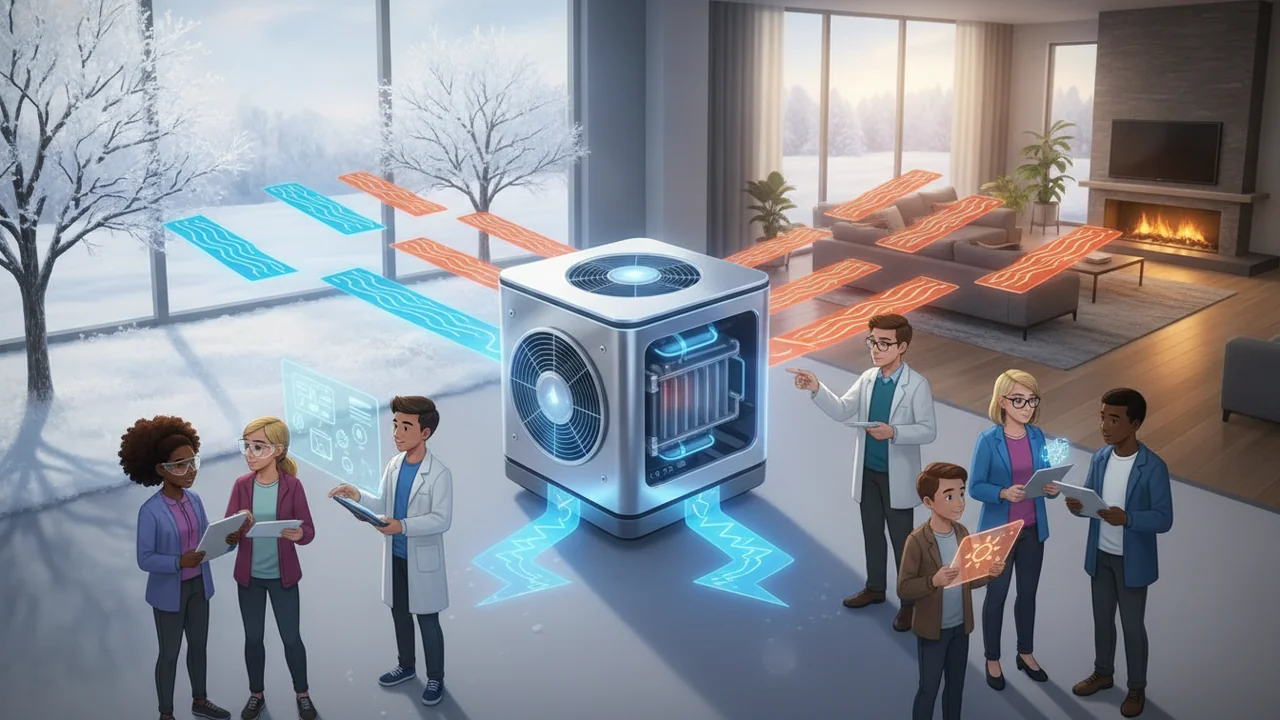
explain gas pressure and the gas laws with the particle model, describe how heat pumps move heat with work, and explain from molecular structure why foam, aerogel and double-pane glass insulate.
- I can identify and explain how the molecular-level structure and atomic interactions of a designed material determine its function.
- I can communicate how the properties of a material make it suitable for its intended use.
- I can describe how a material’s function and macroscopic properties, such as strength, conductivity, or durability, relate to its molecular-level structure.
- I can explain how intermolecular forces and molecular polarity affect a material’s function and properties.
- I can describe how the ability of electrons to move freely in metals relates to their properties and uses.
- I can use my models to illustrate that energy at the macroscopic scale can be explained as a combination of energy from the motion of particles or objects and energy from their relative positions, at both the macroscopic and microscopic scales.
Phase 3: Make Sense
Warm-Up ~5 min
Do Now. Pick up a foam cup and a glass. Which would you choose to keep ice cream cold on a 20-minute walk? Write one reason that mentions what the material is made of.
Which carries thermal energy fastest through a metal spoon?
Instruction ~10 min
Gas pressure is a particle model. A gas is mostly empty space with molecules moving fast in random directions. Each molecule that bounces off a wall reverses its momentum, and the wall must push on it; by Newton’s third law, the molecule pushes back on the wall. Billions of such collisions every nanosecond add up to a steady force per area: pressure. Raise the temperature and the molecules move faster, so they hit harder and more often, and the pressure rises. Worked example: at 300 K the average kinetic energy of a molecule is (3/2)kBT = 6.21 × 10⁻²¹ J. For nitrogen (mass 4.65 × 10⁻²⁶ kg per molecule) that corresponds to a root-mean-square speed vrms = √(3kBT/m) ≈ 517 m/s, faster than the speed of sound in air.
The ideal gas law. Counting the collisions leads to PV = nRT, with R = 8.314 J/(mol·K) and T in kelvin. Its special cases: Boyle’s law (constant T: P1V1 = P2V2), Charles’s law (constant P: V/T constant) and the pressure law (constant V: P/T constant). Worked example: a tire reads 220 kPa on its gauge at 20 °C. A gauge reads pressure above the atmosphere, so the absolute pressure is 220 + 101.3 = 321.3 kPa. Parked on sun-baked asphalt, the air inside reaches 50 °C. At constant volume, P2 = 321.3 × 323.15/293.15 = 354.2 kPa absolute, or 252.9 kPa on the gauge. Forgetting either the kelvin conversion or the atmosphere gives a wrong answer.
Refrigerators and heat pumps. Run a heat engine backward and you get a device that uses work W to move heat Qc out of a cold space and deliver Qh = Qc + W to a warm one. A refrigerator and an air conditioner pump heat out of the cold side; a heat pump heating a home pumps it into the warm side. Its performance is the coefficient of performance, COPheat = Qh/W, and the ideal limit is Th/(Th − Tc). Heating a house to 21 °C from 5 °C outdoor air: ideal COP = 294.15/16 = 18.4. Real heat pumps reach far less (a COP of about 3 is illustrative), but even that delivers three joules of heat per joule of electricity, which a resistance heater (COP 1) cannot.
Conduction and the structure of insulating materials (HS-PS2-6). The conduction rate through a slab is P = kAΔT/d, where k is the thermal conductivity. Approximate room-temperature values: copper about 390, aluminum about 220, glass about 0.84, water about 0.6, still air about 0.026, polystyrene foam about 0.033 W/(m·K). Metals conduct well because free electrons carry energy quickly. Gases conduct poorly because their molecules are far apart and collide rarely. Good insulators are therefore solids that trap still air: foam is mostly tiny closed gas cells separated by thin plastic walls, so the air cannot circulate (no convection) and the solid path is thin and twisted. Silica aerogel takes the idea further: a network of nanometer-scale silica strands whose pores are smaller than the distance an air molecule travels between collisions, which cuts conduction through the gas below that of still air. Double-pane windows put a sealed gas layer between two sheets of glass.
Worked example: for 1 m2 of window, the thermal resistance d/(kA) of 4 mm of glass is 0.0048 K/W, and of a 12 mm still-air gap is 0.462 K/W. Resistances in series add, so a double pane (glass + gap + glass) has 0.471 K/W, almost all of it from the gas. (This slab model ignores the air films on each surface and convection inside the gap, so real windows differ; the comparison is the point.) A foam cooler wall (k = 0.033, A = 0.25 m2, d = 2.5 cm) with a 30 K difference conducts only 9.9 W.
Newton’s law of cooling. The rate of transfer is proportional to the temperature difference, so a cold drink warms quickly at first and then more slowly: T(t) = Troom + (T0 − Troom)e−kt. Insulation lowers k. In the illustrative curves below, 5 °C water in a 24 °C room reaches 10 °C after 6.8 min in a bare cup (k = 0.045/min) but 25.4 min in a foam cup (k = 0.012/min). You will measure your own curves in the mini-lab.
Lab procedure: Mini-Lab: Warming Curves of Insulated and Uninsulated Cups
Question. How much does an insulating layer slow the warming of cold water, and does Newton’s law of cooling model the warming curve?
Materials.
- Three identical thin plastic or paper cups, plus foam sleeves, a foam cup, or cardboard and cloth for wrapping
- Cold tap water chilled with ice (remove the ice before starting)
- Digital thermometer or temperature probe (one per cup if possible)
- Timer, graduated cylinder, spreadsheet or graph paper
Procedure.
- Record the room temperature. Prepare three cups: bare, one layer of insulation, and your best insulated design, each with the same volume (150 mL) of cold water.
- Record each starting temperature, then start the timer. Keep the cups out of direct sunlight and away from vents.
- Record every cup’s temperature every 2 minutes for at least 30 minutes, stirring gently before each reading.
- Plot temperature against time for all three cups on one set of axes.
- For each cup, compute ln[(Troom − T)/(Troom − T0)] and plot it against time; if Newton’s law holds, the points fall on a line with slope −k.
Data table.
| Time (min) | Bare cup (°C) | One layer (°C) | Best design (°C) |
|---|---|---|---|
| 0 (illustrative) | 5.0 | 5.0 | |
| 20 (illustrative) | 16.3 | 9.1 | |
| 0 | |||
| 2 | |||
| 4 | |||
| 6 | |||
| 8 | |||
| 10 | |||
| 12 | |||
| 14 | |||
| 16 | |||
| 18 | |||
| 20 | |||
| 22 | |||
| 24 | |||
| 26 | |||
| 28 | |||
| 30 |
The illustrative rows use a 24 °C room and k = 0.045/min (bare) and 0.012/min (foam); they are not real measurements.
Illustrative warming curves (Option B). Room 24.0 °C, 150 mL of water starting at 5.0 °C in each cup. These temperatures are generated from Newton’s law of cooling with k = 0.045, 0.025 and 0.012 per minute; they are not real measurements.
| Time (min) | Bare cup (°C) | One layer (°C) | Best design, foam (°C) |
|---|---|---|---|
| 0 | 5.0 | 5.0 | 5.0 |
| 2 | 6.6 | 5.9 | 5.5 |
| 4 | 8.1 | 6.8 | 5.9 |
| 6 | 9.5 | 7.6 | 6.3 |
| 8 | 10.7 | 8.4 | 6.7 |
| 10 | 11.9 | 9.2 | 7.1 |
| 12 | 12.9 | 9.9 | 7.5 |
| 14 | 13.9 | 10.6 | 7.9 |
| 16 | 14.8 | 11.3 | 8.3 |
| 18 | 15.5 | 11.9 | 8.7 |
| 20 | 16.3 | 12.5 | 9.1 |
| 22 | 16.9 | 13.0 | 9.4 |
| 24 | 17.5 | 13.6 | 9.8 |
| 26 | 18.1 | 14.1 | 10.1 |
| 28 | 18.6 | 14.6 | 10.4 |
| 30 | 19.1 | 15.0 | 10.7 |
Each cup warms by 5 °C (from 5.0 to 10.0 °C) after about 6.8, 12.2 and 25.4 minutes respectively. Work those times out from the table rather than taking them on trust.
Analysis.
- Claim, evidence, reasoning: which insulation slowed the warming most? Compare the times each cup took to warm by 5 °C and your fitted k values, and explain the difference using conduction, convection and the structure of the insulating material.
- Is your ln plot a straight line? Identify where it curves and name a reason (evaporation, stirring, the cup’s own heat capacity, a thermometer that lags).
- Uncertainty: estimate the uncertainty in your fitted k from the scatter of the points about the line.
Other routes to the same data. Choose one. All three earn full credit and end in the same three curves, the same ln plot and the same fitted k values. Option A — run the three cups. The procedure above. Any three identical cups and a kitchen thermometer will do; ice water from the tap is cold enough. Option B — the illustrative warming curves in the data section above. No equipment and no internet needed. Plot all three, compute ln[(24.0 − T)/(24.0 − 5.0)] against time for each, fit a line and report each k with the scatter about the line as its uncertainty. Because these numbers come from the model itself, your ln plots will be straight; the analysis question about where a real curve bends becomes a prediction, so name the effect you would expect and say where on the curve it would show. Option C — a phone and a window. Measure real cooling instead of warming, which needs no ice: pour equally hot tap water into a bare cup and into a cup wrapped in a towel, and record both temperatures every 2 minutes for 30 minutes with a kitchen thermometer. The law is the same, with Troom below the starting temperature instead of above it, so use ln[(T − Troom)/(T0 − Troom)] and fit k the same way. Two cups instead of three is enough on this route; say in your write-up why the direction of heat flow does not change the model. Safety for Options A and C: hot tap water only, never boiling, and wipe spills at once.
Guided Exercises ~15 min
Run the simulation or use the data table, then work the materials cards.
Independent Practice ~10 min
Write the technical explanation and analyze your warming curves.
Write a one-paragraph technical explanation (about 200 words) for a homeowner comparing a single-pane and a double-pane window. Explain at the molecular level why the gas layer insulates, use the thermal-resistance numbers from the lesson, and state one limitation of the simple slab model.
Mini-lab: from your three warming curves (or the illustrative table), report the time each cup took to warm by 5 °C and its fitted k. Explain the ranking using the molecular structure of the insulation.
Closure ~5 min
Insulation works by trapping gas so particles cannot carry energy quickly. Next lesson we revise our models and brainstorm carrier designs.
Exit ticket: why are good insulators usually solids full of trapped gas, and not solid metal or open air?
How confident are you that you can I can explain gas pressure with the particle model, use the gas laws in kelvin, describe heat pumps, and explain why foam, aerogel and double-pane glass insulate.
Teacher notes
Materials: devices for the Gas Properties sim or the printed table; three cups per team, foam sleeves or cloth, thermometers, ice water.
Timing: Poly ran this workshop over two 50-minute periods. Start the warming-curve mini-lab first so it runs while teams do the sim, or let this lesson span two periods.
Listen for: “foam is cold”; gauge pressure used in the gas law; “air is a good conductor”.
Support / stretch: give a structure-function organizer (material, structure, function). Stretch: research how the gas fill in some windows differs from air and explain it with molecular mass.